



CENPB Protein, Human (sf9, His)

Based on 1 Customer Validation
CENPB proteins form antiparallel homodimers, interact with centromeric heterochromatin, and specifically bind to the CENP-B box (a 17 bp subset of α-class satellite DNA). This interaction is critical for organizing centromeric satellite DNA into higher-order structures, promoting centromere assembly, and directing centromere formation in mammalian chromosomes. CENPB Protein, Human (sf9, His) is the recombinant human-derived CENPB protein, expressed by Sf9 insect cells , with N-His labeled tag.
- Species: Human
- Source: Sf9 insect cells
-
Storage:Stored at -20°C for 2 years from date of receipt. After reconstitution, it is stable at 4°C for 1 week or -20°C for longer (with carrier protein). It is recommended to freeze aliquots at -20°C or -80°C for extended storage.


To place orders, for customer services and technical support, please contact: MedChemExpress USA
Tel: 609-228-6898 E-mail: [email protected] [email protected]


-
 Biological Activity
-
Technical Parameters
-
Product Properties
- Documentation
- Help & FAQs




Biological Activity
Description
CENPB proteins form antiparallel homodimers, interact with centromeric heterochromatin, and specifically bind to the CENP-B box (a 17 bp subset of α-class satellite DNA). This interaction is critical for organizing centromeric satellite DNA into higher-order structures, promoting centromere assembly, and directing centromere formation in mammalian chromosomes. CENPB Protein, Human (sf9, His) is the recombinant human-derived CENPB protein, expressed by Sf9 insect cells , with N-His labeled tag.
Background
The CENPB protein plays a pivotal role in centromere organization by interacting with centromeric heterochromatin in chromosomes and binding specifically to a 17 bp subset of alphoid satellite DNA known as the CENP-B box. This interaction is crucial for the potential organization of centromere satellite DNA into a higher-order structure, likely directing centromere formation and facilitating kinetochore assembly in mammalian chromosomes. CENPB forms an antiparallel homodimer and also interacts with CENPT. Furthermore, it has been identified as a component of a centromere complex that includes histones H2A, H2B, and H4, along with at least CENPA, CENPC, CENPT, CENPN, HJURP, SUPT16H, SSRP1, and RSF1, underscoring its integral role in the intricate architecture of the centromeric region.
MCE Validation Data
-
Purity - SDS-PAGE
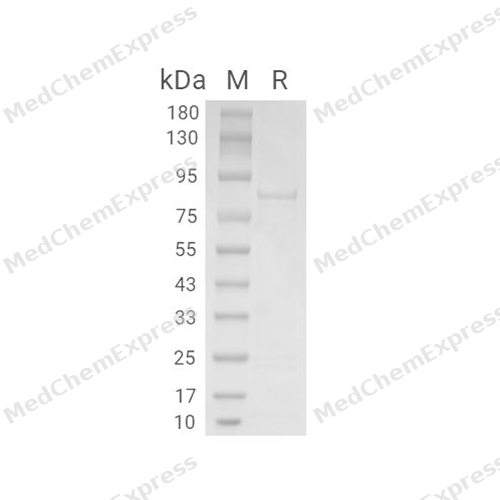
Purity - SDS-PAGE


Technical Parameters
-
Species Human
-
Source Sf9 insect cells
-
Tag N-10*His
-
Accession
P07199 (M1-S599)
-
Molecular Construction
-
N-term
-
10*His
-
CENPB (M1-S599)
Accession # P07199 -
C-term
-
-
Protein Length
Full Length
-
Synonyms
CENPB; CENP-B; Centromere Protein B; Centromere Protein B (80kD); Major Centromere Autoantigen B; Centromere Autoantigen B; Centromere Protein B, 80kDa
-
AA Sequence
MGPKRRQLTFREKSRIIQEVEENPDLRKGEIARRFNIPPSTLSTILKNKRAILASERKYGVASTCRKTNKLSPYDKLEGLLIAWFQQIRAAGLPVKGIILKEKALRIAEELGMDDFTASNGWLDRFRRRHGVVSCSGVARARARNAAPRTPAAPASPAAVPSEGSGGSTTGWRAREEQPPSVAEGYASQDVFSATETSLWYDFLPDQAAGLCGGDGRPRQATQRLSVLLCANADGSEKLPPLVAGKSAKPRAGQAGLPCDYTANSKGGVTTQALAKYLKALDTRMAAESRRVLLLAGRLAAQSLDTSGLRHVQLAFFPPGTVHPLERGVVQQVKGHYRQAMLLKAMAALEGQDPSGLQLGLTEALHFVAAAWQAVEPSDIAACFREAGFGGGPNATITTSLKSEGEEEEEEEEEEEEEEGEGEEEEEEGEEEEEEGGEGEELGEEEEVEEEGDVDSDEEEEEDEESSSEGLEAEDWAQGVVEAGGSFGAYGAQEEAQCPTLHFLEGGEDSDSDSEEEDDEEEDDEDEDDDDDEEDGDEVPVPSFGEAMAYFAMVKRYLTSFPIDDRVQSHILHLEHDLVHVTRKNHARQAGVRGLGHQS
-
Predicted Molecular Mass
66.5 kDa
-
Molecular Weight
Approximately 78-85 kDa, based on SDS-PAGE under reducing conditions, due to the glycosylation.
-
Glycosylation
Yes
-
Purity
≥ 95%, as determined by reducing SDS-PAGE.


Product Properties
Lyophilized powder.
Lyophilized from a 0.22 μm filtered solution of PBS, pH 7.4, 0.2 mM PMSF, 8% trehalose.
<1 EU/μg, determined by LAL method.
It is not recommended to reconstitute to a concentration less than 100 μg/mL in ddH2O. For long term storage it is recommended to add a carrier protein (0.1% BSA, 5% HSA, 10% FBS or 5% Trehalose).
Stored at -20°C for 2 years from date of receipt. After reconstitution, it is stable at 4°C for 1 week or -20°C for longer (with carrier protein). It is recommended to freeze aliquots at -20°C or -80°C for extended storage.
Room temperature in continental US; may vary elsewhere.


Documentation
-
Data Sheet (238 KB)
-
SDS (251 KB)
- English - EN (251 KB)
- Français - FR (251 KB)
- Deutsch - DE (251 KB)
- Norwegian - NO (251 KB)
- Español - ES (251 KB)
- Swedish - SV (251 KB)
- Italian - IT (251 KB)
- Korean - KR (251 KB)
- Portuguese - PT (251 KB)
-
Handling Instructions (2659 KB)

Calculators
Concentration (start) × Volume (start) = Concentration (final) × Volume (final)


 Powered by Bioz

