



CHL1 Protein, Mouse (HEK293)

Based on 1 Customer Validation
CHL1 Protein, Mouse (HEK293) is the recombinant mouse-derived CHL1 protein, expressed by HEK293, with tag free.
- Species: Mouse
- Source: HEK293
-
Storage:Stored at -80°C for 1 year from date of receipt. It is stable at -20°C for 3 months after opening. It is recommended to freeze aliquots at -80°C for extended storage. Avoid repeated freeze-thaw cycles.


To place orders, for customer services and technical support, please contact: MedChemExpress USA
Tel: 609-228-6898 E-mail: [email protected] [email protected]


-
 Biological Activity
-
Technical Parameters
-
Product Properties
- Documentation
- Help & FAQs




Biological Activity
Description
CHL1 Protein, Mouse (HEK293) is the recombinant mouse-derived CHL1 protein, expressed by HEK293, with tag free.
Background
CHL1 is an extracellular matrix and cell adhesion protein involved in nervous system development and synaptic plasticity. Both soluble and membranous forms promote neurite outgrowth in cerebellar and hippocampal neurons while suppressing neuronal cell death. It contributes to pyramidal neuron positioning and regulates interneuron numbers and GABAergic synapse efficacy. CHL1 may also modulate cell migration during nerve regeneration and cortical development. Additionally, it enhances integrin-dependent cell migration toward extracellular matrix proteins. By similarity, it recruits ANK3 to the plasma membrane.
Verified Bioactivity
Measured in a cell proliferation assay using SH-SY5Y cells. The ED50 for this effect is 0.369 μg/mL, corresponding to a specific activity is 2710.027 Unit/mg,
MCE Validation Data
-
Bioactivity - Cell-Based Assay
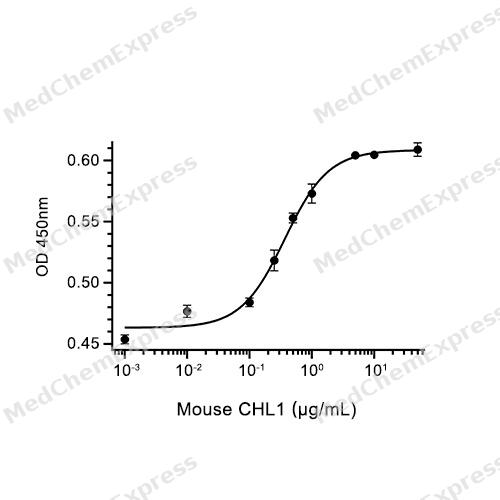
Bioactivity - Cell-Based Assay


Technical Parameters
-
Species Mouse
-
Source HEK293
-
Tag Tag Free
-
Accession
XP_017176866 (A25-Q1027)
-
Molecular Construction
-
N-term
-
CHL1 (A25-Q1027)
Accession # XP_017176866 -
C-term
-
-
Protein Length
Partial
-
Synonyms
CHL1; Cell Adhesion Molecule With Homology To L1CAM (Close Homolog Of L1); Cell Adhesion Molecule L1 Like; MGC132578; Close Homolog Of L1; FLJ44930; CALL; Cell Adhesion Molecule L1-Like; Neural Cell Adhesion Molecule L1-Like Protein; Neural Cell Adhesion
-
AA Sequence
AEIPLSVQQVPTIVKQSYVQVAFPFDEYFQIECEAKGNPEPIFSWTKDDKPFDLSDPRIIAANNSGTFKIPNEGHISHFQGKYRCFASNRLGTAVSEEIEFIVPGVPKFPKEKIEPIDVEEGDSIVLPCNPPKGLPPLHIYWMNIELEHIEQDERVYMSQRGDLYFANVEENDSRNDYCCFAAFPKLRTIVQKMPMKLTVNSSNSIKQRKPKLLLPPAQMGSLSAKTVLKGDTLLLECFAEGLPTPHIQWSKPGSELPEGRATIEVHEKTLKIENISYQDRGNYRCTANNLLGKASHDFHVTVEEPPRWKKKPQSAVYSTGSSGILLCEAEGEPQPTIKWRLNGLPIEKHPFPGDFMFPREISFTNLLPNHTGVYQCEASNIHGTILANANIDVIDVIPLIKTKNEENYATVVGYSAFLHCEYFASPKATVVWEVADETHPLEGDRYHTHENGTLEIYRTTEEDAGSYSCWVDNAMGKAVITANLDIRNATKLRVSPKNPRIPKSHVLELYCESQCDSHLKHSLKLSWSKDGEAFEMNGTEDGRIVIDGAYLTISNITAEDQGVYSCSAQTSLDSTSEKTQVTVLGVPDPPGNLHLSERQNRSVRLSWEAGDDHNSKISEYIVEFEGNREEPGKWEELTRVQGEETDVVLSLAPYVRYQFRVTAVNEVGRSHASLPSDHHETPPAAPDKNPQNIRVQASQPKEMIIKWEPLKSMEQNGPGLEYKVSWKPQGAPEEWEEEIVTNHTLRVMTPTVYAPYDVKVQAINQLGSSPDPQPVTLYSGEDYPSTAPVIQRVDVMNSTLVKVTWSSIPKETVHGLLRGYQINWWKTKSLLDGRTHPKEVNILRFSGQRNSGMVPSLDPFSEFHLTVLAYNSKGAGPESEPYIFQTPEGVPEQPSFLKVIKVDKDTATLSWGLPKKLNGNLTGYLLQYQIINDTYELGELNEINVTTPSKSSWHLSNLNSTTKYKFYLRACTSRGCGKPISEEGATLGEGKYAGLYDDISTQ
-
Predicted Molecular Mass
113.3 kDa
-
Molecular Weight
Approximately 113-123 kDa, based on SDS-PAGE under reducing conditions, due to the glycosylation.
-
Purity
≥ 90%, as determined by reducing SDS-PAGE.


Product Properties
Solution
Supplied as a 0.22 μm filtered solution of PBS, pH 7.4.
<1 EU/μg, determined by LAL method.
Stored at -80°C for 1 year from date of receipt. It is stable at -20°C for 3 months after opening. It is recommended to freeze aliquots at -80°C for extended storage. Avoid repeated freeze-thaw cycles.
Shipping with dry ice.


Documentation
-
Data Sheet (241 KB)
-
SDS (252 KB)
- English - EN (252 KB)
- Français - FR (252 KB)
- Deutsch - DE (252 KB)
- Norwegian - NO (252 KB)
- Español - ES (252 KB)
- Swedish - SV (252 KB)
- Italian - IT (252 KB)
- Korean - KR (252 KB)
- Portuguese - PT (252 KB)
-
Handling Instructions (2659 KB)

Calculators
Concentration (start) × Volume (start) = Concentration (final) × Volume (final)


 Powered by Bioz

