



CKMT1A Protein, Human (sf9, His)

Based on 1 Customer Validation
CKMT1A is a creatine kinase isoenzyme that plays a key role in the reversible transfer of phosphate between ATP and creatine phosphate. The function of this enzyme is critical for tissues with dynamic energy needs, such as skeletal muscle, heart, brain, and sperm. CKMT1A Protein, Human (sf9, His) is the recombinant human-derived CKMT1A protein, expressed by Sf9 insect cells , with N-His labeled tag.
- Species: Human
- Source: Sf9 insect cells
-
Storage:Stored at -80°C for 1 year from date of receipt. It is stable at -20°C for 3 months after opening. It is recommended to freeze aliquots at -80°C for extended storage. Avoid repeated freeze-thaw cycles.


To place orders, for customer services and technical support, please contact: MedChemExpress USA
Tel: 609-228-6898 E-mail: [email protected] [email protected]


-
 Biological Activity
-
Technical Parameters
-
Product Properties
- Documentation
- Help & FAQs




Biological Activity
Description
CKMT1A is a creatine kinase isoenzyme that plays a key role in the reversible transfer of phosphate between ATP and creatine phosphate. The function of this enzyme is critical for tissues with dynamic energy needs, such as skeletal muscle, heart, brain, and sperm. CKMT1A Protein, Human (sf9, His) is the recombinant human-derived CKMT1A protein, expressed by Sf9 insect cells , with N-His labeled tag.
Background
The CKMT1A protein, a creatine kinase isoenzyme, is instrumental in reversibly catalyzing the transfer of phosphate between ATP and various phosphogens, notably creatine phosphate. This enzymatic activity holds significant importance in tissues with substantial and fluctuating energy demands, including skeletal muscle, heart, brain, and spermatozoa. Creatine kinase isoenzymes, including CKMT1A, play a central role in energy transduction, facilitating the efficient utilization and storage of energy in response to dynamic metabolic requirements in these tissues.
Verified Bioactivity
The enzyme activity of this recombinant protein is testing in progress, we cannot offer a guarantee yet.
MCE Validation Data
-
Purity - SDS-PAGE
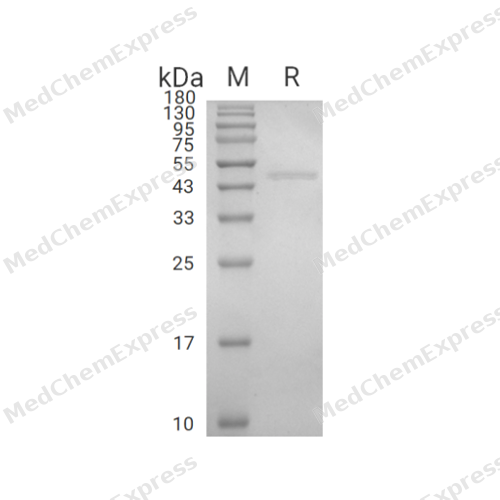
Purity - SDS-PAGE


Technical Parameters
-
Species Human
-
Source Sf9 insect cells
-
Tag N-His
-
Accession
P12532 (A40-H417)
-
Molecular Construction
-
N-term
-
His
-
CKMT1A (A40-H417)
Accession # P12532 -
C-term
-
-
Protein Length
Full Length of Mature Protein
-
Synonyms
CKMT1A; Creatine Kinase, Mitochondrial 1 (Ubiquitous); Prev. CKMT1; Mia-CK; Acidic-Type Mitochondrial Creatine Kinase; CKMT1B; Ubiquitous Mitochondrial Creatine Kinase; CKMT; Creatine Kinase U-Type, Mitochondrial; Creatine Kinase, Mitochondrial 1A; U-MtCK
-
AA Sequence
ASERRRLYPPSAEYPDLRKHNNCMASHLTPAVYARLCDKTTPTGWTLDQCIQTGVDNPGHPFIKTVGMVAGDEETYEVFADLFDPVIQERHNGYDPRTMKHTTDLDASKIRSGYFDERYVLSSRVRTGRSIRGLSLPPACTRAERREVERVVVDALSGLKGDLAGRYYRLSEMTEAEQQQLIDDHFLFDKPVSPLLTAAGMARDWPDARGIWHNNEKSFLIWVNEEDHTRVISMEKGGNMKRVFERFCRGLKEVERLIQERGWEFMWNERLGYILTCPSNLGTGLRAGVHIKLPLLSKDSRFPKILENLRLQKRGTGGVDTAATGGVFDISNLDRLGKSEVELVQLVIDGVNYLIDCERRLERGQDIRIPTPVIHTKH
-
Predicted Molecular Mass
45.3 kDa
-
Molecular Weight
Approximately 43 kDa, based on SDS-PAGE under reducing conditions.
-
Purity
≥ 95%, as determined by reducing SDS-PAGE.


Product Properties
Solution
Supplied as a 0.22 μm filtered solution of 20 mM Tris, 500 mM NaCl, pH 8.5, 10% glycerol.
Note: For SPR assay, please replace the buffer. Primary amine components (e.g., Tris, imidazole) can affect protein-coupled chips.
<1 EU/μg, determined by LAL method.
Stored at -80°C for 1 year from date of receipt. It is stable at -20°C for 3 months after opening. It is recommended to freeze aliquots at -80°C for extended storage. Avoid repeated freeze-thaw cycles.
Shipping with dry ice.


Documentation
-
Data Sheet (237 KB)
-
SDS (251 KB)
- English - EN (251 KB)
- Français - FR (251 KB)
- Deutsch - DE (251 KB)
- Norwegian - NO (251 KB)
- Español - ES (251 KB)
- Swedish - SV (251 KB)
- Italian - IT (251 KB)
- Korean - KR (251 KB)
- Portuguese - PT (251 KB)
-
Handling Instructions (2659 KB)

Calculators
Concentration (start) × Volume (start) = Concentration (final) × Volume (final)


 Powered by Bioz

