



Cystatin B/CSTB Protein, Human (His)
Based on 1 publication(s) in Google Scholar
Cystatin B (CSTB) Protein is a member of the cystatin family. Cystatin B/CSTB Protein, Human (His) is the recombinant human-derived Cystatin B/CSTB protein, expressed by E. coli , with N-His labeled tag.
- Species: Human
- Source: E. coli
-
Storage:Stored at -20°C for 2 years from date of receipt. After reconstitution, it is stable at 4°C for 1 week or -20°C for longer (with carrier protein). It is recommended to freeze aliquots at -20°C or -80°C for extended storage.


To place orders, for customer services and technical support, please contact: MedChemExpress USA
Tel: 609-228-6898 E-mail: [email protected] [email protected]


-
 Biological Activity
-
Technical Parameters
-
Product Properties
- Documentation
- Help & FAQs




Biological Activity
Description
Cystatin B (CSTB) Protein is a member of the cystatin family. Cystatin B/CSTB Protein, Human (His) is the recombinant human-derived Cystatin B/CSTB protein, expressed by E. coli , with N-His labeled tag.
Background
Cystatin B/CSTB Protein functions as an intracellular thiol protease inhibitor. Cystatin B/CSTB protein is able to form a dimer stabilized by noncovalent forces, inhibiting papain and cathepsins l, h and b. Cystatin B/CSTB protein is thought to play a role in protecting against the proteases leaking from lysosomes. Evidence indicates that mutations in Cystatin B/CSTB gene are responsible for the primary defects in patients with progressive myoclonic epilepsy (EPM1). The cystatin superfamily encompasses proteins that contain multiple cystatin-like sequences. There are three inhibitory families in the superfamily, including the type 1 cystatins (stefins), type 2 cystatins and kininogens.
Verified Bioactivity
Measured by its ability to inhibit papain cleavage of a fluorogenic peptide substrate Z-FR-AMC. The IC50 value is < 30 nM. (Activation description: The proenzyme needs to be activated in reducing buffer for an activated form.)
MCE Validation Data
-
Purity - SDS-PAGE
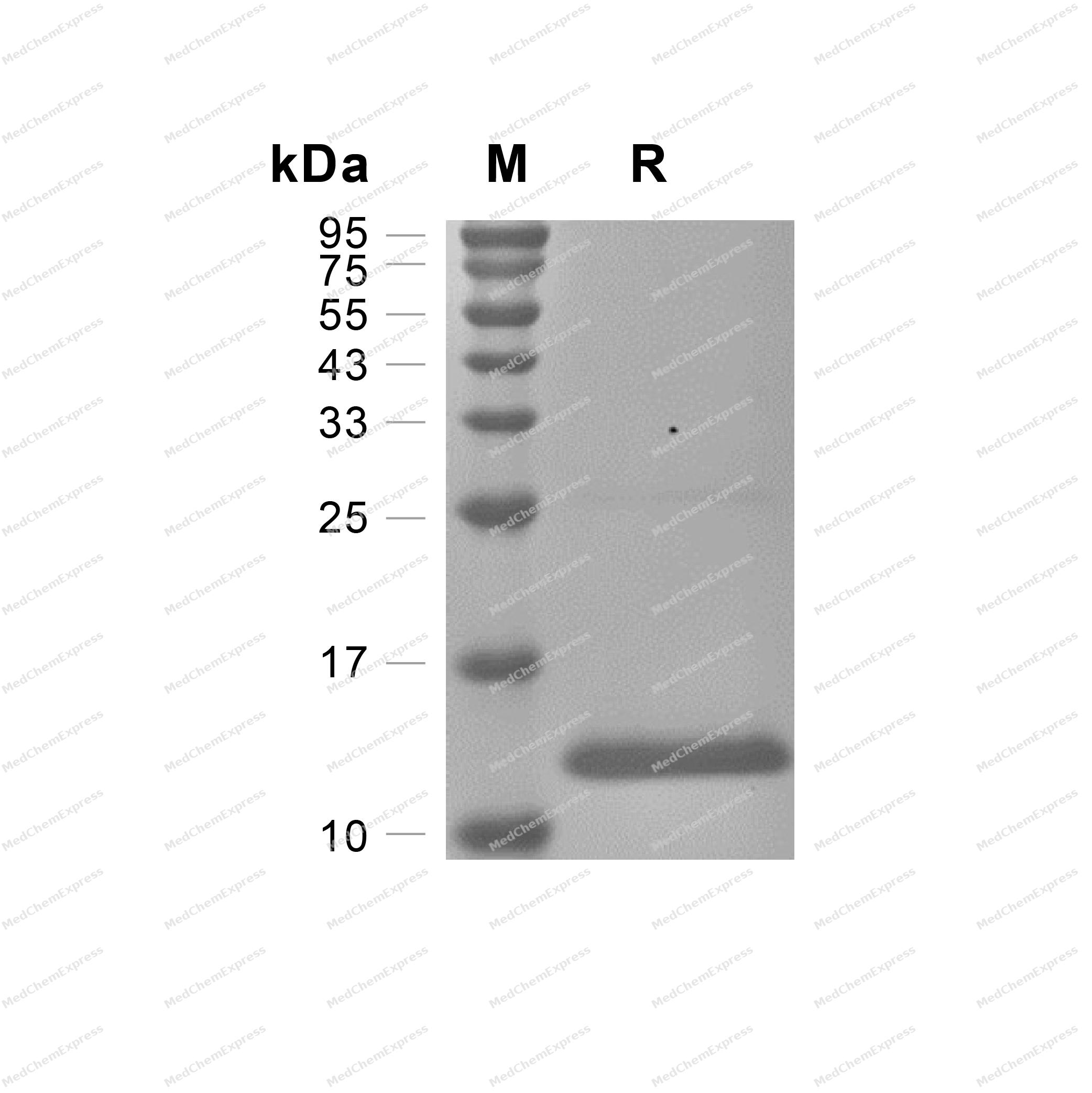
Purity - SDS-PAGE


Publications (1)
-
Journal Impact Factor
-
Most Recent
-
Adv Mater
Trace Detection of Multiple Macromolecular Biomarkers in Saliva by Enzymatic Responsive Serial-Nanofluids Strategy. [Abstract]2026 Mar;38(17):e22747. PMID: 41718019


Technical Parameters
-
Species Human
-
Source E. coli
-
Tag N-His
-
Accession
Q76LA1 (M2-F98)
-
Molecular Construction
-
N-term
-
His
-
CSTB (M2-F98)
Accession # Q76LA1 -
C-term
-
-
Protein Length
Full Length
-
Synonyms
CSTB; Cystatin B (Stefin B); Prev. STFB; CPI-B; Prev. EPM1; Epididymis Secretory Sperm Binding Protein; CST6; Epilepsy, Progressive Myoclonic 1; Cystatin-B; Stefin B; PME; EPM1A; Liver Thiol Proteinase Inhibitor; ULD; Cystatin B; Stefin-B
-
AA Sequence
MCGAPSATQPATAETQHIADQVRSQLEEKENKKFPVFKAVSFKSQVVAGTNYFIKVHVGDEDFVHLRVFQSLPHENKPLTLSNYQTNKAKHDELTYF
-
Molecular Weight
Approximately 15 kDa, based on SDS-PAGE under reducing conditions.
-
Purity
≥ 95%, as determined by reducing SDS-PAGE.


Product Properties
Lyophilized powder.
1.Lyophilized from a 0.22 μm filtered solution of 50 mM Tris, 50 mM NaCl, pH 8.0, 5% trehalose, 5% mannitol, 0.01% Tween 80.
2.Lyophilized from a 0.22 μm filtered solution of 50 mM Tris-HCl, 300 mM NaCl, pH 8.0.
Please refer to the lot-specific COA for specific buffer information.
Note: For SPR assay, please replace the buffer. Primary amine components (e.g., Tris, imidazole) can affect protein-coupled chips.
<1 EU/μg, determined by LAL method.
It is not recommended to reconstitute to a concentration less than 100 μg/mL in ddH2O. For long term storage it is recommended to add a carrier protein (0.1% BSA, 5% HSA, 10% FBS or 5% Trehalose).
Stored at -20°C for 2 years from date of receipt. After reconstitution, it is stable at 4°C for 1 week or -20°C for longer (with carrier protein). It is recommended to freeze aliquots at -20°C or -80°C for extended storage.
Room temperature in continental US; may vary elsewhere.


Documentation
-
Data Sheet (235 KB)
-
SDS (251 KB)
- English - EN (251 KB)
- Français - FR (251 KB)
- Deutsch - DE (251 KB)
- Norwegian - NO (251 KB)
- Español - ES (251 KB)
- Swedish - SV (251 KB)
- Italian - IT (251 KB)
- Korean - KR (251 KB)
- Portuguese - PT (251 KB)
-
Handling Instructions (2659 KB)

Calculators
Concentration (start) × Volume (start) = Concentration (final) × Volume (final)


 Powered by Bioz

