



DHH Protein, Mouse

Based on 1 Customer Validation
DHH Protein, Mouse is a single non-glycosylated polypeptide chain. Desert hedgehog protein (DHH) is a member of the Hedgehog family which encodes signaling molecules that play an important role in regulating morphogenesis.
- Species: Mouse
- Source: E. coli
-
Storage:Stored at -20°C for 2 years from date of receipt. After reconstitution, it is stable at 4°C for 1 week or -20°C for longer (with carrier protein). It is recommended to freeze aliquots at -20°C or -80°C for extended storage.


To place orders, for customer services and technical support, please contact: MedChemExpress USA
Tel: 609-228-6898 E-mail: [email protected] [email protected]


-
 Biological Activity
-
Technical Parameters
-
Product Properties
- Documentation
- References
- Help & FAQs




Biological Activity
Description
DHH Protein, Mouse is a single non-glycosylated polypeptide chain. Desert hedgehog protein (DHH) is a member of the Hedgehog family which encodes signaling molecules that play an important role in regulating morphogenesis.
Background
Desert hedgehog (DHH) belongs to the hedgehog gene family that act as secreted intercellular signal transducers. DHH is an essential morphogen for normal testicular development and function in both mice and humans but is not present in the avian lineage. Like other hedgehog proteins, DHH signals through the patched (PTCH) receptors 1 and 2. The receptors PTCH1 and PTCH2 are highly conserved mediators of hedgehog signalling in both the developing and adult marsupial gonads. Together these findings indicate DHH is an essential therian mammal-specific morphogen in gonadal development and gametogenesis[1].
Verified Bioactivity
Measured by its ability to induce alkaline phosphatase production by MC3T3-E1 mouse embryo osteoblast precursor cells. The ED50 for this effect is < 20 μg/mL.
MCE Validation Data
-
Purity - SDS-PAGE
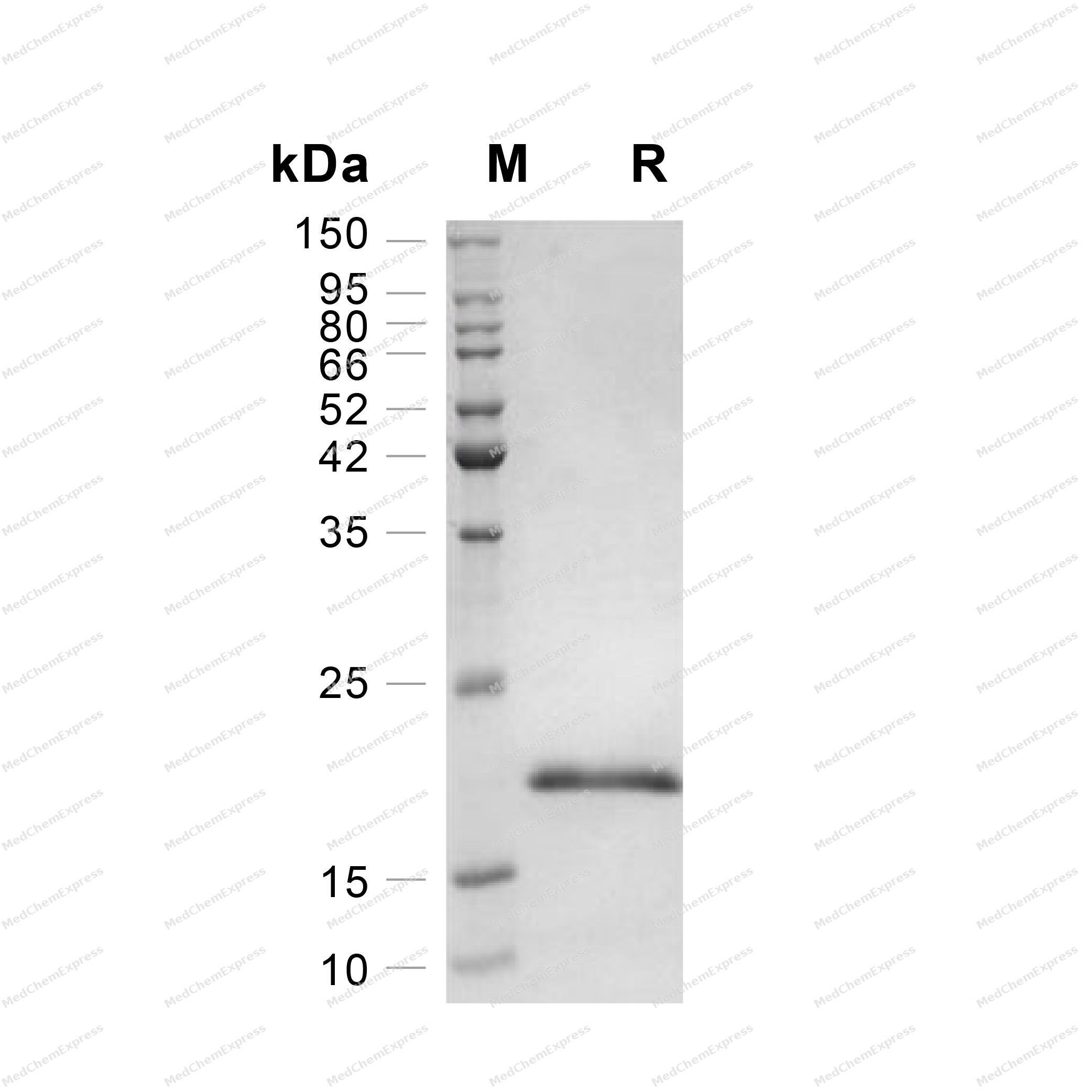
Purity - SDS-PAGE
-
Bioactivity - Cell-Based Assay
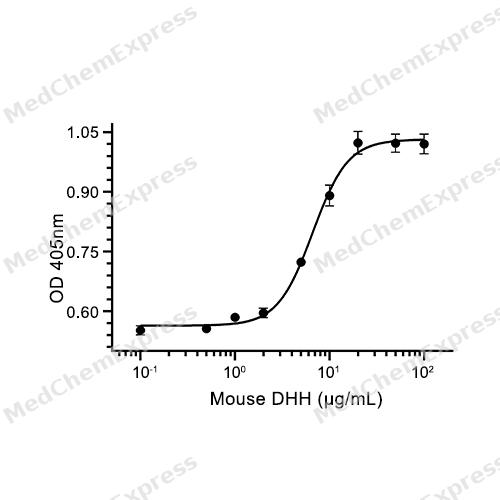
Bioactivity - Cell-Based Assay


Technical Parameters
-
Species Mouse
-
Source E. coli
-
Tag Tag Free
-
Accession
Q61488 (C23-G198, C23I)
-
Molecular Construction
-
N-term
-
DHH (C23-G198, C23I)
Accession # Q61488 -
C-term
-
-
Protein Length
Full Length of Desert hedgehog protein N-product Chain
-
Synonyms
DHH; Mutant Desert Hedgehog; Desert Hedgehog Signaling Molecule; Hedgehog Protein; HHG-3; Desert Hedgehog; Desert Hedgehog Protein; GDXYM; MGC35145; SRXY7; Desert Hedgehog (Drosophila) Homolog; GDMN
-
AA Sequence
IGPGRGPVGRRRYVRKQLVPLLYKQFVPSMPERTLGASGPAEGRVTRGSERFRDLVPNYNPDIIFKDEENSGADRLMTERCKERVNALAIAVMNMWPGVRLRVTEGWDEDGHHAQDSLHYEGRALDITTSDRDRNKYGLLARLAVEAGFDWVYYESRNHIHVSVKADNSLAVRAGG
-
Molecular Weight
Approximately 20 kDa, based on SDS-PAGE under reducing conditions.
-
Purity
≥ 95%, as determined by reducing SDS-PAGE.


Product Properties
Lyophilized powder.
Lyophilized from a 0.2 μm filtered solution of 20 mM PB, 150 mM NaCl, pH 7.4, 8% trehalose.
<0.2 EU/μg, determined by LAL method.
It is not recommended to reconstitute to a concentration less than 100 μg/mL in ddH2O. For long term storage it is recommended to add a carrier protein (0.1% BSA, 5% HSA, 10% FBS or 5% Trehalose).
Stored at -20°C for 2 years from date of receipt. After reconstitution, it is stable at 4°C for 1 week or -20°C for longer (with carrier protein). It is recommended to freeze aliquots at -20°C or -80°C for extended storage.
Room temperature in continental US; may vary elsewhere.


Documentation
-
Data Sheet (261 KB)
-
SDS (251 KB)
- English - EN (251 KB)
- Français - FR (251 KB)
- Deutsch - DE (251 KB)
- Norwegian - NO (251 KB)
- Español - ES (251 KB)
- Swedish - SV (251 KB)
- Italian - IT (251 KB)
- Korean - KR (251 KB)
- Portuguese - PT (251 KB)
-
Handling Instructions (2659 KB)


References

Calculators
Concentration (start) × Volume (start) = Concentration (final) × Volume (final)


 Powered by Bioz

