



Dopamine beta-Hydroxylase Protein, Human (HEK293, His)

Based on 1 Customer Validation
Dopamine beta-hydroxylase protein is an essential enzyme involved in the regulation of neurotransmitters. Its main function is to catalyze the hydroxylation of dopamine, converting it into norepinephrine (also known as norepinephrine). Dopamine beta-Hydroxylase Protein, Human (HEK293, His) is the recombinant human-derived Dopamine beta-Hydroxylase protein, expressed by HEK293 , with N-His labeled tag.
- Species: Human
- Source: HEK293
-
Storage:Stored at -20°C for 2 years from date of receipt. After reconstitution, it is stable at 4°C for 1 week or -20°C for longer (with carrier protein). It is recommended to freeze aliquots at -20°C or -80°C for extended storage.


To place orders, for customer services and technical support, please contact: MedChemExpress USA
Tel: 609-228-6898 E-mail: [email protected] [email protected]


-
 Biological Activity
-
Technical Parameters
-
Product Properties
- Documentation
- Help & FAQs




Biological Activity
Description
Dopamine beta-hydroxylase protein is an essential enzyme involved in the regulation of neurotransmitters. Its main function is to catalyze the hydroxylation of dopamine, converting it into norepinephrine (also known as norepinephrine). Dopamine beta-Hydroxylase Protein, Human (HEK293, His) is the recombinant human-derived Dopamine beta-Hydroxylase protein, expressed by HEK293 , with N-His labeled tag.
Background
Dopamine beta-Hydroxylase protein is an essential enzyme involved in the regulation of neurotransmitters. Its primary function is to catalyze the hydroxylation of dopamine, converting it into noradrenaline (also known as norepinephrine). This enzymatic activity is crucial for the conversion of dopamine to noradrenaline, playing a significant role in modulating these neurotransmitters within the nervous system. By facilitating this chemical transformation, dopamine beta-Hydroxylase protein contributes to the regulation of neurotransmitter levels and influences various physiological processes in the body.
Verified Bioactivity
Measured by its ability to induce Norepinephrine accumulation in SH-SY5Y cells. The ED50 for this effect is 17.76 ng/mL, corresponding to a specific activity is 5.631×10⁴ U/mg.
MCE Validation Data
-
Bioactivity - Cell-Based Assay
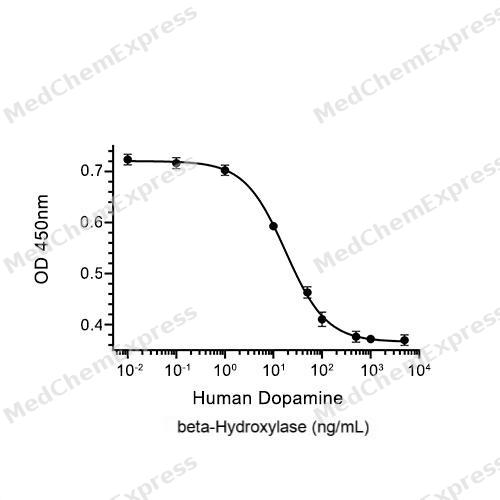
Bioactivity - Cell-Based Assay


Technical Parameters
-
Species Human
-
Source HEK293
-
Tag N-His
-
Accession
P09172 (A41-G617)
-
Molecular Construction
-
N-term
-
His
-
DBH (A41-G617)
Accession # P09172 -
C-term
-
-
Protein Length
Intragranular Domain
-
Synonyms
DBH; Dopamine Beta-Hydroxylase (Dopamine Beta-Monooxygenase); Dopamine Beta-Hydroxylase; Dopamine Beta-Monooxygenase; DBM; ORTHYP1
-
AA Sequence
APRESPLPYHIPLDPEGSLELSWNVSYTQEAIHFQLLVRRLKAGVLFGMSDRGELENADLVVLWTDGDTAYFADAWSDQKGQIHLDPQQDYQLLQVQRTPEGLTLLFKRPFGTCDPKDYLIEDGTVHLVYGILEEPFRSLEAINGSGLQMGLQRVQLLKPNIPEPELPSDACTMEVQAPNIQIPSQETTYWCYIKELPKGFSRHHIIKYEPIVTKGNEALVHHMEVFQCAPEMDSVPHFSGPCDSKMKPDRLNYCRHVLAAWALGAKAFYYPEEAGLAFGGPGSSRYLRLEVHYHNPLVIEGRNDSSGIRLYYTAKLRRFNAGIMELGLVYTPVMAIPPRETAFILTGYCTDKCTQLALPPSGIHIFASQLHTHLTGRKVVTVLVRDGREWEIVNQDNHYSPHFQEIRMLKKVVSVHPGDVLITSCTYNTEDRELATVGGFGILEEMCVNYVHYYPQTQLELCKSAVDAGFLQKYFHLINRFNNEDVCTCPQASVSQQFTSVPWNSFNRDVLKALYSFAPISMHCNKSSAVRFQGEWNLQPLPKVISTLEEPTPQCPTSQGRSPAGPTVVSIGGGKG
-
Predicted Molecular Mass
67.3 kDa
-
Molecular Weight
Approximately 68 kDa, based on SDS-PAGE under reducing conditions, due to the glycosylation.
-
Glycosylation
Yes
-
Purity
≥ 90%, as determined by reducing SDS-PAGE.


Product Properties
Lyophilized powder.
Lyophilized from a 0.22 μm filtered solution of PBS, pH 7.4, 5% trehalose, 5% mannitol and 0.01% Tween 80.
<1 EU/μg, determined by LAL method.
It is not recommended to reconstitute to a concentration less than 100 μg/mL in ddH2O.
Stored at -20°C for 2 years from date of receipt. After reconstitution, it is stable at 4°C for 1 week or -20°C for longer (with carrier protein). It is recommended to freeze aliquots at -20°C or -80°C for extended storage.
Room temperature in continental US; may vary elsewhere.


Documentation
-
Data Sheet (239 KB)
-
SDS (251 KB)
- English - EN (251 KB)
- Français - FR (251 KB)
- Deutsch - DE (251 KB)
- Norwegian - NO (251 KB)
- Español - ES (251 KB)
- Swedish - SV (251 KB)
- Italian - IT (251 KB)
- Korean - KR (251 KB)
- Portuguese - PT (251 KB)
-
Handling Instructions (2659 KB)

Calculators
Concentration (start) × Volume (start) = Concentration (final) × Volume (final)


 Powered by Bioz

