



E-Selectin/CD62E Protein, Rat (HEK293, His)

Based on 1 Customer Validation
The E-selectin/CD62E protein is a cell surface glycoprotein that critically mediates immune adhesion by promoting neutrophil adhesion to cytokine-activated endothelial cells through the SELPLG/PSGL1 interaction. It may also contribute to capillary morphogenesis and interact with SELPLG/PSGL1 and PODXL2 via the sialyl Lewis X epitope regardless of SELPLG sulfation. E-Selectin/CD62E Protein, Rat (HEK293, His) is the recombinant rat-derived E-Selectin/CD62E protein, expressed by HEK293 , with C-His labeled tag.
- Species: Rat
- Source: HEK293
-
Storage:Stored at -20°C for 2 years from date of receipt. After reconstitution, it is stable at 4°C for 1 week or -20°C for longer (with carrier protein). It is recommended to freeze aliquots at -20°C or -80°C for extended storage.


To place orders, for customer services and technical support, please contact: MedChemExpress USA
Tel: 609-228-6898 E-mail: [email protected] [email protected]


-
 Biological Activity
-
Technical Parameters
-
Product Properties
- Documentation
- Help & FAQs




Biological Activity
Description
The E-selectin/CD62E protein is a cell surface glycoprotein that critically mediates immune adhesion by promoting neutrophil adhesion to cytokine-activated endothelial cells through the SELPLG/PSGL1 interaction. It may also contribute to capillary morphogenesis and interact with SELPLG/PSGL1 and PODXL2 via the sialyl Lewis X epitope regardless of SELPLG sulfation. E-Selectin/CD62E Protein, Rat (HEK293, His) is the recombinant rat-derived E-Selectin/CD62E protein, expressed by HEK293 , with C-His labeled tag.
Background
E-Selectin/CD62E protein, a cell-surface glycoprotein, plays a pivotal role in immunoadhesion by mediating the adhesion of blood neutrophils to cytokine-activated endothelium through interaction with SELPLG/PSGL1. Beyond its immunological function, E-Selectin may contribute to capillary morphogenesis. The protein engages in interactions with SELPLG/PSGL1 and PODXL2 through the sialyl Lewis X epitope, with the noteworthy observation that SELPLG sulfation seems dispensable for this interaction. These findings underscore the diverse roles of E-Selectin in facilitating cellular adhesion events and suggest its potential involvement in processes related to vascular development.
Verified Bioactivity
Measured by the ability of the immobilized protein to support the adhesion of U937 human histiocytic lymphoma cells. When 5 x 10⁴ cells/well are added to Rat E-Selectin/Fc Chimera coated plates (2 µg/mL with 100 µL/well), approximately 96.12% will adhere for 1 hour incubation at 37°C.
MCE Validation Data
-
Purity - SDS-PAGE
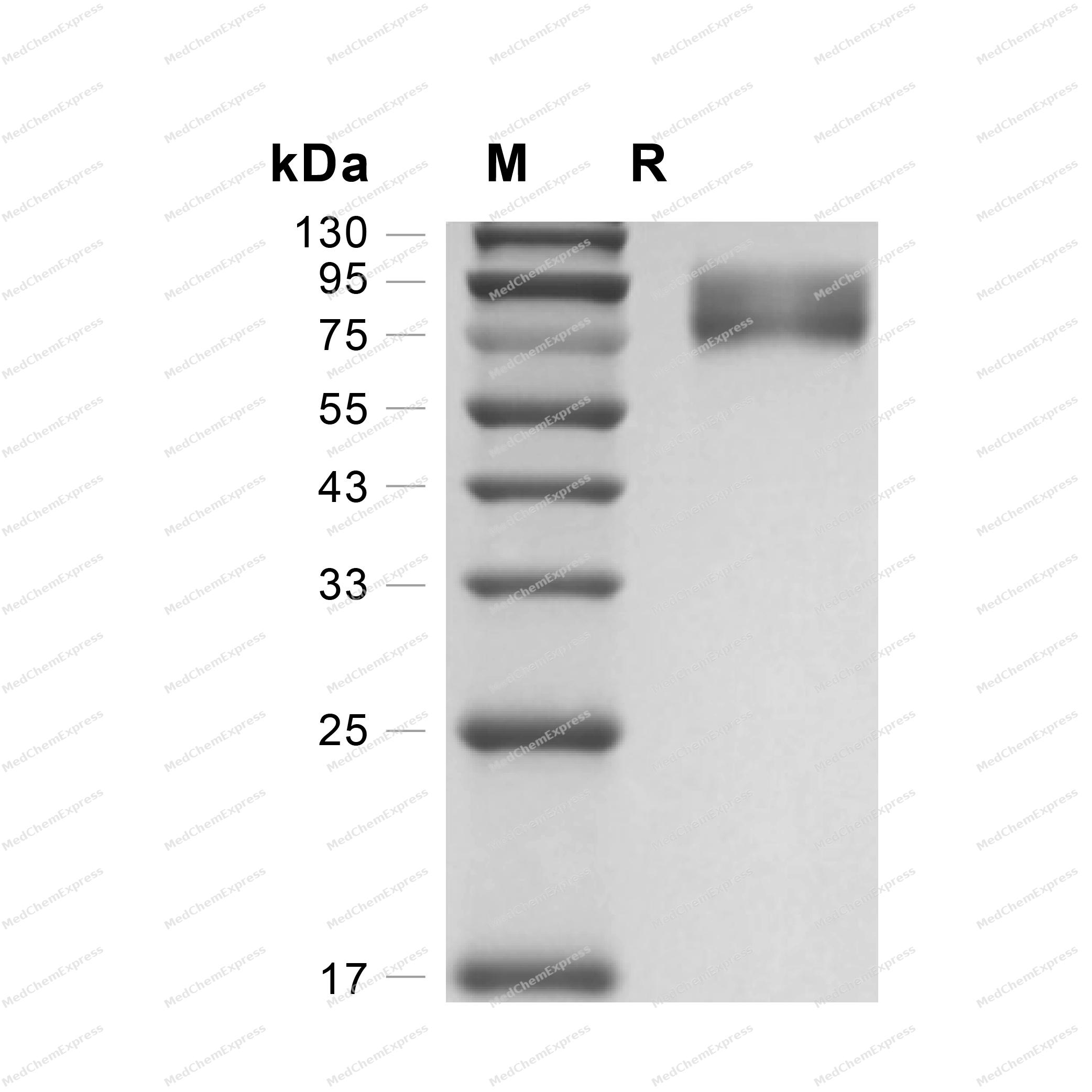
Purity - SDS-PAGE


Technical Parameters
-
Species Rat
-
Source HEK293
-
Tag C-His
-
Accession
P98105 (W22-P494)
-
Molecular Construction
-
N-term
-
CD62E (W22-P494)
Accession # P98105 -
His
-
C-term
-
-
Protein Length
Extracellular Domain
-
Synonyms
SELE; ESEL; Prev. ELAM1; Endothelial Adhesion Molecule 1; Prev. ELAM; ELAM-1; Endothelial Leukocyte Adhesion Molecule 1; LECAM2; CD62 Antigen-Like Family Member E; Leukocyte Endothelial Cell Adhesion Molecule 2; E-Selectin; CD62E Antigen; CD62E; Selectin-
-
AA Sequence
WYYNASSELMTYDEASAYCQRDYTHLVAIQNKEEINYLNSTLRYSPSYYWIGIRKVNNVWIWVGTQKPLTEEAKNWAPGEPNNKQRNEDCVEIYIQRPKDSGMWNDERCDKKKLALCYTASCTNTSCSGHGECVETINSYTCKCHPGFLGPKCDQVVTCQEQEYPDHGSLNCTHPFGLFSYNSSCSFSCERGYVPSSMETTVRCTSSGEWSAPAPACHVVECKALTQPAHGVRKCSSNPGSYPWNTTCTFDCEEGYRRVGAQNLQCTSSGVWDNEKPSCKAVTCDAIPRPQNGSVSCSNSTAGALAFKSSCNFTCEHSFTLQGPAQVECSAQGQWTPQIPVCKASQCEALSAPQRGHMKCLPSASAPFQSGSSCKFSCDEGFELKGSRRLQCGPRGEWDSEKPTCAGVQCSSLDLPGKMNMSCSGPAVFGTVCEFTCPEGWTLNGSSILTCGATGRWSAMLPTCEAPANPPRP
-
Molecular Weight
Approximately 70-80 kDa, based on SDS-PAGE under reducing conditions, due to the glycosylation.
-
Glycosylation
Yes
-
Purity
≥ 95%, as determined by reducing SDS-PAGE.


Product Properties
Lyophilized powder.
Lyophilized from a 0.22 μm filtered solution of PBS, pH 7.4.
<1 EU/μg, determined by LAL method.
It is not recommended to reconstitute to a concentration less than 100 μg/mL in ddH2O. For long term storage it is recommended to add a carrier protein (0.1% BSA, 5% HSA, 10% FBS or 5% Trehalose).
Stored at -20°C for 2 years from date of receipt. After reconstitution, it is stable at 4°C for 1 week or -20°C for longer (with carrier protein). It is recommended to freeze aliquots at -20°C or -80°C for extended storage.
Room temperature in continental US; may vary elsewhere.


Documentation
-
Data Sheet (238 KB)
-
SDS (251 KB)
- English - EN (251 KB)
- Français - FR (251 KB)
- Deutsch - DE (251 KB)
- Norwegian - NO (251 KB)
- Español - ES (251 KB)
- Swedish - SV (251 KB)
- Italian - IT (251 KB)
- Korean - KR (251 KB)
- Portuguese - PT (251 KB)
-
Handling Instructions (2659 KB)

Calculators
Concentration (start) × Volume (start) = Concentration (final) × Volume (final)


 Powered by Bioz

