



ECM1 Protein, Mouse (HEK293, His)

Based on 1 Customer Validation
ECM1 Protein, an extracellular matrix protein, is involved in various biological processes, including skin development, wound healing, and angiogenesis. It supports cell adhesion and migration, and regulates the structure and function of the extracellular matrix. Understanding the functions of ECM1 Protein is important for studying tissue remodeling and developing therapeutic strategies for ECM1-related disorders and diseases. ECM1 Protein, Mouse (HEK293, His) is the recombinant mouse-derived ECM1 protein, expressed by HEK293 , with C-His labeled tag.
- Species: Mouse
- Source: HEK293
-
Storage:Stored at -20°C for 2 years from date of receipt. After reconstitution, it is stable at 4°C for 1 week or -20°C for longer (with carrier protein). It is recommended to freeze aliquots at -20°C or -80°C for extended storage.


To place orders, for customer services and technical support, please contact: MedChemExpress USA
Tel: 609-228-6898 E-mail: [email protected] [email protected]


-
 Biological Activity
-
Technical Parameters
-
Product Properties
- Documentation
- Help & FAQs




Biological Activity
Description
ECM1 Protein, an extracellular matrix protein, is involved in various biological processes, including skin development, wound healing, and angiogenesis. It supports cell adhesion and migration, and regulates the structure and function of the extracellular matrix. Understanding the functions of ECM1 Protein is important for studying tissue remodeling and developing therapeutic strategies for ECM1-related disorders and diseases. ECM1 Protein, Mouse (HEK293, His) is the recombinant mouse-derived ECM1 protein, expressed by HEK293 , with C-His labeled tag.
Background
ECM1, a multifaceted protein, serves as a crucial participant in endochondral bone formation, acting as a negative regulator of bone mineralization. Beyond its role in bone development, ECM1 demonstrates its influence on vascular processes by stimulating endothelial cell proliferation and promoting angiogenesis. Furthermore, the protein exhibits inhibitory effects on MMP9 proteolytic activity, revealing its regulatory function in extracellular matrix remodeling. ECM1 engages in various molecular interactions, including binding to HSPG2 via its C-terminus and forming complexes with EFEMP1/FBLN3 and LAMB3. Additionally, ECM1 interacts directly with MMP9, emphasizing its involvement in the modulation of matrix metalloproteinase activity. The diverse roles and interactions of ECM1 underscore its significance in orchestrating processes related to bone formation and vascular function.
Verified Bioactivity
1.Measured by the ability of the immobilized protein to support the adhesion of HFF Human skin fibroblast cells. When 5 × 10⁴ cells/well are added to mECM1-His coated plates (2.5 μg/mL and 100 μL/well), approximately > 30% will adhere specifically after 90 minutes at 37°C.
2.Measured by the ability of the immobilized protein to support the adhesion of the B16F1 mouse melanoma cells. The adhesion rate for this effect is 69.70% in the presence of 10 μg/mL rmECM-1.
MCE Validation Data
-
Purity - SDS-PAGE
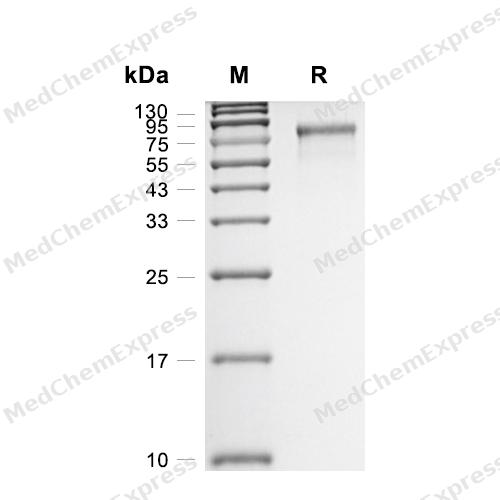
Purity - SDS-PAGE


Technical Parameters
-
Species Mouse
-
Source HEK293
-
Tag C-His
-
Accession
Q61508-1 (A20-E559)
-
Molecular Construction
-
N-term
-
ECM1 (A20-E559)
Accession # Q61508 -
His
-
C-term
-
-
Protein Length
Full Length of Isoform-1
-
Synonyms
ECM1; Testicular Tissue Protein Li 61; Extracellular Matrix Protein 1; ECM1 Short Variant; Secretory Component P85; URBWD
-
AA Sequence
ASEGAFKASDQREMTPERLFQHLHEVGYAAPPSPPQTRRLRVDHSVTSLHDPPLFEEQREVQPPSSPEDIPVYEEDWPTFLNPNVDKAGPAVPQEAIPLQKEQPPPQVHIEQKEIDPPAQPQEEIVQKEVKPHTLAGQLPPEPRTWNPARHCQQGRRGVWGHRLDGFPPGRPSPDNLKQICLPERQHVIYGPWNLPQTGYSHLSRQGETLNVLETGYSRCCRCRSDTNRLDCLKLVWEDAMTQFCEAEFSVKTRPHLCCRLRGEERFSCFQKEAPRPDYLLRPCPVHQNGMSSGPQLPFPPGLPTPDNVKNICLLRRFRAVPRNLPATDAIQRQLQALTRLETEFQRCCRQGHNHTCTWKAWEGTLDGYCERELAIKTHPHSCCHYPPSPARDECFAHLAPYPNYDRDILTLDLSRVTPNLMGQLCGSGRVLSKHKQIPGLIQNMTIRCCELPYPEQACCGEEEKLAFIENLCGPRRNSWKDPALCCDLSPEDKQINCFNTNYLRNVALVAGDTGNATGLGEQGPTRGTDANPAPGSKEE
-
Molecular Weight
Approximately 90-95 kDa, based on SDS-PAGE under reducing conditions, due to the glycosylation.
-
Glycosylation
Yes
-
Purity
≥ 95%, as determined by reducing SDS-PAGE.


Product Properties
Lyophilized powder.
Lyophilized from a 0.2 μm filtered solution of PBS, pH 7.4.
<1 EU/μg, determined by LAL method.
It is not recommended to reconstitute to a concentration less than 100 μg/mL in ddH2O. For long term storage it is recommended to add a carrier protein (0.1% BSA, 5% HSA, 10% FBS or 5% Trehalose).
Stored at -20°C for 2 years from date of receipt. After reconstitution, it is stable at 4°C for 1 week or -20°C for longer (with carrier protein). It is recommended to freeze aliquots at -20°C or -80°C for extended storage.
Room temperature in continental US; may vary elsewhere.


Documentation
-
Data Sheet (239 KB)
-
SDS (251 KB)
- English - EN (251 KB)
- Français - FR (251 KB)
- Deutsch - DE (251 KB)
- Norwegian - NO (251 KB)
- Español - ES (251 KB)
- Swedish - SV (251 KB)
- Italian - IT (251 KB)
- Korean - KR (251 KB)
- Portuguese - PT (251 KB)
-
Handling Instructions (2659 KB)

Calculators
Concentration (start) × Volume (start) = Concentration (final) × Volume (final)


 Powered by Bioz

