



EGFL6 Protein, Mouse (HEK293, His)

Based on 1 Customer Validation
The EGFL6 protein is a key player in hair follicle morphogenesis and may influence cell dynamics through binding to integrin α-8/β-1. This interaction is shown to play a key role in the complex process that controls hair follicle formation. EGFL6 Protein, Mouse (HEK293, His) is the recombinant mouse-derived EGFL6 protein, expressed by HEK293 , with C-10*His labeled tag.
- Species: Mouse
- Source: HEK293
-
Storage:Stored at -20°C for 2 years from date of receipt. After reconstitution, it is stable at 4°C for 1 week or -20°C for longer (with carrier protein). It is recommended to freeze aliquots at -20°C or -80°C for extended storage.


To place orders, for customer services and technical support, please contact: MedChemExpress USA
Tel: 609-228-6898 E-mail: [email protected] [email protected]


-
 Biological Activity
-
Technical Parameters
-
Product Properties
- Documentation
- Help & FAQs




Biological Activity
Description
The EGFL6 protein is a key player in hair follicle morphogenesis and may influence cell dynamics through binding to integrin α-8/β-1. This interaction is shown to play a key role in the complex process that controls hair follicle formation. EGFL6 Protein, Mouse (HEK293, His) is the recombinant mouse-derived EGFL6 protein, expressed by HEK293 , with C-10*His labeled tag.
Background
The EGFL6 protein emerges as a pivotal participant in hair follicle morphogenesis, potentially exerting its influence by binding to integrin alpha-8/beta-1. This interaction suggests a key role in the intricate processes governing cellular dynamics during hair follicle formation. Moreover, EGFL6 is implicated in promoting matrix assembly, underscoring its essential contribution to the structural organization crucial for the development and maintenance of hair follicles. The dual functionality of EGFL6, involving integrin binding and matrix assembly, highlights its multifaceted role in orchestrating cellular events and structural processes integral to hair follicle morphogenesis. Further investigation is warranted to unravel the specific mechanisms through which EGFL6 modulates these processes, deepening our understanding of its significance in hair follicle development.
Verified Bioactivity
Measured by the ability of the immobilized protein to support the adhesion of NIH-3T3 mouse embryonic fibroblast cells. Recombinant Mouse EGF-L6 immobilized at 2 µg/mL, 100 µL/well, >60% cells will adhere specifically after 30 minutes at 37 °C.
MCE Validation Data
-
Purity - SDS-PAGE
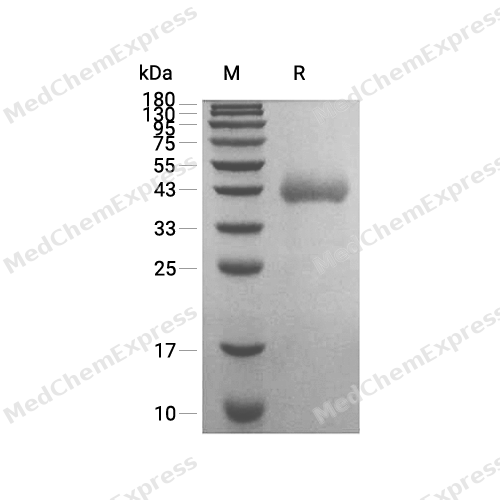
Purity - SDS-PAGE


Technical Parameters
-
Species Mouse
-
Source HEK293
-
Tag C-10*His
-
Accession
Q9JJZ5 (T287-G550)
-
Molecular Construction
-
N-term
-
EGFL6 (T287-G550)
Accession # Q9JJZ5 -
10*His
-
C-term
-
-
Protein Length
Partial
-
Synonyms
EGFL6; MAM And EGF Domain Containing; Prev. MAEG; EGF Repeat-Containing Protein 6; MAM And EGF Domains-Containing Gene Protein; EGF-Like-Domain, Multiple 6; Epidermal Growth Factor-Like Protein 6; W80; EGF Like Domain Multiple 6; EGF-Like Protein 6
-
AA Sequence
TMKKKVKLKMVTPRPASTRVPKVNLPYSSEEGVSRGRNYDGEQKKKEEGKRERLEEEKGEKTLRNEVEQERTLRGDVFSPKVNEAEDLDLVYVQRKELNSKLKHKDLNISVDCSFDLGVCDWKQDREDDFDWHPADRDNDVGYYMAVPALAGHKKNIGRLKLLLPNLTPQSNFCLLFDYRLAGDKVGKLRVFVKNSNNALAWEETKNEDGRWRTGKIQLYQGIDTTKSVIFEAERGKGKTGEIAVDGVLLVSGLCPDDFLSVEG
-
Predicted Molecular Mass
31.4 kDa
-
Molecular Weight
Approximately 38-45 kDa, based on SDS-PAGE under reducing conditions, due to the glycosylation.
-
Glycosylation
Yes
-
Purity
≥ 95%, as determined by reducing SDS-PAGE.


Product Properties
Lyophilized powder
Lyophilized from a 0.22 μm filtered solution of PBS, pH 7.4, 8% trehalose.
<1 EU/μg, determined by LAL method.
It is not recommended to reconstitute to a concentration less than 100 μg/mL in ddH2O.
Stored at -20°C for 2 years from date of receipt. After reconstitution, it is stable at 4°C for 1 week or -20°C for longer (with carrier protein). It is recommended to freeze aliquots at -20°C or -80°C for extended storage.
Shipping with dry ice.


Documentation
-
Data Sheet (237 KB)
-
SDS (252 KB)
- English - EN (252 KB)
- Français - FR (252 KB)
- Deutsch - DE (252 KB)
- Norwegian - NO (252 KB)
- Español - ES (252 KB)
- Swedish - SV (252 KB)
- Italian - IT (252 KB)
- Korean - KR (252 KB)
- Portuguese - PT (252 KB)
-
Handling Instructions (2659 KB)

Calculators
Concentration (start) × Volume (start) = Concentration (final) × Volume (final)


 Powered by Bioz

