



EMAP-II Protein, Mouse (His)

Based on 1 Customer Validation
EMAP-II is a noncatalytic component of the multisynthase complex (MSC) and plays a critical role in coordinating tRNA ligase function. It stimulates cytoplasmic arginyl-tRNA synthase and binds to tRNA. EMAP-II Protein, Mouse (His) is the recombinant mouse-derived EMAP-II protein, expressed by E. coli , with N-His labeled tag.
- Species: Mouse
- Source: E. coli
-
Storage:Stored at -80°C for 1 year from date of receipt. It is stable at -20°C for 3 months after opening. It is recommended to freeze aliquots at -80°C for extended storage. Avoid repeated freeze-thaw cycles.


To place orders, for customer services and technical support, please contact: MedChemExpress USA
Tel: 609-228-6898 E-mail: [email protected] [email protected]


-
 Biological Activity
-
Technical Parameters
-
Product Properties
- Documentation
- Help & FAQs




Biological Activity
Description
EMAP-II is a noncatalytic component of the multisynthase complex (MSC) and plays a critical role in coordinating tRNA ligase function. It stimulates cytoplasmic arginyl-tRNA synthase and binds to tRNA. EMAP-II Protein, Mouse (His) is the recombinant mouse-derived EMAP-II protein, expressed by E. coli , with N-His labeled tag.
Background
EMAP-II serves as a non-catalytic component within the multisynthase complex (MSC), playing a crucial role in orchestrating the functions of various tRNA ligases. It specifically stimulates the catalytic activity of cytoplasmic arginyl-tRNA synthase and binds to tRNA. Apart from its role in protein synthesis, EMAP-II exhibits inflammatory cytokine activity and negatively regulates TGF-beta signaling by stabilizing SMURF2 and inhibiting its SMAD7-mediated degradation. Additionally, EMAP-II contributes to glucose homeostasis through the induction of glucagon secretion, promotes dermal fibroblast proliferation and wound repair, and modulates endothelial cell responses by inducing migration at low concentrations and apoptosis at high concentrations. It forms homodimers and is part of the MSC, interacting with various tRNA ligases, SMURF2, HSP90B1/gp96, and PSMA7, showcasing its involvement in diverse cellular processes and regulatory networks.
Verified Bioactivity
Measured by its ability to induce TNF-alpha secretion by RAW 264.7 mouse monocyte/macrophage cells. When rmEMAP-II is coated, it will induce TNF-alpha production by RAW 264.7 cells in the presence of Polymyxin B (20 µg/mL) with an ED50 is 5.179 µg/mL.
MCE Validation Data
-
Bioactivity - Cell-Based Assay
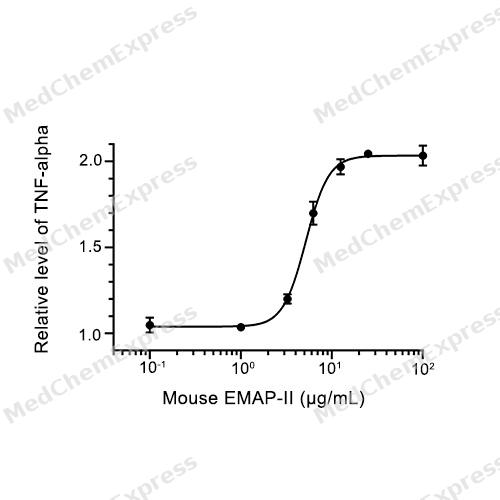
Bioactivity - Cell-Based Assay


Technical Parameters
-
Species Mouse
-
Source E. coli
-
Tag N-8*His
-
Accession
P31230 (A2-K310)
-
Gene ID13722
-
Molecular Construction
-
N-term
-
His
-
EMAP-II (A2-K310)
Accession # P31230 -
C-term
-
-
Protein Length
Full Length of Mature Protein
-
Synonyms
AIMP1; Multisynthase Complex Auxiliary Component P43; Prev. SCYE1; EMAP-2; EMAPII; EMAP2; P43; Endothelial-Monocyte Activating Polypeptide II; Small Inducible Cytokine Subfamily E, Member 1 (Endothelial Monocyte-Activating); Endothelial Monocyte-Activatin
-
AA Sequence
ATNDAVLKRLEQKGAEADQIIEYLKQQVALLKEKAILQATMREEKKLRVENAKLKKEIEELKQELILAEIHNGVEQVRVRLSTPLQTNCTASESVVQSPSVATTASPATKEQIKAGEEKKVKEKTEKKGEKKEKQQSAAASTDSKPIDASRLDLRIGCIVTAKKHPDADSLYVEEVDVGEAAPRTVVSGLVNHVPLEQMQNRMVVLLCNLKPAKMRGVLSQAMVMCASSPEKVEILAPPNGSVPGDRITFDAFPGEPDKELNPKKKIWEQIQPDLHTNAECVATYKGAPFEVKGKGVCRAQTMANSGIK
-
Predicted Molecular Mass
35.1 kDa
-
Molecular Weight
Approximately 42-46 kDa, based on SDS-PAGE under reducing conditions.
-
Purity
≥ 95%, as determined by Bis-Tris PAGE.


Product Properties
Solution
Supplied as a 0.22 μm filtered solution of 20 mM Tris, 500 mM NaCl, 10% glycerol, pH 8.0.
Note: For SPR assay, please replace the buffer. Primary amine components (e.g., Tris, imidazole) can affect protein-coupled chips.
<1 EU/μg, determined by LAL method.
Stored at -80°C for 1 year from date of receipt. It is stable at -20°C for 3 months after opening. It is recommended to freeze aliquots at -80°C for extended storage. Avoid repeated freeze-thaw cycles.
Shipping with dry ice.


Documentation
-
Data Sheet (237 KB)
-
SDS (252 KB)
- English - EN (252 KB)
- Français - FR (252 KB)
- Deutsch - DE (252 KB)
- Norwegian - NO (252 KB)
- Español - ES (252 KB)
- Swedish - SV (252 KB)
- Italian - IT (252 KB)
- Korean - KR (252 KB)
- Portuguese - PT (252 KB)
-
Handling Instructions (2659 KB)

Calculators
Concentration (start) × Volume (start) = Concentration (final) × Volume (final)


 Powered by Bioz

