



Enoyl-ACP Reductase Protein, E. coli (His)

Based on 1 Customer Validation
Enoyl-ACP Reductase Protein is a member of the Short chain Dehydrogenase Reductase (SDR) superfamily.It is a key enzyme of the type II fatty acid synthesis (FAS) system.Enoyl-ACP Reductase catalyzes the reduction of a carbon-carbon double bond in an enoyl moiety that is covalently linked to an acyl carrier protein (ACP).And it is involved in the elongation cycle of fatty acid which are used in the lipid metabolism and in the biotin biosynthesis.Enoyl-ACP Reductase Protein, E.coli (His) is the recombinant E.coli-derived Enoyl-ACP Reductase protein, expressed by E.coli , with N-His labeled tag.
- Species: E.coli
- Source: E. coli
-
Storage:Stored at -20°C for 2 years from date of receipt. After reconstitution, it is stable at 4°C for 1 week or -20°C for longer (with carrier protein). It is recommended to freeze aliquots at -20°C or -80°C for extended storage.


To place orders, for customer services and technical support, please contact: MedChemExpress USA
Tel: 609-228-6898 E-mail: [email protected] [email protected]


-
 Biological Activity
-
Technical Parameters
-
Product Properties
- Documentation
- Help & FAQs




Biological Activity
Description
Enoyl-ACP Reductase Protein is a member of the Short chain Dehydrogenase Reductase (SDR) superfamily.It is a key enzyme of the type II fatty acid synthesis (FAS) system.Enoyl-ACP Reductase catalyzes the reduction of a carbon-carbon double bond in an enoyl moiety that is covalently linked to an acyl carrier protein (ACP).And it is involved in the elongation cycle of fatty acid which are used in the lipid metabolism and in the biotin biosynthesis.Enoyl-ACP Reductase Protein, E.coli (His) is the recombinant E.coli-derived Enoyl-ACP Reductase protein, expressed by E.coli , with N-His labeled tag.
Background
Enoyl-ACP Reductase is a member of the Short chain Dehydrogenase Reductase (SDR) superfamily and thus are closely related to the other SDR enzyme of the fatty acid synthesis cycle, 3-ketoacyl-ACP reductase, in both structure and mechanism. Enoyl-ACP Reductase is a key enzyme of the type II fatty acid synthesis (FAS) system. Fatty acid biosynthesis is essential for survival in mammals, plants, fungi and bacteria (the archaea make isoprenoid-based lipids). Enoyl-ACP Reductase catalyzes the reduction of a carbon-carbon double bond in an enoyl moiety that is covalently linked to an acyl carrier protein (ACP). And it is involved in the elongation cycle of fatty acid which are used in the lipid metabolism and in the biotin biosynthesis[1][2].
Verified Bioactivity
Enzymatic activity is determined by following NADH consumption. The specific activity is 1055.75 pmol/min/μg.
MCE Validation Data
-
Purity - SDS-PAGE
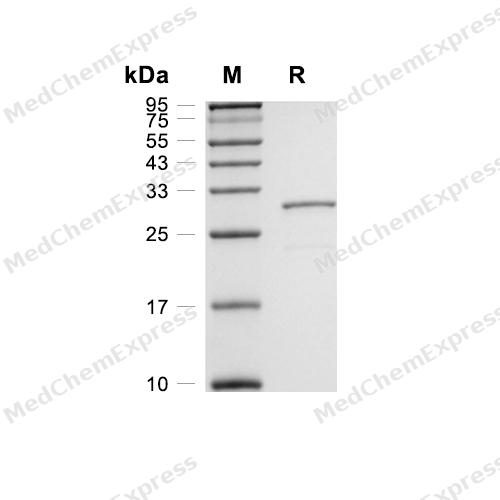
Purity - SDS-PAGE


Technical Parameters
-
Species E.coli
-
Source E. coli
-
Tag N-6*His
-
Accession
WP_000506490 (G2-K262)
-
Gene ID/
-
Molecular Construction
-
N-term
-
His
-
ENR (G2-K262)
Accession # WP_000506490 -
C-term
-
-
Protein Length
Full Length
-
Synonyms
b1288 Protein; ECK1283 Protein; envM Protein; gts Protein; JW1281 Protein; qmeA Protein
-
AA Sequence
GFLSGKRILVTGVASKLSIAYGIAQAMHREGAELAFTYQNDKLKGRVEEFAAQLGSDIVLQCDVAEDASIDTMFAELGKVWPKFDGFVHSIGFAPGDQLDGDYVNAVTREGFKIAHDISSYSFVAMAKACRSMLNPGSALLTLSYLGAERAIPNYNVMGLAKASLEANVRYMANAMGPEGVRVNAISAGPIRTLAASGIKDFRKMLAHCEAVTPIRRTVTIEDVGNSAAFLCSDLSAGISGEVVHVDGGFSIAAMNELELK
-
Molecular Weight
Approximately 33 kDa, based on SDS-PAGE under reducing conditions.
-
Purity
≥ 95%, as determined by reducing SDS-PAGE.


Product Properties
Lyophilized powder.
Lyophilized from a 0.22 μm filtered solution of 50 mM Tris-HCl, 300 mM NaCl, pH 7.4.
Note: For SPR assay, please replace the buffer. Primary amine components (e.g., Tris, imidazole) can affect protein-coupled chips.
<1 EU/μg, determined by LAL method.
It is not recommended to reconstitute to a concentration less than 100 μg/mL in ddH2O. For long term storage it is recommended to add a carrier protein (0.1% BSA, 5% HSA, 10% FBS or 5% Trehalose).
Stored at -20°C for 2 years from date of receipt. After reconstitution, it is stable at 4°C for 1 week or -20°C for longer (with carrier protein). It is recommended to freeze aliquots at -20°C or -80°C for extended storage.
Room temperature in continental US; may vary elsewhere.


Documentation
-
Data Sheet (237 KB)
-
SDS (251 KB)
- English - EN (251 KB)
- Français - FR (251 KB)
- Deutsch - DE (251 KB)
- Norwegian - NO (251 KB)
- Español - ES (251 KB)
- Swedish - SV (251 KB)
- Italian - IT (251 KB)
- Korean - KR (251 KB)
- Portuguese - PT (251 KB)
-
Handling Instructions (2659 KB)

Calculators
Concentration (start) × Volume (start) = Concentration (final) × Volume (final)


 Powered by Bioz

