



Frizzled-6 Protein, Human (HEK293, His)

Based on 1 Customer Validation
Frizzled-6 is a Wnt receptor that complexly activates signaling pathways that converge primarily on the β-catenin canonical pathway. This triggers disorganized protein activation, GSK-3 kinase inhibition, nuclear β-catenin accumulation, and Wnt target gene activation. Frizzled-6 Protein, Human (HEK293, His) is the recombinant human-derived Frizzled-6 protein, expressed by HEK293 , with C-His labeled tag.
- Species: Human
- Source: HEK293
-
Storage:Stored at -20°C for 2 years from date of receipt. After reconstitution, it is stable at 4°C for 1 week or -20°C for longer (with carrier protein). It is recommended to freeze aliquots at -20°C or -80°C for extended storage.


To place orders, for customer services and technical support, please contact: MedChemExpress USA
Tel: 609-228-6898 E-mail: [email protected] [email protected]


-
 Biological Activity
-
Technical Parameters
-
Product Properties
- Documentation
- Help & FAQs




Biological Activity
Description
Frizzled-6 is a Wnt receptor that complexly activates signaling pathways that converge primarily on the β-catenin canonical pathway. This triggers disorganized protein activation, GSK-3 kinase inhibition, nuclear β-catenin accumulation, and Wnt target gene activation. Frizzled-6 Protein, Human (HEK293, His) is the recombinant human-derived Frizzled-6 protein, expressed by HEK293 , with C-His labeled tag.
Background
Frizzled-6, a receptor for Wnt proteins, is intricately involved in signaling pathways that predominantly converge on the beta-catenin canonical pathway. This cascade triggers the activation of disheveled proteins, inhibition of GSK-3 kinase, nuclear accumulation of beta-catenin, and subsequent activation of Wnt target genes. While a secondary signaling pathway implicating PKC and calcium fluxes has been observed in some family members, its precise relationship with the canonical pathway remains unclear, and the requirement of PKC for Wnt-mediated inactivation of GSK-3 kinase adds complexity to this interplay. Interactions with G-proteins are integral to both pathways. Frizzled-6 is positioned to play a pivotal role in transducing polarity information during tissue morphogenesis and in differentiated tissues. Teaming up with FZD3, it contributes to neural tube closure and regulates the establishment of planar cell polarity, especially in orienting asymmetric bundles of stereocilia on the apical faces of select auditory and vestibular sensory cells within the inner ear. Its functional repertoire is further underscored by interactions with LMBR1L.
Verified Bioactivity
Measured by its binding ability in a functional ELISA. Immobilized Human Frizzled-6, at 0.1μg/mL (100 μL/well) can bind Wnt-5a. The ED50 for this effect is 125.3 ng/mL.
MCE Validation Data
-
Purity - SDS-PAGE
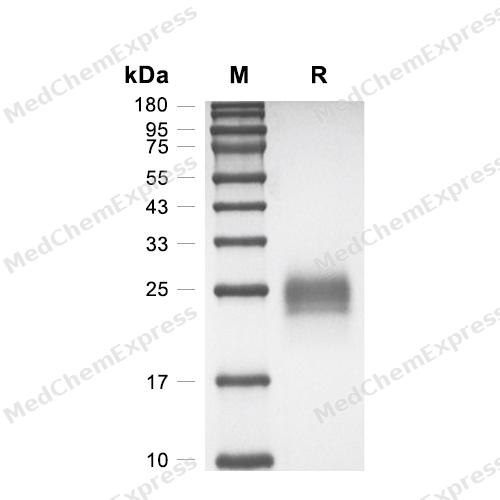
Purity - SDS-PAGE
-
Bioactivity - ELISA
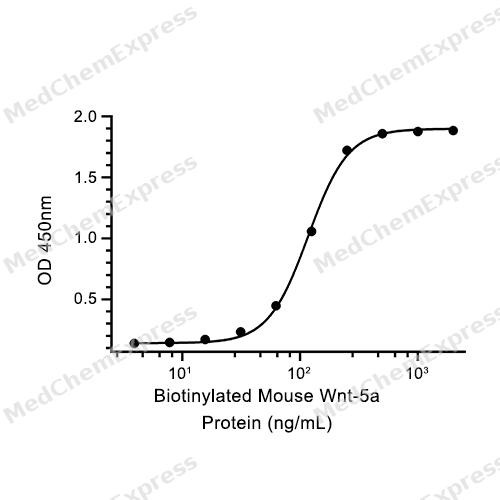
Bioactivity - ELISA


Technical Parameters
-
Species Human
-
Source HEK293
-
Tag C-6*His
-
Accession
O60353-1/NP_003497.2 (H19-V153)
-
Molecular Construction
-
N-term
-
Frizzled-6 (H19-V153)
Accession # O60353/NP_003497.2 -
His
-
C-term
-
-
Protein Length
Partial Extracellular Domain
-
Synonyms
FZD6; Frizzled Homolog 6 (Drosophila); Frizzled Class Receptor 6; Frizzled Homolog 6; Frizzled-6; NDNC10; Hfz6; NDNC1; Frizzled 6, Seven Transmembrane Spanning Receptor; FZ-6; Frizzled Family Receptor 6; HFz6; Seven Transmembrane Helix Receptor; Fz-6; Fri
-
AA Sequence
HSLFTCEPITVPRCMKMAYNMTFFPNLMGHYDQSIAAVEMEHFLPLANLECSPNIETFLCKAFVPTCIEQIHVVPPCRKLCEKVYSDCKKLIDTFGIRWPEELECDRLQYCDETVPVTFDPHTEFLGPQKKTEQV
-
Molecular Weight
Approximately 20-28 kDa, based on SDS-PAGE under reducing conditions, due to the glycosylation.
-
Glycosylation
Yes
-
Purity
≥ 95%, as determined by reducing SDS-PAGE.


Product Properties
Lyophilized powder.
Lyophilized from a 0.22 μm filtered solution of PBS, pH 7.4.
<1 EU/μg, determined by LAL method.
It is not recommended to reconstitute to a concentration less than 100 μg/mL in ddH2O. For long term storage it is recommended to add a carrier protein (0.1% BSA, 5% HSA, 10% FBS or 5% Trehalose).
Stored at -20°C for 2 years from date of receipt. After reconstitution, it is stable at 4°C for 1 week or -20°C for longer (with carrier protein). It is recommended to freeze aliquots at -20°C or -80°C for extended storage.
Room temperature in continental US; may vary elsewhere.


Documentation
-
Data Sheet (236 KB)
-
SDS (251 KB)
- English - EN (251 KB)
- Français - FR (251 KB)
- Deutsch - DE (251 KB)
- Norwegian - NO (251 KB)
- Español - ES (251 KB)
- Swedish - SV (251 KB)
- Italian - IT (251 KB)
- Korean - KR (251 KB)
- Portuguese - PT (251 KB)
-
Handling Instructions (2659 KB)

Calculators
Concentration (start) × Volume (start) = Concentration (final) × Volume (final)


 Powered by Bioz

