



GBP1 Protein, Human (HEK293, His)

Based on 1 Customer Validation
GBP1 Protein belongs to the dynamin superfamily of large GTPases. GBP1 plays important roles in innate immunity against a diverse range of bacterial, viral and protozoan pathogens. It hydrolyzes GTP to GMP in two consecutive cleavage reactions. GBP1 also acts as a positive regulator of inflammasome assembly by promoting the release of inflammasome ligands from bacteria. In addition, it exhibits antiviral activity against influenza virus. GBP1 Protein, Human (HEK293, His) is the recombinant human-derived GBP1 protein, expressed by HEK293 , with C-10*His labeled tag.
- Species: Human
- Source: HEK293
-
Storage:Stored at -80°C for 1 year from date of receipt. It is stable at -20°C for 3 months after opening. It is recommended to freeze aliquots at -80°C for extended storage. Avoid repeated freeze-thaw cycles.


To place orders, for customer services and technical support, please contact: MedChemExpress USA
Tel: 609-228-6898 E-mail: [email protected] [email protected]


-
 Biological Activity
-
Technical Parameters
-
Product Properties
- Documentation
- Help & FAQs




Biological Activity
Description
GBP1 Protein belongs to the dynamin superfamily of large GTPases. GBP1 plays important roles in innate immunity against a diverse range of bacterial, viral and protozoan pathogens. It hydrolyzes GTP to GMP in two consecutive cleavage reactions. GBP1 also acts as a positive regulator of inflammasome assembly by promoting the release of inflammasome ligands from bacteria. In addition, it exhibits antiviral activity against influenza virus. GBP1 Protein, Human (HEK293, His) is the recombinant human-derived GBP1 protein, expressed by HEK293 , with C-10*His labeled tag.
Background
Guanylate-binding protein 1 (GBP1) belongs to the dynamin superfamily of large GTPases. GBP1 plays important roles in innate immunity against a diverse range of bacterial, viral and protozoan pathogens. It hydrolyzes GTP to GMP in two consecutive cleavage reactions: GTP is first hydrolyzed to GDP and then to GMP in a processive manner. Following infection, GBP1 is recruited to the pathogen-containing vacuoles or vacuole-escaped bacteria and promotes both autophagy and inflammasome assembly. GBP1 also acts as a positive regulator of inflammasome assembly by promoting the release of inflammasome ligands from bacteria. GBP1 confers protection to several pathogens, including the bacterial pathogens L.monocytogenes and M.bovis BCG as well as the protozoan pathogen T.gondii. In addition, it exhibits antiviral activity against influenza virus[1][2].
MCE Validation Data
-
Purity - SDS-PAGE
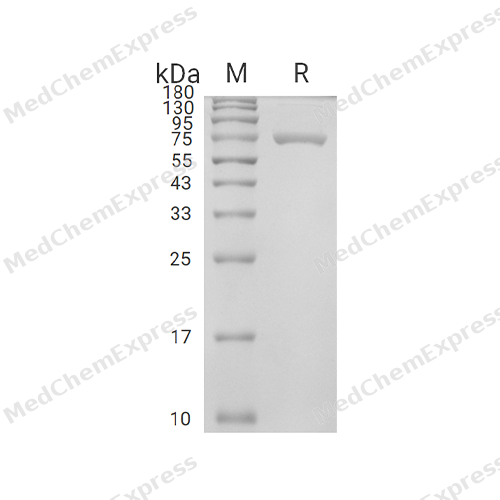
Purity - SDS-PAGE


Technical Parameters
-
Species Human
-
Source HEK293
-
Tag C-10*His
-
Accession
AAA35871.1 (M1-C589)
-
Molecular Construction
-
N-term
-
GBP1 (M1-C589)
Accession # AAA35871.1 -
10*His
-
C-term
-
-
Protein Length
Partial
-
Synonyms
GBP1; GTP-Binding Protein 1; Guanylate Binding Protein 1; HuGBP-1; Guanylate-Binding Protein 1; HGBP1; Guanylate Binding Protein 1, Interferon-Inducible, 67kDa; GBP-1; Interferon-Induced Guanylate-Binding Protein 1; Guanylate Binding Protein 1, Interferon
-
AA Sequence
MASEIHMTGPMCLIENTNGRLMANPEALKILSAITQPMVVVAIVGLYRTGKSYLMNKLAGKKKGFSLGSTVQSHTKGIWMWCVPHPKKPGHILVLLDTEGLGDVEKGDNQNDSWIFALAVLLSSTFVYNSIGTINQQAMDQLYYVTELTHRIRSKSSPDENENEVEDSADFVSFFPDFVWTLRDFSLDLEADGQPLTPDEYLTYSLKLKKGTSQKDETFNLPRLCIRKFFPKKKCFVFDRPVHRRKLAQLEKLQDEELDPEFVQQVADFCSYIFSNSKTKTLSGGIQVNGPRLESLVLTYVNAISSGDLPCMENAVLALAQIENSAAVQKAIAHYEQQMGQKVQLPTESLQELLDLHRDSEREAIEVFIRSSFKDVDHLFQKELAAQLEKKRDDFCKQNQEASSDRCSGLLQVIFSPLEEEVKAGIYSKPGGYRLFVQKLQDLKKKYYEEPRKGIQAEEILQTYLKSKESMTDAILQTDQTLTEKEKEIEVERVKAESAQASAKMLQEMQRKNEQMMEQKERSYQEHLKQLTEKMENDRVQLLKEQERTLALKLQEQEQLLKEGFQKESRIMKNEIQDLQTKMRRRKAC
-
Predicted Molecular Mass
69 kDa
-
Molecular Weight
Approximately 65 kDa, based on SDS-PAGE under reducing conditions.
-
Purity
≥ 95%, as determined by reducing SDS-PAGE.


Product Properties
Solution
Supplied as a 0.22 μm filtered solution of PBS, pH 7.4.
<1 EU/μg, determined by LAL method.
Stored at -80°C for 1 year from date of receipt. It is stable at -20°C for 3 months after opening. It is recommended to freeze aliquots at -80°C for extended storage. Avoid repeated freeze-thaw cycles.
Shipping with dry ice.


Documentation
-
Data Sheet (238 KB)
-
SDS (252 KB)
- English - EN (252 KB)
- Français - FR (252 KB)
- Deutsch - DE (252 KB)
- Norwegian - NO (252 KB)
- Español - ES (252 KB)
- Swedish - SV (252 KB)
- Italian - IT (252 KB)
- Korean - KR (252 KB)
- Portuguese - PT (252 KB)
-
Handling Instructions (2659 KB)

Calculators
Concentration (start) × Volume (start) = Concentration (final) × Volume (final)


 Powered by Bioz

