



GJA1 Protein, Human (His)
Based on 1 publication(s) in Google Scholar
The GJA1 protein regulates bladder capacity through gap junctions, clusters of transmembrane channels that allow the diffusion of low molecular weight materials between adjacent cells. GJA1 protein also regulates NOV expression and localization and is important for ventricular gap junction communication. GJA1 Protein, Human (His) is the recombinant human-derived GJA1 protein, expressed by E. coli , with N-6*His labeled tag.
- Species: Human
- Source: E. coli
-
Storage:Stored at -20°C for 2 years from date of receipt. After reconstitution, it is stable at 4°C for 1 week or -20°C for longer (with carrier protein). It is recommended to freeze aliquots at -20°C or -80°C for extended storage.


To place orders, for customer services and technical support, please contact: MedChemExpress USA
Tel: 609-228-6898 E-mail: [email protected] [email protected]


-
 Biological Activity
-
Technical Parameters
-
Product Properties
- Documentation
- Help & FAQs




Biological Activity
Description
The GJA1 protein regulates bladder capacity through gap junctions, clusters of transmembrane channels that allow the diffusion of low molecular weight materials between adjacent cells. GJA1 protein also regulates NOV expression and localization and is important for ventricular gap junction communication. GJA1 Protein, Human (His) is the recombinant human-derived GJA1 protein, expressed by E. coli , with N-6*His labeled tag.
Background
The GJA1 Protein serves as a gap junction protein with regulatory roles in bladder capacity. Comprising closely packed pairs of transmembrane channels called connexons, it facilitates the diffusion of low molecular weight materials between neighboring cells. This protein plays a crucial role in hearing physiology by participating in the recycling of potassium to the cochlear endolymph. Acting as a negative regulator of bladder functional capacity, GJA1 enhances intercellular electrical and chemical transmission, sensitizing bladder muscles to cholinergic neural stimuli and causing contraction. Additionally, it may contribute to cell growth inhibition through the regulation of NOV expression and localization. Essential for gap junction communication in the ventricles, GJA1 interacts with various proteins, including TJP1, SRC, UBQLN4, SGSM3, CNST, RIC1/CIP150, CSNK1D, NOV, and TMEM65, thereby playing a multifaceted role in cellular communication and regulation.
MCE Validation Data
-
Purity - SDS-PAGE
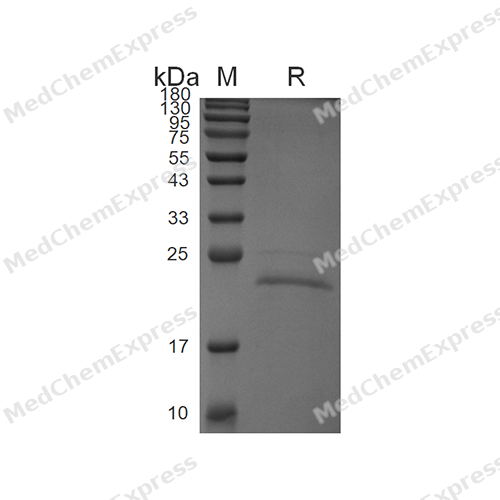
Purity - SDS-PAGE


Publications (1)
-
Journal Impact Factor
-
Most Recent
-
Acta Pharmacol Sin
Ginsenoside Rg1 alleviates chronic stress-induced depression in rats by targeting Cx43-YAP axis. [Abstract]2025 Jul;46(7):1877-1891. PMID: 40055527


Technical Parameters
-
Species Human
-
Source E. coli
-
Tag N-6*His
-
Accession
P17302 (F233-I382)
-
Molecular Construction
-
N-term
-
6*His
-
GJA1 (F233-I382)
Accession # P17302 -
C-term
-
-
Protein Length
Cytoplasmic Domain
-
Synonyms
GJA1; Oculodentodigital Dysplasia (Syndactyly Type III); Prev. GJAL; Gap Junction Protein; Prev. ODDD; Connexin 43; CX43; AVSD3; Gap Junction Protein, Alpha 1, 43kDa; EKVP3; Gap Junction 43 KDa Heart Protein; HLHS1; Gap Junction Alpha-1 Protein; PPKCA; Co
-
AA Sequence
FKGVKDRVKGKSDPYHATSGALSPAKDCGSQKYAYFNGCSSPTAPLSPMSPPGYKLVTGDRNNSSCRNYNKQASEQNWANYSAEQNRMGQAGSTISNSHAQPFDFPDDNQNSKKLAAGHELQPLAIVDQRPSSRASSRASSRPRPDDLEI
-
Predicted Molecular Mass
20.3 kDa
-
Molecular Weight
Approximately 22 kDa, based on SDS-PAGE under reducing conditions.
-
Purity
≥ 90%, as determined by reducing SDS-PAGE.


Product Properties
Lyophilized powder.
Lyophilized from a 0.22 μm filtered solution of 20 mM Tris-HC1, 0.5 M NaCl, 6% trehalose, pH 8.0.
Note: For SPR assay, please replace the buffer. Primary amine components (e.g., Tris, imidazole) can affect protein-coupled chips.
<1 EU/μg, determined by LAL method.
It is not recommended to reconstitute to a concentration less than 100 μg/mL in ddH2O.
Stored at -20°C for 2 years from date of receipt. After reconstitution, it is stable at 4°C for 1 week or -20°C for longer (with carrier protein). It is recommended to freeze aliquots at -20°C or -80°C for extended storage.
Room temperature in continental US; may vary elsewhere.


Documentation
-
Data Sheet (236 KB)
-
SDS (252 KB)
- English - EN (252 KB)
- Français - FR (252 KB)
- Deutsch - DE (252 KB)
- Norwegian - NO (252 KB)
- Español - ES (252 KB)
- Swedish - SV (252 KB)
- Italian - IT (252 KB)
- Korean - KR (252 KB)
- Portuguese - PT (252 KB)
-
Handling Instructions (2659 KB)

Calculators
Concentration (start) × Volume (start) = Concentration (final) × Volume (final)


 Powered by Bioz

