



GPVI Protein, Mouse (HEK293, His)
Based on 1 publication(s) in Google Scholar
GPVI Protein is a platelet membrane protein with a molecular weight of ~62 kDa that is a physiological collagen receptor. GPVI is present as a complex with the homodimeric Fc receptor y-chain. GPVI must form such a dimeric complex to exhibit high affinity binding to collagen. The GPVI-induced activation mechanism is initiated by tyrosine phosphorylation of the immunoreceptor tyrosine-based activation motif (ITAM) of the FcR gamma-chain, and then this signal is transduced to many related proteins, mainly by tyrosine phosphorylation. Interaction of platelets with collagen via the receptor GPVI results in platelet activation and adhesion. GPVI Protein, Mouse (HEK293, His) is the recombinant mouse-derived GPVI protein, expressed by HEK293 , with C-6*His labeled tag.
- Species: Mouse
- Source: HEK293
-
Storage:Stored at -20°C for 2 years from date of receipt. After reconstitution, it is stable at 4°C for 1 week or -20°C for longer (with carrier protein). It is recommended to freeze aliquots at -20°C or -80°C for extended storage.


To place orders, for customer services and technical support, please contact: MedChemExpress USA
Tel: 609-228-6898 E-mail: [email protected] [email protected]


-
 Biological Activity
-
Technical Parameters
-
Product Properties
- Documentation
- Help & FAQs




Biological Activity
Description
GPVI Protein is a platelet membrane protein with a molecular weight of ~62 kDa that is a physiological collagen receptor. GPVI is present as a complex with the homodimeric Fc receptor y-chain. GPVI must form such a dimeric complex to exhibit high affinity binding to collagen. The GPVI-induced activation mechanism is initiated by tyrosine phosphorylation of the immunoreceptor tyrosine-based activation motif (ITAM) of the FcR gamma-chain, and then this signal is transduced to many related proteins, mainly by tyrosine phosphorylation. Interaction of platelets with collagen via the receptor GPVI results in platelet activation and adhesion[1][2][3]. GPVI Protein, Mouse (HEK293, His) is the recombinant mouse-derived GPVI protein, expressed by HEK293 , with C-6*His labeled tag.
Background
Interaction of platelets with collagen via the receptor GPVI results in platelet activation and adhesion--the processes that are essential for thrombus formation. On the platelet surface, GPVI is present as a complex with the homodimeric Fc receptor y-chain (FcRgamma with a possible stoichiometry of two GPVI molecules and one FcRgamma dimer). When collagen binds to GPVI, a platelet activation cascade is initiated by tyrosine phosphorylation of the immunoreceptor tyrosine-based activation motif of FcRgamma and this phosphorylation induces the formation of a large complex composed from many signal-transducing proteins. GPVI inhibitor would be able to inhibit thrombus formation but still not cause a significant bleeding tendency[1].
both collagen and GPVI are insoluble molecules. The extracellular domain of GPVI is soluble forms as follows: the monomeric form (GPVIex) and the dimeric form of GPVI fused with the human immunoglobulin Fc domain (GPVI-Fc2). Purified GPVIex strongly inhibited convulxin (Cvx)-induced platelet aggregation but only weakly inhibited that induced by collagen-related peptide. However, only GPVI-Fc2, and not GPVIex, inhibited collagen-induced platelet aggregation[3].
MCE Validation Data
-
Purity - SDS-PAGE
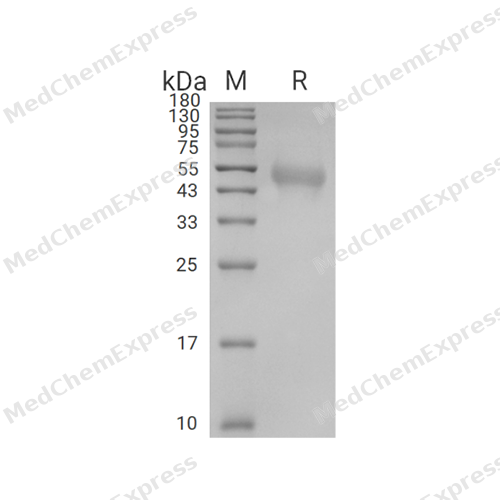
Purity - SDS-PAGE


Publications (1)
-
Journal Impact Factor
-
Most Recent
-
Front Pharmacol
2023 Oct 31:14:1255069. PMID: 38026984


Technical Parameters
-
Species Mouse
-
Source HEK293
-
Tag C-6*His
-
Accession
B2RR15 (Q22-K265)
-
Gene ID243816
-
Molecular Construction
-
N-term
-
GPVI (Q22-K265)
Accession # B2RR15 -
6*His
-
C-term
-
-
Protein Length
Partial
-
Synonyms
GP6; Glycoprotein VI (Platelet); Glycoprotein VI Platelet; Platelet Collagen Receptor; GPVI; BDPLT11; Platelet Glycoprotein VI; GPIV; Glycoprotein 6
-
AA Sequence
QSGPLPKPSLQAQPSSLVPLGQSVILRCQGPPDVDLYRLEKLKPEKYEDQDFLFIPTMERSNAGRYRCSYQNGSHWSLPSDQLELIATGVYAKPSLSAHPSSAVPQGRDVTLKCQSPYSFDEFVLYKEGDTGPYKRPEKWYRANFPIITVTAAHSGTYRCYSFSSSSPYLWSAPSDPLVLVVTGLSATPSQVPTEESFPVTESSRRPSILPTNKISTTEKPMNITASPEGLSPPIGFAHQHYAK
-
Predicted Molecular Mass
27.8 kDa
-
Molecular Weight
Approximately 40-60 kDa, based on SDS-PAGE under reducing conditions.
-
Purity
≥ 95%, as determined by reducing SDS-PAGE.


Product Properties
Lyophilized powder.
Lyophilized from a 0.22 μm filtered solution of PBS, pH 7.4.
<1 EU/μg, determined by LAL method.
It is not recommended to reconstitute to a concentration less than 100 μg/mL in ddH2O. For long term storage it is recommended to add a carrier protein (0.1% BSA, 5% HSA, 10% FBS or 5% Trehalose).
Stored at -20°C for 2 years from date of receipt. After reconstitution, it is stable at 4°C for 1 week or -20°C for longer (with carrier protein). It is recommended to freeze aliquots at -20°C or -80°C for extended storage.
Room temperature in continental US; may vary elsewhere.


Documentation
-
Data Sheet (237 KB)
-
SDS (251 KB)
- English - EN (251 KB)
- Français - FR (251 KB)
- Deutsch - DE (251 KB)
- Norwegian - NO (251 KB)
- Español - ES (251 KB)
- Swedish - SV (251 KB)
- Italian - IT (251 KB)
- Korean - KR (251 KB)
- Portuguese - PT (251 KB)
-
Handling Instructions (2659 KB)

Calculators
Concentration (start) × Volume (start) = Concentration (final) × Volume (final)


 Powered by Bioz

