



GSTM2 Protein, Human (His)
Based on 1 publication(s) in Google Scholar
GSTM2 protein is pivotal in conjugating reduced glutathione to diverse hydrophobic electrophiles and actively participates in synthesizing hepoxilin regioisomers, as documented. This underscores GSTM2's multifunctional nature, emphasizing its role in detoxification and forming unique molecular species, contributing to the broader cellular response to various electrophilic compounds. GSTM2 Protein, Human (His) is the recombinant human-derived GSTM2, expressed by E. coli, with N-6*His labeled tag.
- Species: Human
- Source: E. coli
-
Storage:Stored at -20°C for 2 years from date of receipt. After reconstitution, it is stable at 4°C for 1 week or -20°C for longer (with carrier protein). It is recommended to freeze aliquots at -20°C or -80°C for extended storage.


To place orders, for customer services and technical support, please contact: MedChemExpress USA
Tel: 609-228-6898 E-mail: [email protected] [email protected]


-
 Biological Activity
-
Technical Parameters
-
Product Properties
- Documentation
- Help & FAQs




Biological Activity
Description
GSTM2 protein is pivotal in conjugating reduced glutathione to diverse hydrophobic electrophiles and actively participates in synthesizing hepoxilin regioisomers, as documented. This underscores GSTM2's multifunctional nature, emphasizing its role in detoxification and forming unique molecular species, contributing to the broader cellular response to various electrophilic compounds. GSTM2 Protein, Human (His) is the recombinant human-derived GSTM2, expressed by E. coli, with N-6*His labeled tag.
Background
The GSTM2 protein plays a pivotal role in the cellular process of conjugating reduced glutathione to a diverse range of exogenous and endogenous hydrophobic electrophiles. Additionally, GSTM2 actively participates in the synthesis of novel hepoxilin regioisomers, as documented in studies. This highlights the multifunctional nature of GSTM2, emphasizing its involvement in the detoxification pathway and the formation of unique molecular species, contributing to the broader cellular response to various electrophilic compounds.
Verified Bioactivity
10-15 U/mg, Bio-activity is defined as the amount of enzyme that conjugate 1.0 umole of 1-chloro-2,4-dinitrobenzene (CDNB) with reduced glutathione per minute at at 37°C.
MCE Validation Data
-
Purity - SDS-PAGE
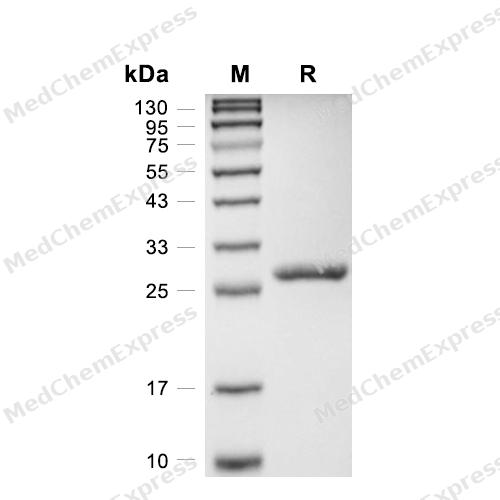
Purity - SDS-PAGE


Publications (1)
-
Journal Impact Factor
-
Most Recent


Technical Parameters
-
Species Human
-
Source E. coli
-
Tag N-6*His
-
Accession
P28161-1 (M1-K218)
-
Gene ID2946
-
Molecular Construction
-
N-term
-
6*His
-
GSTM2 (M1-K218)
Accession # P28161-1 -
C-term
-
-
Protein Length
Full Length of Isoform-1
-
Synonyms
GSTM2; Glutathione S-Alkyltransferase M2; Glutathione S-Transferase Mu 2; Glutathione S-Aryltransferase M2; GST4; Glutathione S-Transferase M1; Glutathione S-Transferase Mu 2 (Muscle); Glutathione S-Transferase 4; Glutathione S-Transferase M2 (Muscle); Gl
-
AA Sequence
MPMTLGYWNIRGLAHSIRLLLEYTDSSYEEKKYTMGDAPDYDRSQWLNEKFKLGLDFPNLPYLIDGTHKITQSNAILRYIARKHNLCGESEKEQIREDILENQFMDSRMQLAKLCYDPDFEKLKPEYLQALPEMLKLYSQFLGKQPWFLGDKITFVDFIAYDVLERNQVFEPSCLDAFPNLKDFISRFEGLEKISAYMKSSRFLPRPVFTKMAVWGNK
-
Predicted Molecular Mass
25.7 kDa
-
Molecular Weight
Approximately 26 kDa, based on SDS-PAGE under reducing conditions.
-
Purity
≥ 95%, as determined by reducing SDS-PAGE.


Product Properties
Lyophilized powder.
Lyophilized from a 0.22 μm filtered solution of 50 mM Tris-HCl, 200 mM NaCl, 1 mM CaCl2, pH 8.0, 10% trehalose, 0.02% Tween80.
Note: For SPR assay, please replace the buffer. Primary amine components (e.g., Tris, imidazole) can affect protein-coupled chips.
<1 EU/μg, determined by LAL method.
It is not recommended to reconstitute to a concentration less than 100 μg/mL in ddH2O.
Stored at -20°C for 2 years from date of receipt. After reconstitution, it is stable at 4°C for 1 week or -20°C for longer (with carrier protein). It is recommended to freeze aliquots at -20°C or -80°C for extended storage.
Room temperature in continental US; may vary elsewhere.


Documentation
-
Data Sheet (236 KB)
-
SDS (251 KB)
- English - EN (251 KB)
- Français - FR (251 KB)
- Deutsch - DE (251 KB)
- Norwegian - NO (251 KB)
- Español - ES (251 KB)
- Swedish - SV (251 KB)
- Italian - IT (251 KB)
- Korean - KR (251 KB)
- Portuguese - PT (251 KB)
-
Handling Instructions (2659 KB)

Calculators
Concentration (start) × Volume (start) = Concentration (final) × Volume (final)


 Powered by Bioz

