



Heparanase/HPSE Protein, Human (CHO, His)

Based on 1 Customer Validation
Heparanase (HPSE) functions as an endoglycosidase, playing a crucial role in the cleavage of heparan sulfate proteoglycans (HSPGs) into heparan sulfate side chains and core proteoglycans. It is implicated in various cellular processes, including facilitating cell migration associated with metastasis, wound healing, and inflammation. Heparanase also plays a role in cell adhesion to the ECM, independent of its enzymatic activity, and induces AKT1/PKB phosphorylation, thereby increasing cell mobility and invasion. Additionally, Heparanase is involved in the regulation of osteogenesis, promotes angiogenesis through up-regulation of SRC-mediated activation of VEGF, and is implicated in hair follicle inner root sheath differentiation and hair homeostasis. Heparanase/HPSE Protein, Human (CHO, His) is the recombinant human-derived Heparanase/HPSE protein, expressed by CHO , with N-6*His labeled tag.
- Species: Human
- Source: CHO
-
Storage:Stored at -20°C for 2 years from date of receipt. After reconstitution, it is stable at 4°C for 1 week or -20°C for longer (with carrier protein). It is recommended to freeze aliquots at -20°C or -80°C for extended storage.


To place orders, for customer services and technical support, please contact: MedChemExpress USA
Tel: 609-228-6898 E-mail: [email protected] [email protected]


-
 Biological Activity
-
Technical Parameters
-
Product Properties
- Documentation
- Help & FAQs




Biological Activity
Description
Heparanase (HPSE) functions as an endoglycosidase, playing a crucial role in the cleavage of heparan sulfate proteoglycans (HSPGs) into heparan sulfate side chains and core proteoglycans. It is implicated in various cellular processes, including facilitating cell migration associated with metastasis, wound healing, and inflammation. Heparanase also plays a role in cell adhesion to the ECM, independent of its enzymatic activity, and induces AKT1/PKB phosphorylation, thereby increasing cell mobility and invasion. Additionally, Heparanase is involved in the regulation of osteogenesis, promotes angiogenesis through up-regulation of SRC-mediated activation of VEGF, and is implicated in hair follicle inner root sheath differentiation and hair homeostasis. Heparanase/HPSE Protein, Human (CHO, His) is the recombinant human-derived Heparanase/HPSE protein, expressed by CHO , with N-6*His labeled tag.
Background
Heparanase (HPSE) functions as an endoglycosidase, playing a crucial role in the cleavage of heparan sulfate proteoglycans (HSPGs) into heparan sulfate side chains and core proteoglycans. This enzymatic activity contributes to extracellular matrix (ECM) degradation and remodeling, selectively cleaving linkages within glucuronic acid units and N-sulfo glucosamine units carrying specific sulfation patterns. While predominantly inactive at neutral pH, HPSE becomes active under acidic conditions, such as during tumor invasion and inflammatory processes. This protein is implicated in various cellular processes, including facilitating cell migration associated with metastasis, wound healing, and inflammation. It enhances shedding of syndecans, promotes endothelial invasion and angiogenesis in myelomas, and acts as a procoagulant by increasing the generation of activation factor X in the presence of tissue factor and activation factor VII. Notably, HPSE also plays a role in cell adhesion to the ECM, independent of its enzymatic activity, and induces AKT1/PKB phosphorylation, thereby increasing cell mobility and invasion. Additionally, HPSE is involved in the regulation of osteogenesis, promotes angiogenesis through up-regulation of SRC-mediated activation of VEGF, and is implicated in hair follicle inner root sheath differentiation and hair homeostasis[1][2][3][4][5].
Verified Bioactivity
1.The enzyme activity of this recombinant protein is testing in progress, we cannot offer a guarantee yet.
2.Measured by its binding ability in a functional ELISA. Immobilized HPSE at 2 μg/ml (100μl/well) can bind HPSE antibody. The ED50 for this effect is 0.1-0.5 μg/mL.
MCE Validation Data
-
Purity - SDS-PAGE
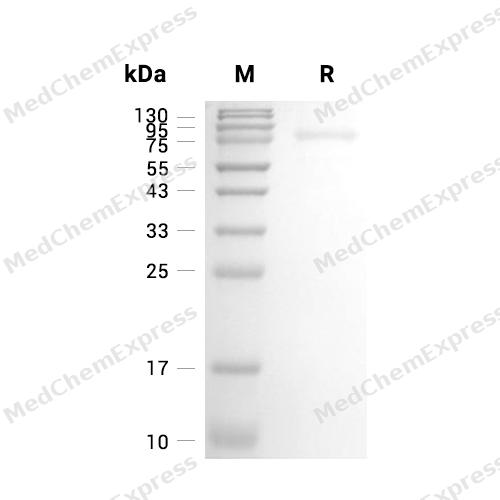
Purity - SDS-PAGE
-
Bioactivity - ELISA
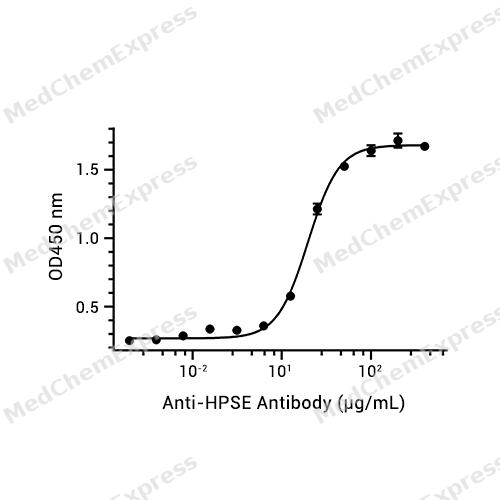
Bioactivity - ELISA


Technical Parameters
-
Species Human
-
Source CHO
-
Tag N-6*His
-
Accession
AAD41342.1 (Q36-I543)
-
Molecular Construction
-
N-term
-
6*His
-
HPSE (Q36-I543)
Accession # AAD41342.1 -
C-term
-
-
Protein Length
Full length of Mature Protein
-
Synonyms
HPSE; Endo-Glucoronidase; Heparanase; HPA1; HPSE1; HPR1; HSE1; Hpa1; HPA; HEP; Heparanase-1
-
AA Sequence
QDVVDLDFFTQEPLHLVSPSFLSVTIDANLATDPRFLILLGSPKLRTLARGLSPAYLRFGGTKTDFLIFDPKKESTFEERSYWQSQVNQDICKYGSIPPDVEEKLRLEWPYQEQLLLREHYQKKFKNSTYSRSSVDVLYTFANCSGLDLIFGLNALLRTADLQWNSSNAQLLLDYCSSKGYNISWELGNEPNSFLKKADIFINGSQLGEDFIQLHKLLRKSTFKNAKLYGPDVGQPRRKTAKMLKSFLKAGGEVIDSVTWHHYYLNGRTATREDFLNPDVLDIFISSVQKVFQVVESTRPGKKVWLGETSSAYGGGAPLLSDTFAAGFMWLDKLGLSARMGIEVVMRQVFFGAGNYHLVDENFDPLPDYWLSLLFKKLVGTKVLMASVQGSKRRKLRVYLHCTNTDNPRYKEGDLTLYAINLHNVTKYLRLPYPFSNKQVDKYLLRPLGPHGLLSKSVQLNGLTLKMVDDQTLPPLMEKPLRPGSSLGLPAFSYSFFVIRNAKVAACI
-
Predicted Molecular Mass
58.4 kDa
-
Molecular Weight
Approximately 78 kDa, based on SDS-PAGE under reducing conditions, due to the glycosylation.
-
Glycosylation
Yes
-
Purity
≥ 95%, as determined by reducing SDS-PAGE.


Product Properties
Lyophilized powder
Lyophilized from a 0.22 μm filtered solution of PBS, pH 7.4, 8% trehalose.
<1 EU/μg, determined by LAL method.
It is not recommended to reconstitute to a concentration less than 100 μg/mL in ddH2O.
Stored at -20°C for 2 years from date of receipt. After reconstitution, it is stable at 4°C for 1 week or -20°C for longer (with carrier protein). It is recommended to freeze aliquots at -20°C or -80°C for extended storage.
Room temperature in continental US; may vary elsewhere.


Documentation
-
Data Sheet (239 KB)
-
SDS (252 KB)
- English - EN (252 KB)
- Français - FR (252 KB)
- Deutsch - DE (252 KB)
- Norwegian - NO (252 KB)
- Español - ES (252 KB)
- Swedish - SV (252 KB)
- Italian - IT (252 KB)
- Korean - KR (252 KB)
- Portuguese - PT (252 KB)
-
Handling Instructions (2659 KB)

Calculators
Concentration (start) × Volume (start) = Concentration (final) × Volume (final)


 Powered by Bioz

