



HSP10/EPF Protein, Human (His)
Based on 1 publication(s) in Google Scholar
The HSP10/EPF protein is a cochaperone that plays a role in mitochondrial protein import and assembly. HSP10/EPF Protein, Human (His) is the recombinant human-derived HSP10/EPF protein, expressed by E. coli , with N-His, N-6*His labeled tag.
- Species: Human
- Source: E. coli
-
Storage:Stored at -20°C for 2 years from date of receipt. After reconstitution, it is stable at 4°C for 1 week or -20°C for longer (with carrier protein). It is recommended to freeze aliquots at -20°C or -80°C for extended storage.


To place orders, for customer services and technical support, please contact: MedChemExpress USA
Tel: 609-228-6898 E-mail: [email protected] [email protected]


-
 Biological Activity
-
Technical Parameters
-
Product Properties
- Documentation
- Help & FAQs




Biological Activity
Description
The HSP10/EPF protein is a cochaperone that plays a role in mitochondrial protein import and assembly. HSP10/EPF Protein, Human (His) is the recombinant human-derived HSP10/EPF protein, expressed by E. coli , with N-His, N-6*His labeled tag.
Background
The HSP10/EPF protein functions as a co-chaperonin actively involved in mitochondrial protein import and macromolecular assembly. Collaborating with Hsp60, it facilitates the correct folding of imported proteins and, under stress conditions in the mitochondrial matrix, may prevent misfolding while promoting the refolding and proper assembly of unfolded polypeptides. The operational units of these chaperonins comprise heptameric rings of the large subunit Hsp60, forming a back-to-back double ring structure. In a cyclic process, Hsp60 ring complexes bind unfolded substrate proteins, followed by ATP binding and association with two heptameric rings of the co-chaperonin Hsp10. This leads to the sequestration of the substrate protein within the inner cavity of Hsp60, allowing for undisturbed folding. Synchronous ATP hydrolysis in all Hsp60 subunits results in the dissociation of the chaperonin rings, releasing ADP and the folded substrate protein. The HSP10/EPF protein forms a homoheptamer arranged in a ring structure and interacts with a Hsp60 tetradecamer to create the symmetrical football complex. These molecular interactions underscore the essential role of HSP10/EPF in orchestrating the folding and assembly of mitochondrial proteins.
MCE Validation Data
-
Purity - SDS-PAGE
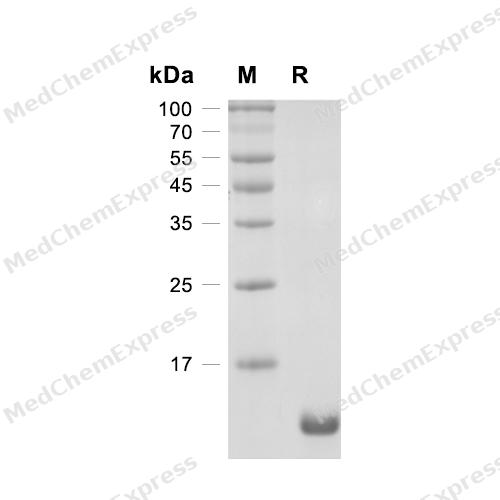
Purity - SDS-PAGE


Publications (1)
-
Journal Impact Factor
-
Most Recent
-
Stem Cells Dev
Human Neural Stem Cell Secretome Inhibits Neuron Heme Uptake and Ferroptosis in Intracerebral Hemorrhage through Nrf-2 Signaling Pathway. [Abstract]2023 Jun;32(11-12):346-363. PMID: 36960702


Technical Parameters
-
Species Human
-
Source E. coli
-
Tag N-His;N-6*His
-
Accession
P61604 (M1-D102)
-
Protein Length
Full Length
-
Synonyms
HSPE1; Heat Shock 10kD Protein 1 (Chaperonin 10); Heat Shock Protein Family E (Hsp10) Member 1; Heat Shock Protein Family E Member 1; Chaperonin 10; Heat Shock 10kDa Protein 1; CPN10; Early-Pregnancy Factor; EPF; Heat Shock 10kDa Protein 1 (Chaperonin 10)
-
AA Sequence
MAGQAFRKFLPLFDRVLVERSAAETVTKGGIMLPEKSQGKVLQATVVAVGSGSKGKGGEIQPVSVKVGDKVLLPEYGGTKVVLDDKDYFLFRDGDILGKYVD
-
Molecular Weight
Approximately 13 kDa.
-
Purity
≥ 95%, as determined by reducing SDS-PAGE.


Product Properties
Lyophilized powder.
Lyophilized from a 0.22 μm filtered solution of 50 mM Tris, 300 mM NaCl, 5% trehalose, 5% mannitol and 0.01% Tween 80, pH 7.4.
Note: For SPR assay, please replace the buffer. Primary amine components (e.g., Tris, imidazole) can affect protein-coupled chips.
<1 EU/μg, determined by LAL method.
It is not recommended to reconstitute to a concentration less than 100 μg/mL in ddH2O.
Stored at -20°C for 2 years from date of receipt. After reconstitution, it is stable at 4°C for 1 week or -20°C for longer (with carrier protein). It is recommended to freeze aliquots at -20°C or -80°C for extended storage.
Room temperature in continental US; may vary elsewhere.


Documentation
-
Data Sheet (235 KB)
-
SDS (251 KB)
- English - EN (251 KB)
- Français - FR (251 KB)
- Deutsch - DE (251 KB)
- Norwegian - NO (251 KB)
- Español - ES (251 KB)
- Swedish - SV (251 KB)
- Italian - IT (251 KB)
- Korean - KR (251 KB)
- Portuguese - PT (251 KB)
-
Handling Instructions (2659 KB)

Calculators
Concentration (start) × Volume (start) = Concentration (final) × Volume (final)


 Powered by Bioz

