



HSP27/HSPB1 Protein, Human (His)

Based on 1 Customer Validation
The HSP27/HSPB1 protein is a small heat shock protein that acts as a molecular chaperone, possibly maintaining denatured proteins in a foldable state. In addition to its chaperone role, it crucially enhances stress resistance and contributes to actin organization. HSP27/HSPB1 Protein, Human (His) is the recombinant human-derived HSP27/HSPB1 protein, expressed by E. coli , with C-His labeled tag.
- Species: Human
- Source: E. coli
-
Storage:Stored at -20°C for 2 years from date of receipt. After reconstitution, it is stable at 4°C for 1 week or -20°C for longer (with carrier protein). It is recommended to freeze aliquots at -20°C or -80°C for extended storage.


To place orders, for customer services and technical support, please contact: MedChemExpress USA
Tel: 609-228-6898 E-mail: [email protected] [email protected]


-
 Biological Activity
-
Technical Parameters
-
Product Properties
- Documentation
- Help & FAQs




Biological Activity
Description
The HSP27/HSPB1 protein is a small heat shock protein that acts as a molecular chaperone, possibly maintaining denatured proteins in a foldable state. In addition to its chaperone role, it crucially enhances stress resistance and contributes to actin organization. HSP27/HSPB1 Protein, Human (His) is the recombinant human-derived HSP27/HSPB1 protein, expressed by E. coli , with C-His labeled tag.
Background
HSP27/HSPB1, a small heat shock protein, serves as a molecular chaperone with a likely role in maintaining denatured proteins in a folding-competent state. Beyond its chaperone function, this protein plays a crucial role in stress resistance and contributes to actin organization. Its molecular chaperone activity is implicated in regulating various biological processes, including the phosphorylation and axonal transport of neurofilament proteins. HSP27/HSPB1 forms homooligomers and homodimers, the latter transitioning to a monomeric state upon activation. Additionally, it participates in heterooligomer formation with HSPB6. The protein interacts with alpha- and beta-tubulin, and it engages in molecular associations with TGFB1I1, CRYAB, HSPB8, and HSPBAP1, thereby contributing to a network of protein-protein interactions that underlie its diverse cellular functions.
MCE Validation Data
-
Purity - SDS-PAGE
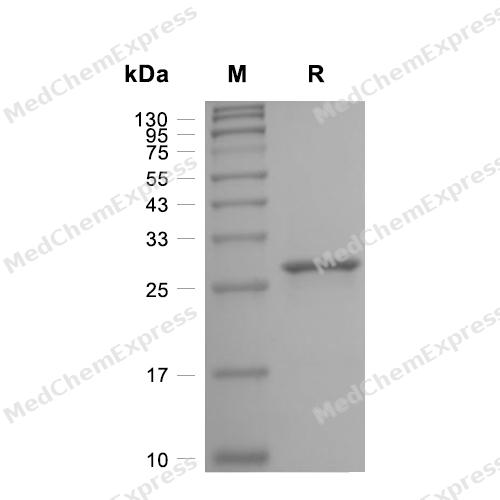
Purity - SDS-PAGE


Technical Parameters
-
Species Human
-
Source E. coli
-
Tag C-His
-
Accession
P04792/NP_001531.1 (M1-K205)
-
Molecular Construction
-
N-term
-
HSPB1 (M1-K205)
Accession # P04792/NP_001531.1 -
His
-
C-term
-
-
Protein Length
Full Length
-
Synonyms
HSPB1; Heat Shock 27kDa Protein 1; Heat Shock Protein Family B (Small) Member 1; Heat Shock 27kD Protein 1; HSP28; 28 KDa Heat Shock Protein; HSP27; SRP27; Heat Shock 27 KDa Protein; Putative Heat Shock Protein Family B Member 1 Isoform; Heat Shock Protei
-
AA Sequence
MTERRVPFSLLRGPSWDPFRDWYPHSRLFDQAFGLPRLPEEWSQWLGGSSWPGYVRPLPPAAIESPAVAAPAYSRALSRQLSSGVSEIRHTADRWRVSLDVNHFAPDELTVKTKDGVVEITGKHEERQDEHGYISRCFTRKYTLPPGVDPTQVSSSLSPEGTLTVEAPMPKLATQSNEITIPVTFESRAQLGGPEAAKSDETAAK
-
Molecular Weight
Approximately 26-28 kDa, based on SDS-PAGE under reducing conditions.
-
Purity
≥ 95%, as determined by reducing SDS-PAGE.


Product Properties
Lyophilized powder
1.Lyophilized from a 0.22 μm filtered solution of PBS, 2 mM DTT, pH 7.4, 8% trehalose.
2.Lyophilized from a 0.22 μm filtered solution of PBS, pH 7.4, 8% trehalose.
Please refer to the lot-specific COA for specific buffer information.
<1 EU/μg, determined by LAL method.
It is not recommended to reconstitute to a concentration less than 100 μg/mL in ddH2O. For long term storage it is recommended to add a carrier protein (0.1% BSA, 5% HSA, 10% FBS or 5% Trehalose).
Stored at -20°C for 2 years from date of receipt. After reconstitution, it is stable at 4°C for 1 week or -20°C for longer (with carrier protein). It is recommended to freeze aliquots at -20°C or -80°C for extended storage.
Room temperature in continental US; may vary elsewhere.


Documentation
-
Data Sheet (236 KB)
-
SDS (251 KB)
- English - EN (251 KB)
- Français - FR (251 KB)
- Deutsch - DE (251 KB)
- Norwegian - NO (251 KB)
- Español - ES (251 KB)
- Swedish - SV (251 KB)
- Italian - IT (251 KB)
- Korean - KR (251 KB)
- Portuguese - PT (251 KB)
-
Handling Instructions (2659 KB)

Calculators
Concentration (start) × Volume (start) = Concentration (final) × Volume (final)


 Powered by Bioz

