



IDO-1 Protein, Mouse (His)

Based on 1 Customer Validation
IDO Protein, an enzyme, is involved in the metabolism of tryptophan. Dysregulation of IDO Protein has been linked to immune escape mechanisms and tumor progression. Targeting IDO Protein may provide potential therapeutic interventions in cancer by modulating tryptophan metabolism, enhancing immune responses, and inhibiting tumor growth. IDO-1 Protein, Mouse (His) is the recombinant mouse-derived IDO protein, expressed by E. coli , with N-6*His labeled tag.
- Species: Mouse
- Source: E. coli
-
Storage:Stored at -80°C for 1 year from date of receipt. It is stable at -20°C for 3 months after opening. It is recommended to freeze aliquots at -80°C for extended storage. Avoid repeated freeze-thaw cycles.


To place orders, for customer services and technical support, please contact: MedChemExpress USA
Tel: 609-228-6898 E-mail: [email protected] [email protected]


-
 Biological Activity
-
Technical Parameters
-
Product Properties
- Documentation
- Help & FAQs




Biological Activity
Description
IDO Protein, an enzyme, is involved in the metabolism of tryptophan. Dysregulation of IDO Protein has been linked to immune escape mechanisms and tumor progression. Targeting IDO Protein may provide potential therapeutic interventions in cancer by modulating tryptophan metabolism, enhancing immune responses, and inhibiting tumor growth. IDO-1 Protein, Mouse (His) is the recombinant mouse-derived IDO protein, expressed by E. coli , with N-6*His labeled tag.
Background
The IDO protein serves as a key catalyst in initiating and regulating the catabolism of the essential amino acid tryptophan along the kynurenine pathway. Its pivotal role extends beyond metabolism, encompassing active participation in peripheral immune tolerance to maintain homeostasis by averting autoimmunity and immunopathology arising from unbridled immune responses. Notably, a shortage of tryptophan impedes T lymphocyte division, while the accumulation of tryptophan catabolites induces T-cell apoptosis and fosters the differentiation of regulatory T-cells. Additionally, IDO functions as a potent suppressor of anti-tumor immunity and plays a crucial role in limiting the growth of intracellular pathogens by depriving them of tryptophan. Furthermore, IDO is integral to safeguarding the fetus from maternal immune rejection, highlighting its diverse contributions to immune regulation and cellular equilibrium.
Verified Bioactivity
Measured by its ability to oxidize L-tryptophan to N-formyl-kynurenine that incubate at room temperature for 5 minutes. The specific activity is >1000 pmol/min/µg.
MCE Validation Data
-
Purity - SDS-PAGE
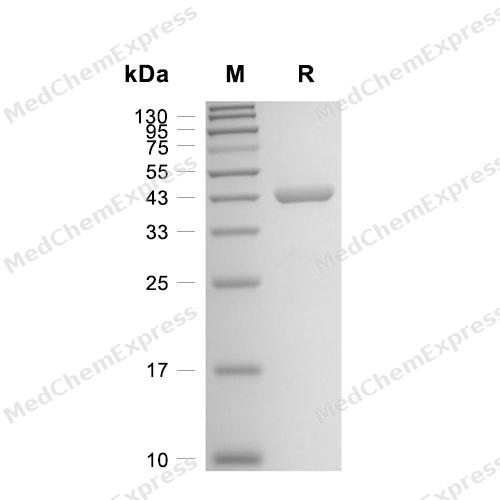
Purity - SDS-PAGE


Technical Parameters
-
Species Mouse
-
Source E. coli
-
Tag N-6*His
-
Accession
P28776 (M1-P407)
-
Protein Length
Full Length
-
Synonyms
IDO1; Indoleamine-Pyrrole 2,3-Dioxygenase; Prev. INDO; Indolamine 2,3 Dioxygenase; Prev. IDO; Indole 2,3-Dioxygenase; IDO-1; Indoleamine 2,3-Dioxygenase 1; Indoleamine-Pyrrole 2,3 Dioxygenase
-
AA Sequence
MALSKISPTEGSRRILEDHHIDEDVGFALPHPLVELPDAYSPWVLVARNLPVLIENGQLREEVEKLPTLSTDGLRGHRLQRLAHLALGYITMAYVWNRGDDDVRKVLPRNIAVPYCELSEKLGLPPILSYADCVLANWKKKDPNGPMTYENMDILFSFPGGDCDKGFFLVSLLVEIAASPAIKAIPTVSSAVERQDLKALEKALHDIATSLEKAKEIFKRMRDFVDPDTFFHVLRIYLSGWKCSSKLPEGLLYEGVWDTPKMFSGGSAGQSSIFQSLDVLLGIKHEAGKESPAEFLQEMREYMPPAHRNFLFFLESAPPVREFVISRHNEDLTKAYNECVNGLVSVRKFHLAIVDTYIMKPSKKKPTDGDKSEEPSNVESRGTGGTNPMTFLRSVKDTTEKALLSWP
-
Molecular Weight
Approximately 40-50 kDa, based on SDS-PAGE under reducing conditions.
-
Purity
≥ 95%, as determined by reducing SDS-PAGE.


Product Properties
Solution
1.Supplied as a 0.22 μm filtered solution of PBS, pH 7.4.
2.Supplied as a 0.22 μm filtered solution of 20 mM Tris-HCl, 500 mM NaCl, 0.01% Tween 80, 1 mM EDTA, 50% Glycerol,pH 8.0.
3.Supplied as a 0.22 μm filtered solution of 20 mM NaAc, 150 mM NaCl, pH 5.5, 20% Glycerol.
Note: For SPR assay, please replace the buffer. Primary amine components (e.g., Tris, imidazole) can affect protein-coupled chips.
<1 EU/μg, determined by LAL method.
Stored at -80°C for 1 year from date of receipt. It is stable at -20°C for 3 months after opening. It is recommended to freeze aliquots at -80°C for extended storage. Avoid repeated freeze-thaw cycles.
Shipping with dry ice.


Documentation
-
Data Sheet (238 KB)
-
SDS (252 KB)
- English - EN (252 KB)
- Français - FR (252 KB)
- Deutsch - DE (252 KB)
- Norwegian - NO (252 KB)
- Español - ES (252 KB)
- Swedish - SV (252 KB)
- Italian - IT (252 KB)
- Korean - KR (252 KB)
- Portuguese - PT (252 KB)
-
Handling Instructions (2659 KB)

Calculators
Concentration (start) × Volume (start) = Concentration (final) × Volume (final)


 Powered by Bioz

