



IMPA3 Protein, Mouse (HEK293, His)
Based on 1 Customer Validation
IMPA3 protein has 3'-nucleotidase activity and can hydrolyze PAP into AMP and phosphate. This function suggests a role in the formation of bone components during endochondral ossification by scavenging PAP produced by Golgi sulfotransferases. IMPA3 Protein, Mouse (HEK293, His) is the recombinant mouse-derived IMPA3 protein, expressed by HEK293 , with N-6*His labeled tag.
- Species: Mouse
- Source: HEK293
-
Storage:Stored at -80°C for 1 year from date of receipt. It is stable at -20°C for 3 months after opening. It is recommended to freeze aliquots at -80°C for extended storage. Avoid repeated freeze-thaw cycles.


To place orders, for customer services and technical support, please contact: MedChemExpress USA
Tel: 609-228-6898 E-mail: [email protected] [email protected]


-
 Biological Activity
-
Technical Parameters
-
Product Properties
- Documentation
- Help & FAQs




Biological Activity
Description
IMPA3 protein has 3'-nucleotidase activity and can hydrolyze PAP into AMP and phosphate. This function suggests a role in the formation of bone components during endochondral ossification by scavenging PAP produced by Golgi sulfotransferases. IMPA3 Protein, Mouse (HEK293, His) is the recombinant mouse-derived IMPA3 protein, expressed by HEK293 , with N-6*His labeled tag.
Background
IMPA3 protein demonstrates 3'-nucleotidase activity, specifically hydrolyzing adenosine 3',5'-bisphosphate (PAP) into adenosine 5'-monophosphate (AMP) and a phosphate. This enzymatic function suggests a potential role in the formation of skeletal elements derived through endochondral ossification, possibly by clearing adenosine 3',5'-bisphosphate produced by Golgi sulfotransferases during glycosaminoglycan sulfation. Notably, IMPA3 exhibits no activity toward 3'-phosphoadenosine 5'-phosphosulfate (PAPS) or inositol phosphate (IP) substrates, including I(1)P, I(1,4)P2, I(1,3,4)P3, I(1,4,5)P3, and I(1,3,4,5)P4. The selective enzymatic profile of IMPA3 underscores its specific involvement in nucleotide metabolism and its potential regulatory role in skeletal development processes.
Verified Bioactivity
The enzyme activity of this recombinant protein is testing in progress, we cannot offer a guarantee yet.
MCE Validation Data
-
Purity - SDS-PAGE
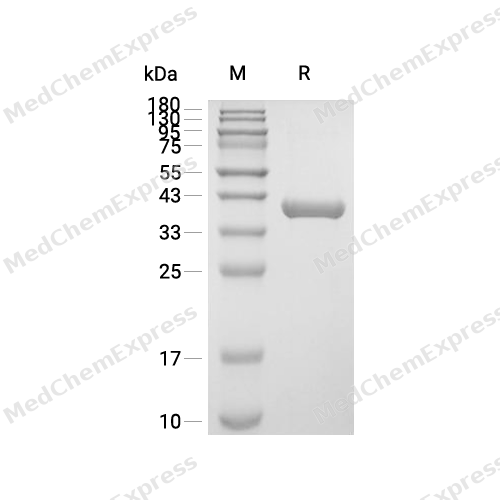
Purity - SDS-PAGE


Technical Parameters
-
Species Mouse
-
Source HEK293
-
Tag N-6*His
-
Accession
Q80V26 (E51-H356)
-
Gene ID242291 [NCBI]
-
Molecular Construction
-
N-term
-
6*His
-
IMPA3 (E51-H356)
Accession # Q80V26 -
C-term
-
-
Protein Length
Partial
-
Synonyms
BPNT2; Myo-Inositol Monophosphatase A3; Prev. IMPAD1; FLJ20421; IMPA3; Golgi 3-Prime Phosphoadenosine 5-Prime Phosphate 3-Prime Phosphatase; GPAPP; 3'(2'),5'-Bisphosphate Nucleotidase; Golgi-Resident Adenosine 3',5'-Bisphosphate 3'-Phosphatase; Inositol-1
-
AA Sequence
EVASDGGTVDLREMLAVAVLAAERGGDEVRRVRESNVLHEKSKGKTREGADDKMTSGDVLSNRKMFYLLKTAFPNVQINTEEHVDASDKEVIVWNRKIPEDILKEIAAPKEVPAESVTVWIDPLDATQEYTEDLRKYVTTMVCVAVNGKPVLGVIHKPFSEYTAWAMVDGGSNVKARSSYNEKTPKIIVSRSHAGMVKQVALQTFGNQTSIIPAGGAGYKVLALLDVPDMTQEKADLYIHVTYIKKWDICAGNAILKALGGHMTTLNGEEISYTGSDGIEGGLLASIRMNHQALVRKLPDLEKSGH
-
Predicted Molecular Mass
34.3 kDa
-
Molecular Weight
Approximately 38 kDa, based on SDS-PAGE under reducing conditions.
-
Glycosylation
Yes
-
Purity
≥ 95%, as determined by reducing SDS-PAGE.


Product Properties
Solution
Supplied as a 0.22 μm filtered solution of 50 mM Tris-HCl, 150 mM NaCl, 10% glycerol, pH 7.5.
Note: For SPR assay, please replace the buffer. Primary amine components (e.g., Tris, imidazole) can affect protein-coupled chips.
<1 EU/μg, determined by LAL method.
Stored at -80°C for 1 year from date of receipt. It is stable at -20°C for 3 months after opening. It is recommended to freeze aliquots at -80°C for extended storage. Avoid repeated freeze-thaw cycles.
Shipping with dry ice.


Documentation
-
Data Sheet (237 KB)
-
SDS (251 KB)
- English - EN (251 KB)
- Français - FR (251 KB)
- Deutsch - DE (251 KB)
- Norwegian - NO (251 KB)
- Español - ES (251 KB)
- Swedish - SV (251 KB)
- Italian - IT (251 KB)
- Korean - KR (251 KB)
- Portuguese - PT (251 KB)
-
Handling Instructions (2659 KB)

Calculators
Concentration (start) × Volume (start) = Concentration (final) × Volume (final)


 Powered by Bioz

