



IRF5 Protein, Human (His)
Based on 1 publication(s) in Google Scholar
The IRF5 protein is a key transcription factor in innate immunity and activates type I interferon (IFN) and inflammatory cytokine genes through endolysosomal Toll-like receptors (TLR7, TLR8, TLR9). It regulates IFN genes and IFN-stimulated genes (ISGs) by binding to ISREs in their promoters. IRF5 Protein, Human (His) is the recombinant human-derived IRF5 protein, expressed by E. coli , with C-6*His labeled tag.
- Species: Human
- Source: E. coli
-
Storage:Stored at -20°C for 2 years from date of receipt. After reconstitution, it is stable at 4°C for 1 week or -20°C for longer (with carrier protein). It is recommended to freeze aliquots at -20°C or -80°C for extended storage.


To place orders, for customer services and technical support, please contact: MedChemExpress USA
Tel: 609-228-6898 E-mail: [email protected] [email protected]


-
 Biological Activity
-
Technical Parameters
-
Product Properties
- Documentation
- Help & FAQs




Biological Activity
Description
The IRF5 protein is a key transcription factor in innate immunity and activates type I interferon (IFN) and inflammatory cytokine genes through endolysosomal Toll-like receptors (TLR7, TLR8, TLR9). It regulates IFN genes and IFN-stimulated genes (ISGs) by binding to ISREs in their promoters. IRF5 Protein, Human (His) is the recombinant human-derived IRF5 protein, expressed by E. coli , with C-6*His labeled tag.
Background
IRF5, a critical transcription factor, assumes a pivotal role in innate immunity by orchestrating the activation of type I interferon (IFN) genes, including IFNA and INFB, and inflammatory cytokines downstream of endolysosomal toll-like receptors (TLR7, TLR8, and TLR9). It functions as a key regulator in the transcription of type I IFN genes and IFN-stimulated genes (ISG) by binding to the interferon-stimulated response element (ISRE) in their promoters. Notably, IRF5 efficiently activates both IFN-beta (IFNB) and IFN-alpha (IFNA) genes, mediating their induction through the TLR-activated, MyD88-dependent pathway. Particularly relevant in the context of SARS-CoV-2 infection, IRF5 stands out as a significant transcriptional regulator of the IFN response. Maintained as a monomer in an autoinhibited state, its activation involves phosphorylation facilitated by the innate adapter protein TASL, which recruits IRF5, licensing it for phosphorylation by IKBKB. Subsequent steps involve the dissociation of phosphorylated IRF5 from adapter proteins, its dimerization, and nuclear entry to induce IFNs.
Verified Bioactivity
Immobilized Human IRF5 at 10 μg/mL (100μL/well) can bind Anti-IRF5 Polyclonal antibody. The ED50 for this effect is <0.1 μg/mL.
MCE Validation Data
-
Purity - SDS-PAGE
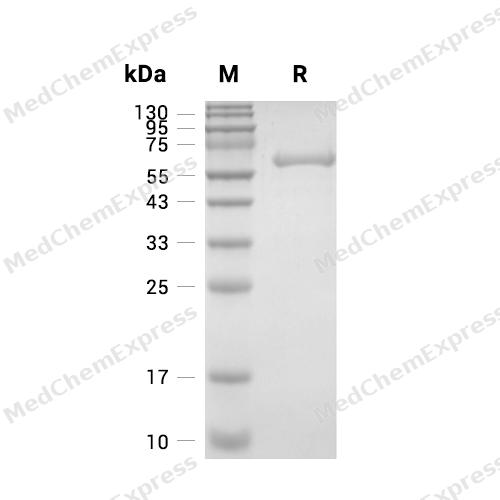
Purity - SDS-PAGE
-
Bioactivity - ELISA
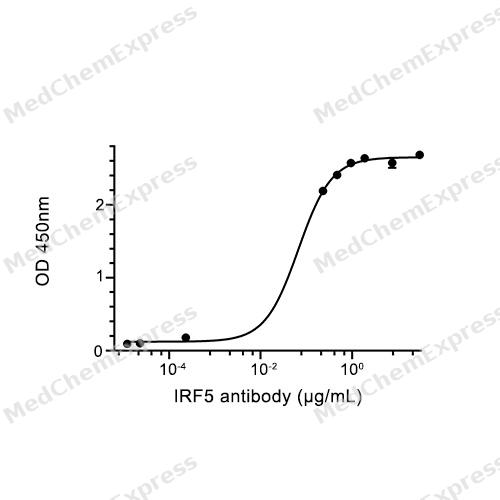
Bioactivity - ELISA


Publications (1)
-
Journal Impact Factor
-
Most Recent
-
J Ethnopharmacol
Sinomenine restrains the proliferation and hyperactivation of B lymphocytes partly by inhibiting interferon regulatory factor 5. [Abstract]2026 Nov 15:370:122034. PMID: 42288163


Technical Parameters
-
Species Human
-
Source E. coli
-
Tag C-6*His
-
Accession
Q13568-1 (M1-Q498)
-
Gene ID3663
-
Molecular Construction
-
N-term
-
IRF5 (M1-Q498)
Accession # Q13568-1 -
6*His
-
C-term
-
-
Protein Length
Full Length of Isoform-1
-
Synonyms
IRF5; Interferon Regulatory Factor 5 Transcript Variant 15; Interferon Regulatory Factor 5; Interferon Regulatory Factor 5 Transcript Variant 17; IRF-5; Interferon Regulatory Factor 5 Variant 7; Interferon Regulatory Factor 5 Transcript Variant 16; Interf
-
AA Sequence
MNQSIPVAPTPPRRVRLKPWLVAQVNSCQYPGLQWVNGEKKLFCIPWRHATRHGPSQDGDNTIFKAWAKETGKYTEGVDEADPAKWKANLRCALNKSRDFRLIYDGPRDMPPQPYKIYEVCSNGPAPTDSQPPEDYSFGAGEEEEEEEELQRMLPSLSLTEDVKWPPTLQPPTLRPPTLQPPTLQPPVVLGPPAPDPSPLAPPPGNPAGFRELLSEVLEPGPLPASLPPAGEQLLPDLLISPHMLPLTDLEIKFQYRGRPPRALTISNPHGCRLFYSQLEATQEQVELFGPISLEQVRFPSPEDIPSDKQRFYTNQLLDVLDRGLILQLQGQDLYAIRLCQCKVFWSGPCASAHDSCPNPIQREVKTKLFSLEHFLNELILFQKGQTNTPPPFEIFFCFGEEWPDRKPREKKLITVQVVPVAARLLLEMFSGELSWSADSIRLQISNPDLKDRMVEQFKELHHIWQSQQRLQPVAQAPPGAGLGVGQGPWPMHPAGMQ
-
Predicted Molecular Mass
56.9 kDa
-
Molecular Weight
Approximately 58 kDa, based on SDS-PAGE under reducing conditions.
-
Purity
≥ 95%, as determined by reducing SDS-PAGE.


Product Properties
Lyophilized powder
Lyophilized from a 0.22 μm filtered solution of PBS, pH 7.4, 8% trehalose.
<1 EU/μg, determined by LAL method.
It is not recommended to reconstitute to a concentration less than 100 μg/mL in ddH2O.
Stored at -20°C for 2 years from date of receipt. After reconstitution, it is stable at 4°C for 1 week or -20°C for longer (with carrier protein). It is recommended to freeze aliquots at -20°C or -80°C for extended storage.
Room temperature in continental US; may vary elsewhere.


Documentation
-
Data Sheet (238 KB)
-
SDS (251 KB)
- English - EN (251 KB)
- Français - FR (251 KB)
- Deutsch - DE (251 KB)
- Norwegian - NO (251 KB)
- Español - ES (251 KB)
- Swedish - SV (251 KB)
- Italian - IT (251 KB)
- Korean - KR (251 KB)
- Portuguese - PT (251 KB)
-
Handling Instructions (2659 KB)

Calculators
Concentration (start) × Volume (start) = Concentration (final) × Volume (final)


 Powered by Bioz

