



KEAP1 Protein, Human (sf9, His-GST)
Based on 1 publication(s) in Google Scholar
KEAP1 in the BCR E3 ubiquitin ligase complex complex regulates cellular responses to oxidative stress by ubiquitinating NFE2L2/NRF2. As an oxidative stress sensor, KEAP1 normally promotes NFE2L2/NRF2 degradation. KEAP1 Protein, Human (sf9, His-GST) is the recombinant human-derived KEAP1 protein, expressed by Sf9 insect cells , with N-His, N-GST labeled tag.
- Species: Human
- Source: Sf9 insect cells
-
Storage:Stored at -80°C for 1 year from date of receipt. It is stable at -20°C for 3 months after opening. It is recommended to freeze aliquots at -80°C for extended storage. Avoid repeated freeze-thaw cycles.


To place orders, for customer services and technical support, please contact: MedChemExpress USA
Tel: 609-228-6898 E-mail: [email protected] [email protected]


-
 Biological Activity
-
Technical Parameters
-
Product Properties
- Documentation
- Help & FAQs




Biological Activity
Description
KEAP1 in the BCR E3 ubiquitin ligase complex complex regulates cellular responses to oxidative stress by ubiquitinating NFE2L2/NRF2. As an oxidative stress sensor, KEAP1 normally promotes NFE2L2/NRF2 degradation. KEAP1 Protein, Human (sf9, His-GST) is the recombinant human-derived KEAP1 protein, expressed by Sf9 insect cells , with N-His, N-GST labeled tag.
Background
KEAP1, as the substrate-specific adapter within the BCR (BTB-CUL3-RBX1) E3 ubiquitin ligase complex, intricately regulates the cellular response to oxidative stress by orchestrating the ubiquitination of NFE2L2/NRF2. Serving as a crucial sensor for oxidative and electrophilic stress, KEAP1, under normal conditions, facilitates the ubiquitination and subsequent degradation of NFE2L2/NRF2, a transcription factor essential for the expression of numerous cytoprotective genes. When confronted with oxidative stress, distinct electrophile metabolites induce non-enzymatic covalent modifications on highly reactive cysteine residues in KEAP1, effectively dampening the ubiquitin ligase activity of the BCR(KEAP1) complex. This disruption promotes the nuclear accumulation of NFE2L2/NRF2 and triggers the expression of phase II detoxifying enzymes. Furthermore, selective autophagy leads to the sequestration of KEAP1 in inclusion bodies through its interaction with SQSTM1/p62, resulting in the inactivation of the BCR(KEAP1) complex and the activation of NFE2L2/NRF2. Notably, the BCR(KEAP1) complex extends its ubiquitin ligase activity to substrates like SQSTM1/p62, BPTF, and PGAM5, modulating their degradation via the proteasome. The ubiquitin ligase activity of the BCR(KEAP1) complex faces inhibition in response to oxidative stress and electrophile metabolites such as sulforaphane, as these metabolites react with reactive cysteine residues in KEAP1, leading to the non-enzymatic covalent modifications that incapacitate the complex. Moreover, selective autophagy contributes to the inactivation of the BCR(KEAP1) complex through the interaction between KEAP1 and SQSTM1/p62, promoting the sequestration of the complex in inclusion bodies and facilitating its degradation.
MCE Validation Data
-
Purity - SDS-PAGE
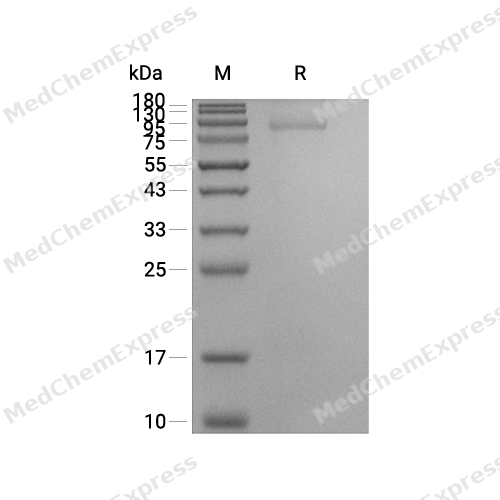
Purity - SDS-PAGE


Publications (1)
-
Journal Impact Factor
-
Most Recent
-
Phytomedicine
Salvianolic acid B attenuates drug-induced liver injury in an Nrf2-dependent mechanism via covalently modifying Keap1 at Cys395/Cys434. [Abstract]2026 Jun 11:159:158413. PMID: 42314351


Technical Parameters
-
Species Human
-
Source Sf9 insect cells
-
Tag N-His;N-GST
-
Accession
Q14145 (Q2-C624)
-
Molecular Construction
-
N-term
-
His-GST
-
KEAP1 (Q2-C624)
Accession # Q14145 -
C-term
-
-
Protein Length
Full Length
-
Synonyms
KEAP1; Kelch-Like Protein 19; Kelch Like ECH Associated Protein 1; MGC10630; KLHL19; MGC20887; INrf2; MGC1114; Kelch-Like ECH-Associated Protein 1; MGC4407; KIAA0132; MGC9454; Kelch-Like Family Member 19; KEAP1 Delta C; Cytosolic Inhibitor Of Nrf2; INRF2
-
AA Sequence
QPDPRPSGAGACCRFLPLQSQCPEGAGDAVMYASTECKAEVTPSQHGNRTFSYTLEDHTKQAFGIMNELRLSQQLCDVTLQVKYQDAPAAQFMAHKVVLASSSPVFKAMFTNGLREQGMEVVSIEGIHPKVMERLIEFAYTASISMGEKCVLHVMNGAVMYQIDSVVRACSDFLVQQLDPSNAIGIANFAEQIGCVELHQRAREYIYMHFGEVAKQEEFFNLSHCQLVTLISRDDLNVRCESEVFHACINWVKYDCEQRRFYVQALLRAVRCHSLTPNFLQMQLQKCEILQSDSRCKDYLVKIFEELTLHKPTQVMPCRAPKVGRLIYTAGGYFRQSLSYLEAYNPSDGTWLRLADLQVPRSGLAGCVVGGLLYAVGGRNNSPDGNTDSSALDCYNPMTNQWSPCAPMSVPRNRIGVGVIDGHIYAVGGSHGCIHHNSVERYEPERDEWHLVAPMLTRRIGVGVAVLNRLLYAVGGFDGTNRLNSAECYYPERNEWRMITAMNTIRSGAGVCVLHNCIYAAGGYDGQDQLNSVERYDVETETWTFVAPMKHRRSALGITVHQGRIYVLGGYDGHTFLDSVECYDPDTDTWSEVTRMTSGRSGVGVAVTMEPCRKQIDQQNCTC
-
Predicted Molecular Mass
97.4 kDa
-
Molecular Weight
Approximately 109 kDa, based on SDS-PAGE under reducing conditions.
-
Purity
≥ 90%, as determined by reducing SDS-PAGE.


Product Properties
Solution
Supplied as a 0.22 μm filtered solution of 20 mM Tris, 300 mM NaCl, 10% Glycerol, pH 7.5.
Note: For SPR assay, please replace the buffer. Primary amine components (e.g., Tris, imidazole) can affect protein-coupled chips.
<1 EU/μg, determined by LAL method.
Stored at -80°C for 1 year from date of receipt. It is stable at -20°C for 3 months after opening. It is recommended to freeze aliquots at -80°C for extended storage. Avoid repeated freeze-thaw cycles.
Shipping with dry ice.


Documentation
-
Data Sheet (239 KB)
-
SDS (252 KB)
- English - EN (252 KB)
- Français - FR (252 KB)
- Deutsch - DE (252 KB)
- Norwegian - NO (252 KB)
- Español - ES (252 KB)
- Swedish - SV (252 KB)
- Italian - IT (252 KB)
- Korean - KR (252 KB)
- Portuguese - PT (252 KB)
-
Handling Instructions (2659 KB)

Calculators
Concentration (start) × Volume (start) = Concentration (final) × Volume (final)


 Powered by Bioz

