



Kininogen-1 Protein, Mouse (HEK293, His)
Based on 1 Customer Validation
Together with endopeptidase inhibitor, protease, and signaling receptor binding activities, the Kininogen-1 protein is predicted to play a critical role in antimicrobial response, coagulation regulation, and control of endopeptidase activity.Kininogen-1 is located in the collagen-containing matrix and shows biased expression, particularly in the liver at embryonic (E18) and adult stages (RPKM 646.0 and 179.1).Kininogen-1 Protein, Mouse (HEK293, His) is the recombinant mouse-derived Kininogen-1 protein, expressed by HEK293 , with C-His labeled tag.
- Species: Mouse
- Source: HEK293
-
Storage:Stored at -20°C for 2 years from date of receipt. After reconstitution, it is stable at 4°C for 1 week or -20°C for longer (with carrier protein). It is recommended to freeze aliquots at -20°C or -80°C for extended storage.


To place orders, for customer services and technical support, please contact: MedChemExpress USA
Tel: 609-228-6898 E-mail: [email protected] [email protected]


-
 Biological Activity
-
Technical Parameters
-
Product Properties
- Documentation
- Help & FAQs




Biological Activity
Description
Together with endopeptidase inhibitor, protease, and signaling receptor binding activities, the Kininogen-1 protein is predicted to play a critical role in antimicrobial response, coagulation regulation, and control of endopeptidase activity.Kininogen-1 is located in the collagen-containing matrix and shows biased expression, particularly in the liver at embryonic (E18) and adult stages (RPKM 646.0 and 179.1).Kininogen-1 Protein, Mouse (HEK293, His) is the recombinant mouse-derived Kininogen-1 protein, expressed by HEK293 , with C-His labeled tag.
Background
Kininogen-1 Protein, with predicted functions including cysteine-type endopeptidase inhibitor activity, protease binding activity, and signaling receptor binding activity, plays a crucial role in various biological processes. Its involvement spans antimicrobial humoral immune responses, negative regulation of blood coagulation, and the negative regulation of endopeptidase activity. Situated in the collagen-containing extracellular matrix, Kininogen-1 demonstrates a biased expression pattern, with notable levels in the liver at both embryonic (E18) and adult stages (RPKM 646.0 and 179.1, respectively), highlighting its significance in hepatic functions across different developmental stages.
Verified Bioactivity
Measured by its ability to inhibit papain cleavage of a fluorogenic peptide substrate Z-FR-AMC (HY-P1759B). The IC50 value is 1-3 nM that incubate at 37°C for 15 minutes. (Activation description: The proenzyme needs to be activated in reducing buffer for an activated form.)
MCE Validation Data
-
Purity - SDS-PAGE
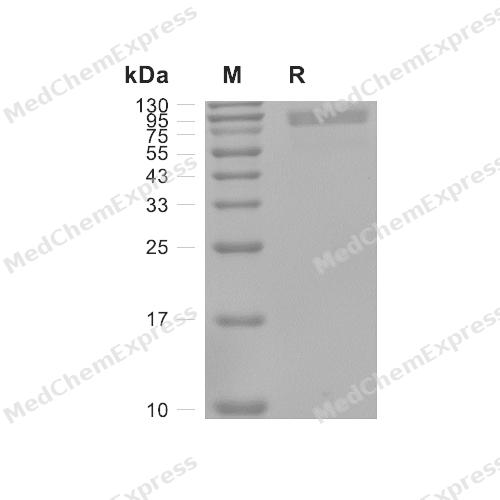
Purity - SDS-PAGE


Technical Parameters
-
Species Mouse
-
Source HEK293
-
Tag C-10*His
-
Accession
NP_001095882.1 (E21-S480)
-
Molecular Construction
-
N-term
-
Kininogen-1 (E21-S480)
Accession # NP_001095882.1 -
10*His
-
C-term
-
-
Protein Length
Full Length of Mature Protein
-
Synonyms
KNG1; Fitzgerald Factor; Prev. BDK; Bradykinin; Prev. KNG; CDNA FLJ56836, Highly Similar To Kininogen-1; Prev. HK; High-Molecular-Weight Kininogen; HMWK; Kininogen 1, Isoform CRA_b; Alpha-2-Thiol Proteinase Inhibitor; KNG1 Protein; BK; Kininogen; Williams
-
AA Sequence
EEAQEIDCNDEAVFQAVDFSLKQFNPGVKSGNQYMLHRVIEGTKTDGSPTFYSFKYLIKEGNCSAQSGLAWQDCDFKDAEEAATGECTATVGKRENEFFIVTQTCKIAPSKAPILKAYFPCIGCVHAISTDSPDLEPVLKHSIEHFNNNTDHSHLFTLRKVKSAHRQVVAGLNFDITYTIVQTNCSKERFPSLHGDCVALPNGDDGECRGNLFMDINNKIANFSQSCTLYSGDDLVEALPKPCPGCPRDIPVDSPELKEVLGHSIAQLNAENDHPFYYKIDTVKKATSQVVAGTKYVIEFIARETKCSKESNTELAEDCEIKHLGQSLDCNANVYMRPWENKVVPTVKCQALDMTEMARRPPGFSPFRSVTVQETKEGRTDSDFIEDVVATTPPYDTGAHDDLIPDIHVQPDSLSFKLISDFPEATSPKCPGRPWKPASWKDPNTETTEFSDFDLLDALS
-
Molecular Weight
Approximately 70-80 kDa, based on SDS-PAGE under reducing conditions, due to the glycosylation.
-
Purity
≥ 95%, as determined by reducing SDS-PAGE.


Product Properties
Lyophilized powder
Lyophilized from a 0.22 μm filtered solution of 20 mM Tris, 50 mM NaCl, pH 7.5.
Note: For SPR assay, please replace the buffer. Primary amine components (e.g., Tris, imidazole) can affect protein-coupled chips.
<1 EU/μg, determined by LAL method.
It is not recommended to reconstitute to a concentration less than 100 μg/mL in ddH2O. For long term storage it is recommended to add a carrier protein (0.1% BSA, 5% HSA, 10% FBS or 5% Trehalose).
Stored at -20°C for 2 years from date of receipt. After reconstitution, it is stable at 4°C for 1 week or -20°C for longer (with carrier protein). It is recommended to freeze aliquots at -20°C or -80°C for extended storage.
Room temperature in continental US; may vary elsewhere.


Documentation
-
Data Sheet (239 KB)
-
SDS (254 KB)
- English - EN (254 KB)
- Français - FR (254 KB)
- Deutsch - DE (254 KB)
- Norwegian - NO (254 KB)
- Español - ES (254 KB)
- Swedish - SV (254 KB)
- Italian - IT (254 KB)
- Korean - KR (254 KB)
- Portuguese - PT (254 KB)
-
Handling Instructions (2659 KB)

Calculators
Concentration (start) × Volume (start) = Concentration (final) × Volume (final)


 Powered by Bioz

