



LRP-11 Protein, Human (HEK293, His)

Based on 1 Customer Validation
Low-density lipoprotein receptor-related protein 11 is a member of LRP family and it acts as a tumour promoter in cervical cancer. Low-density lipoprotein receptor-related protein 11 enables phosphoprotein binding activity. LRP-11 Protein, Human (HEK293, His) is the recombinant human-derived LRP-11 protein, expressed by HEK293 , with C-His labeled tag.
- Species: Human
- Source: HEK293
-
Storage:Stored at -20°C for 2 years from date of receipt. After reconstitution, it is stable at 4°C for 1 week or -20°C for longer (with carrier protein). It is recommended to freeze aliquots at -20°C or -80°C for extended storage.


To place orders, for customer services and technical support, please contact: MedChemExpress USA
Tel: 609-228-6898 E-mail: [email protected] [email protected]


-
 Biological Activity
-
Technical Parameters
-
Product Properties
- Documentation
- Help & FAQs




Biological Activity
Description
Low-density lipoprotein receptor-related protein 11 is a member of LRP family and it acts as a tumour promoter in cervical cancer. Low-density lipoprotein receptor-related protein 11 enables phosphoprotein binding activity. LRP-11 Protein, Human (HEK293, His) is the recombinant human-derived LRP-11 protein, expressed by HEK293 , with C-His labeled tag.
Background
Low density lipoprotein receptor-related protein 11 (Lrp11) gene is highly expressed in the amygdala and hippocampus, two main brain regions involved in stress response, and its expression is significantly correlated with some stress related phenotypes based on our genetic correlation analysis using phenotype database of the BXD RI strains. Lrp11 enables phosphoprotein binding and involved in multicellular organismal response to stress[1][2][3].
MCE Validation Data
-
Purity - SDS-PAGE
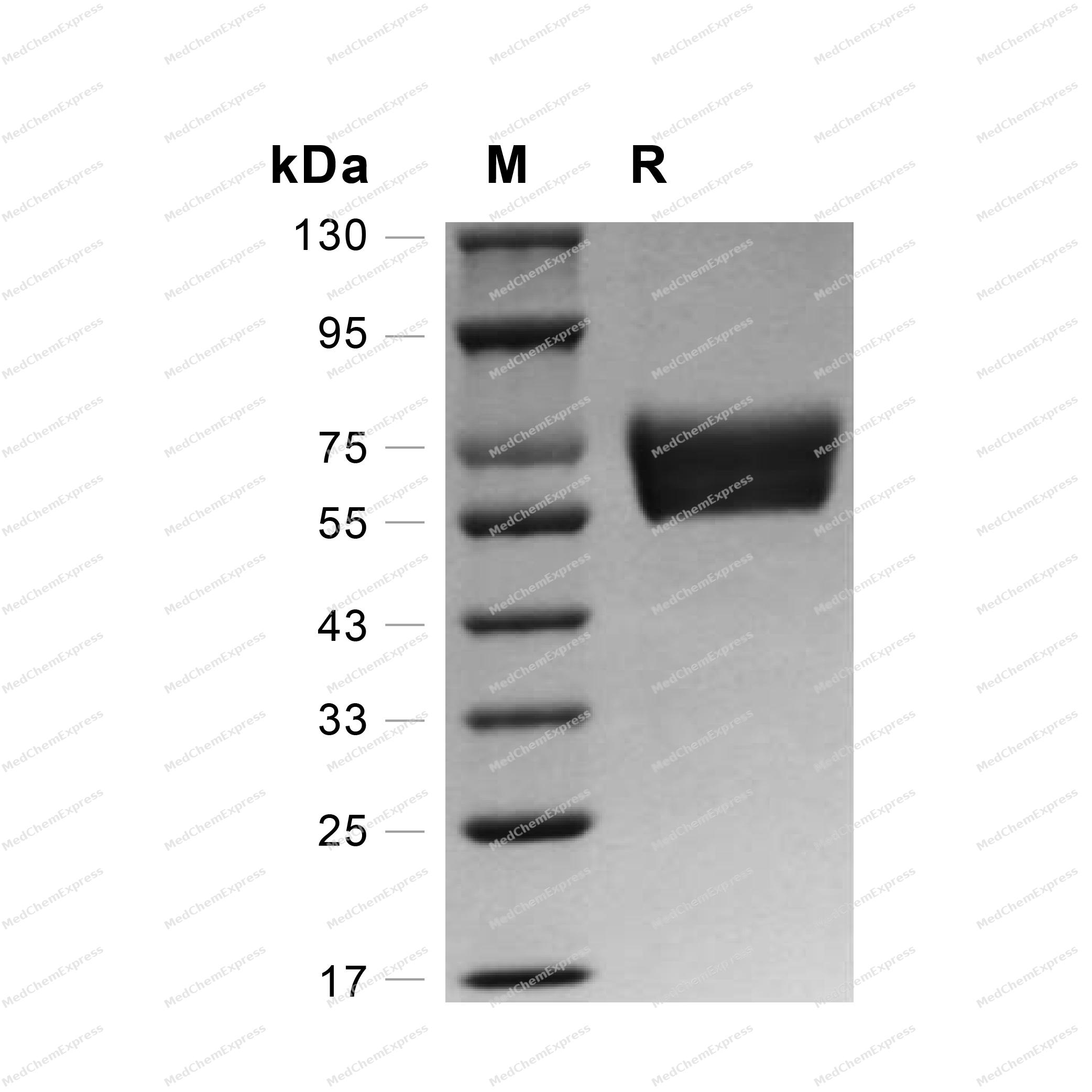
Purity - SDS-PAGE


Technical Parameters
-
Species Human
-
Source HEK293
-
Tag C-His
-
Accession
Q86VZ4 (A38-G450)
-
Molecular Construction
-
N-term
-
LRP-11 (A38-G450)
Accession # Q86VZ4 -
His
-
C-term
-
-
Protein Length
Extracellular Domain
-
Synonyms
LRP11; Low-Density Lipoprotein Receptor-Related Protein 11; LDL Receptor Related Protein 11; LRP-11; BA350J20.3; Low Density Lipoprotein Receptor-Related Protein 11; MANSC3; LRP11 Protein
-
AA Sequence
ALPPAAPLSELHAQLSGVEQLLEEFRRQLQQERPQEELELELRAGGGPQEDCPGPGSGGYSAMPDAIIRTKDSLAAGASFLRAPAAVRGWRQCVAACCSEPRCSVAVVELPRRPAPPAAVLGCYLFNCTARGRNVCKFALHSGYSSYSLSRAPDGAALATARASPRQEKDAPPLSKAGQDVVLHLPTDGVVLDGRESTDDHAIVQYEWALLQGDPSVDMKVPQSGTLKLSHLQEGTYTFQLTVTDTAGQRSSDNVSVTVLRAAYSTGGCLHTCSRYHFFCDDGCCIDITLACDGVQQCPDGSDEDFCQNLGLDRKMVTHTAASPALPRTTGPSEDAGGDSLVEKSQKATAPNKPPALSNTEKRNHSAFWGPESQIIPVMPDSSSSGKNRKEESYIFESKGDGGGGEHPAPETG
-
Molecular Weight
Approximately 51-65 kDa, based on SDS-PAGE under reducing conditions, due to the glycosylation.
-
Purity
≥ 95%, as determined by reducing SDS-PAGE.


Product Properties
Lyophilized powder.
Lyophilized from a 0.22 μm filtered solution of PBS, pH 7.4.
<1 EU/μg, determined by LAL method.
It is not recommended to reconstitute to a concentration less than 100 μg/mL in ddH2O. For long term storage it is recommended to add a carrier protein (0.1% BSA, 5% HSA, 10% FBS or 5% Trehalose).
Stored at -20°C for 2 years from date of receipt. After reconstitution, it is stable at 4°C for 1 week or -20°C for longer (with carrier protein). It is recommended to freeze aliquots at -20°C or -80°C for extended storage.
Room temperature in continental US; may vary elsewhere.


Documentation
-
Data Sheet (237 KB)
-
SDS (251 KB)
- English - EN (251 KB)
- Français - FR (251 KB)
- Deutsch - DE (251 KB)
- Norwegian - NO (251 KB)
- Español - ES (251 KB)
- Swedish - SV (251 KB)
- Italian - IT (251 KB)
- Korean - KR (251 KB)
- Portuguese - PT (251 KB)
-
Handling Instructions (2659 KB)

Calculators
Concentration (start) × Volume (start) = Concentration (final) × Volume (final)


 Powered by Bioz

