



Matriptase/ST14 Catalytic Domain Protein, Mouse (His)
Based on 1 Customer Validation
The Matriptase/ST14 catalytic domain protein exhibits serine-type endopeptidase activity and is critical in processes as diverse as placental branching and neural tube closure. It is an extrinsic component of the plasma membrane and is expressed in structures such as the digestive system, early concepts, genitourinary system, pituitary gland, and sense organs. Matriptase/ST14 Catalytic Domain Protein, Mouse (His) is the recombinant mouse-derived Matriptase/ST14 Catalytic Domain protein, expressed by E. coli , with N-6*His labeled tag.
- Species: Mouse
- Source: E. coli
-
Storage:Stored at -20°C for 2 years from date of receipt. After reconstitution, it is stable at 4°C for 1 week or -20°C for longer (with carrier protein). It is recommended to freeze aliquots at -20°C or -80°C for extended storage.


To place orders, for customer services and technical support, please contact: MedChemExpress USA
Tel: 609-228-6898 E-mail: [email protected] [email protected]


-
 Biological Activity
-
Technical Parameters
-
Product Properties
- Documentation
- Help & FAQs




Biological Activity
Description
The Matriptase/ST14 catalytic domain protein exhibits serine-type endopeptidase activity and is critical in processes as diverse as placental branching and neural tube closure. It is an extrinsic component of the plasma membrane and is expressed in structures such as the digestive system, early concepts, genitourinary system, pituitary gland, and sense organs. Matriptase/ST14 Catalytic Domain Protein, Mouse (His) is the recombinant mouse-derived Matriptase/ST14 Catalytic Domain protein, expressed by E. coli , with N-6*His labeled tag.
Background
The catalytic domain of Matriptase/ST14 protein exhibits serine-type endopeptidase activity and plays a crucial role upstream of various processes, including epithelial cell morphogenesis involved in placental branching and neural tube closure. Located in the extracellular region as an extrinsic component of the plasma membrane, this protein is expressed in diverse structures, such as the alimentary system, early conceptus, genitourinary system, pituitary gland, and sensory organ. Investigations into Matriptase/ST14 function have implications for understanding its involvement in physiological processes and may contribute to insights into conditions such as Sjogren's syndrome. The human ortholog of this gene, ST14 (ST14 transmembrane serine protease matriptase), is implicated in autosomal recessive congenital ichthyosis 11, highlighting its potential significance in genetic disorders.
Verified Bioactivity
Measured by its ability to cleave the fluorogenic peptide substrate BOC-Gln-Ala-Arg-AMC (HY-134432A) that incubate at room temperature for 5 min. The specific activity is 16782.82 pmol/min/µg.
MCE Validation Data
-
Purity - SDS-PAGE
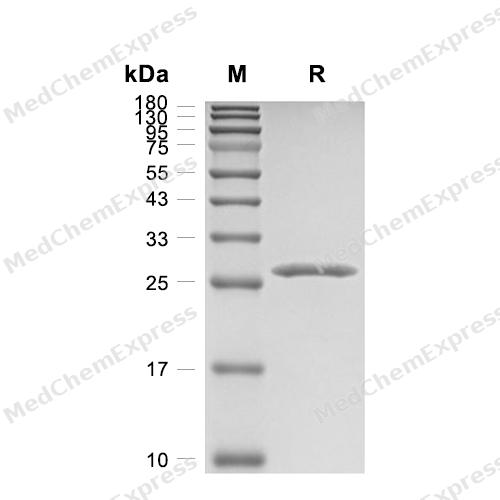
Purity - SDS-PAGE


Technical Parameters
-
Species Mouse
-
Source E. coli
-
Tag N-6*His
-
Accession
NP_035306 (G596-V855)
-
Gene ID19143
-
Molecular Construction
-
N-term
-
6*His
-
Matriptase (G596-V855)
Accession # NP_035306 -
C-term
-
-
Protein Length
Partial Extracellular Domain
-
Synonyms
ST14; Matriptase; Prev. PRSS14; TADG15; MT-SP1; Suppression Of Tumorigenicity 14 (Colon Carcinoma, Matriptase, Epithin); SNC19; Tumor Associated Differentially Expressed Gene 15 Protein; TMPRSS14; Tumor-Associated Differentially-Expressed Gene 15 Protein;
-
AA Sequence
GSDEKNCDCGLRSFTKQARVVGGTNADEGEWPWQVSLHALGQGHLCGASLISPDWLVSAAHCFQDDKNFKYSDYTMWTAFLGLLDQSKRSASGVQELKLKRIITHPSFNDFTFDYDIALLELEKSVEYSTVVRPICLPDATHVFPAGKAIWVTGWGHTKEGGTGALILQKGEIRVINQTTCEDLMPQQITPRMMCVGFLSGGVDSCQGDSGGPLSSAEKDGRMFQAGVVSWGEGCAQRNKPGVYTRLPVVRDWIKEHTGV
-
Predicted Molecular Mass
28.5 kDa
-
Molecular Weight
Approximately 28 kDa, based on SDS-PAGE under reducing conditions.
-
Purity
≥ 95%, as determined by reducing SDS-PAGE.


Product Properties
Lyophilized powder.
Lyophilized from a 0.22 μm filtered solution of PBS, pH 7.4.
<1 EU/μg, determined by LAL method.
It is not recommended to reconstitute to a concentration less than 100 μg/mL in ddH2O. For long term storage it is recommended to add a carrier protein (0.1% BSA, 5% HSA, 10% FBS or 5% Trehalose).
Stored at -20°C for 2 years from date of receipt. After reconstitution, it is stable at 4°C for 1 week or -20°C for longer (with carrier protein). It is recommended to freeze aliquots at -20°C or -80°C for extended storage.
Room temperature in continental US; may vary elsewhere.


Documentation
-
Data Sheet (237 KB)
-
SDS (252 KB)
- English - EN (252 KB)
- Français - FR (252 KB)
- Deutsch - DE (252 KB)
- Norwegian - NO (252 KB)
- Español - ES (252 KB)
- Swedish - SV (252 KB)
- Italian - IT (252 KB)
- Korean - KR (252 KB)
- Portuguese - PT (252 KB)
-
Handling Instructions (2659 KB)

Calculators
Concentration (start) × Volume (start) = Concentration (final) × Volume (final)


 Powered by Bioz

