



Netrin receptor DCC/DCC Protein, Human (HEK293, His)

Based on 1 Customer Validation
The netrin receptor DCC guides axonal attraction in neuronal growth cones during nervous system development. Interaction with UNC5 protein induces axonal repulsion. Netrin receptor DCC/DCC Protein, Human (HEK293, His) is the recombinant human-derived Netrin receptor DCC/DCC protein, expressed by HEK293 , with C-10*His labeled tag.
- Species: Human
- Source: HEK293
-
Storage:Stored at -20°C for 2 years from date of receipt. After reconstitution, it is stable at 4°C for 1 week or -20°C for longer (with carrier protein). It is recommended to freeze aliquots at -20°C or -80°C for extended storage.


To place orders, for customer services and technical support, please contact: MedChemExpress USA
Tel: 609-228-6898 E-mail: [email protected] [email protected]


-
 Biological Activity
-
Technical Parameters
-
Product Properties
- Documentation
- Help & FAQs




Biological Activity
Description
The netrin receptor DCC guides axonal attraction in neuronal growth cones during nervous system development. Interaction with UNC5 protein induces axonal repulsion. Netrin receptor DCC/DCC Protein, Human (HEK293, His) is the recombinant human-derived Netrin receptor DCC/DCC protein, expressed by HEK293 , with C-10*His labeled tag.
Background
DCC, a critical receptor for netrin, plays a pivotal role in axon guidance by mediating axon attraction in neuronal growth cones during nervous system development upon ligand binding. Its intricate associations with UNC5 proteins may trigger signaling pathways leading to axon repulsion. Additionally, DCC acts as a dependence receptor, instigating apoptosis when not bound to the netrin ligand. Beyond its role in neural development, DCC is implicated as a tumor suppressor gene. The receptor engages in diverse protein interactions, including the cytoplasmic parts of UNC5A, UNC5B, UNC5C, and possibly UNC5D, as well as with DSCAM, PTK2/FAK1, MAPK1, NTN1, MYO10, CBLN4, SIAH1, and SIAH2. These interactions underscore the multifaceted functions of DCC in orchestrating axon guidance, apoptosis, and potential tumor suppression.
Verified Bioactivity
Immobilized Recombinant Human DCC at 1 μg/ml (100 μl/well) can bind Biotinylated Recombinant Human Netrin-1 Protein. The ED50 for this effect is 85.29 ng/mL.
MCE Validation Data
-
Purity - SDS-PAGE
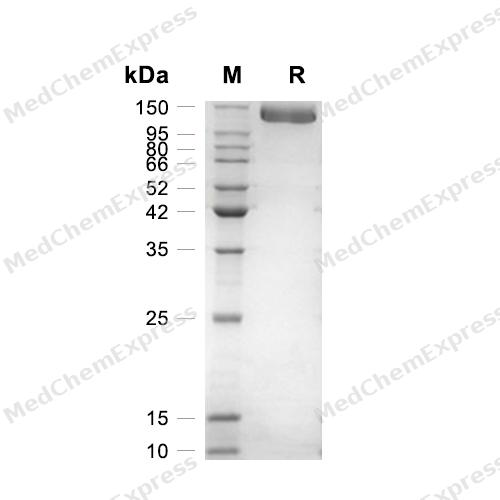
Purity - SDS-PAGE
-
Bioactivity - ELISA
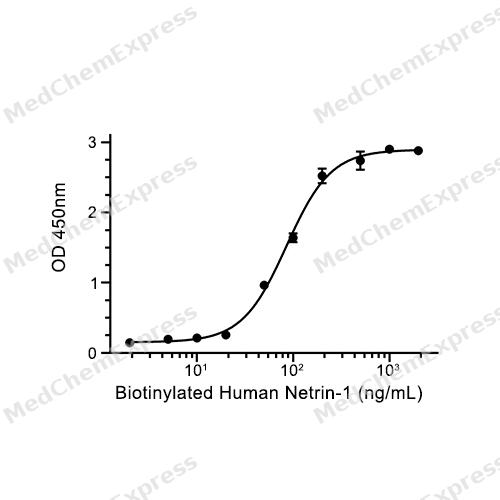
Bioactivity - ELISA


Technical Parameters
-
Species Human
-
Source HEK293
-
Tag C-10*His
-
Accession
P43146 (F32-N1097)
-
Molecular Construction
-
N-term
-
DCC (F32-N1097)
Accession # P43146 -
10*His
-
C-term
-
-
Protein Length
Partial Extracellular Domain
-
Synonyms
DCC; Immunoglobulin Superfamily, DCC Subclass, Member 1; DCC Netrin 1 Receptor; Putative Colorectal Tumor Suppressor; IGDCC1; Deleted In Colorectal Cancer Protein; Tumor Suppressor Protein DCC; DCC Protein; Netrin Receptor DCC; HGPPS2; NTN1R1; CRC18; Immu
-
AA Sequence
FQIKAFTALRFLSEPSDAVTMRGGNVLLDCSAESDRGVPVIKWKKDGIHLALGMDERKQQLSNGSLLIQNILHSRHHKPDEGLYQCEASLGDSGSIISRTAKVAVAGPLRFLSQTESVTAFMGDTVLLKCEVIGEPMPTIHWQKNQQDLTPIPGDSRVVVLPSGALQISRLQPGDIGIYRCSARNPASSRTGNEAEVRILSDPGLHRQLYFLQRPSNVVAIEGKDAVLECCVSGYPPPSFTWLRGEEVIQLRSKKYSLLGGSNLLISNVTDDDSGMYTCVVTYKNENISASAELTVLVPPWFLNHPSNLYAYESMDIEFECTVSGKPVPTVNWMKNGDVVIPSDYFQIVGGSNLRILGVVKSDEGFYQCVAENEAGNAQTSAQLIVPKPAIPSSSVLPSAPRDVVPVLVSSRFVRLSWRPPAEAKGNIQTFTVFFSREGDNRERALNTTQPGSLQLTVGNLKPEAMYTFRVVAYNEWGPGESSQPIKVATQPELQVPGPVENLQAVSTSPTSILITWEPPAYANGPVQGYRLFCTEVSTGKEQNIEVDGLSYKLEGLKKFTEYSLRFLAYNRYGPGVSTDDITVVTLSDVPSAPPQNVSLEVVNSRSIKVSWLPPPSGTQNGFITGYKIRHRKTTRRGEMETLEPNNLWYLFTGLEKGSQYSFQVSAMTVNGTGPPSNWYTAETPENDLDESQVPDQPSSLHVRPQTNCIIMSWTPPLNPNIVVRGYIIGYGVGSPYAETVRVDSKQRYYSIERLESSSHYVISLKAFNNAGEGVPLYESATTRSITDPTDPVDYYPLLDDFPTSVPDLSTPMLPPVGVQAVALTHDAVRVSWADNSVPKNQKTSEVRLYTVRWRTSFSASAKYKSEDTTSLSYTATGLKPNTMYEFSVMVTKNRRSSTWSMTAHATTYEAAPTSAPKDLTVITREGKPRAVIVSWQPPLEANGKITAYILFYTLDKNIPIDDWIMETISGDRLTHQIMDLNLDTMYYFRIQARNSKGVGPLSDPILFRTLKVEHPDKMANDQGRHGDGGYWPVDTNLIDRSTLNEPPIGQMHPPHGSVTPQKNSN
-
Molecular Weight
Approximately 125-150 kDa, based on SDS-PAGE under reducing conditions, due to the glycosylation.
-
Glycosylation
Yes
-
Purity
≥ 95%, as determined by reducing SDS-PAGE.


Product Properties
Lyophilized powder.
Lyophilized a 0.22 μm filtered solution of PB, 150 mM NaCl, pH 7.4.
<1 EU/μg, determined by LAL method.
It is not recommended to reconstitute to a concentration less than 100 μg/mL in ddH2O. For long term storage it is recommended to add a carrier protein (0.1% BSA, 5% HSA, 10% FBS or 5% Trehalose).
Stored at -20°C for 2 years from date of receipt. After reconstitution, it is stable at 4°C for 1 week or -20°C for longer (with carrier protein). It is recommended to freeze aliquots at -20°C or -80°C for extended storage.
Room temperature in continental US; may vary elsewhere.


Documentation
-
Data Sheet (242 KB)
-
SDS (251 KB)
- English - EN (251 KB)
- Français - FR (251 KB)
- Deutsch - DE (251 KB)
- Norwegian - NO (251 KB)
- Español - ES (251 KB)
- Swedish - SV (251 KB)
- Italian - IT (251 KB)
- Korean - KR (251 KB)
- Portuguese - PT (251 KB)
-
Handling Instructions (2659 KB)

Calculators
Concentration (start) × Volume (start) = Concentration (final) × Volume (final)


 Powered by Bioz

