



Outer membrane porin F/OmpF Protein, E.coli (His, Myc)

Based on 1 Customer Validation
Outer membrane protein F (OmpF) facilitates the formation of pores, enabling the passive diffusion of small molecules across the bacterial outer membrane. Beyond its role in membrane permeability, OmpF serves as a crucial receptor for the bacteriophage T2 and is considered the primary receptor for colicin E5, playing a probable role in the mechanisms associated with these interactions. Outer membrane porin F/OmpF Protein, E.coli (His, Myc) is the recombinant E. coli-derived Outer membrane protein F/OmpF protein, expressed by E. coli , with C-Myc, N-10*His labeled tag.
- Species: E.coli
- Source: E. coli
-
Storage:Stored at -20°C for 2 years from date of receipt. After reconstitution, it is stable at 4°C for 1 week or -20°C for longer (with carrier protein). It is recommended to freeze aliquots at -20°C or -80°C for extended storage.


To place orders, for customer services and technical support, please contact: MedChemExpress USA
Tel: 609-228-6898 E-mail: [email protected] [email protected]


-
 Biological Activity
-
Technical Parameters
-
Product Properties
- Documentation
- Help & FAQs




Biological Activity
Description
Outer membrane protein F (OmpF) facilitates the formation of pores, enabling the passive diffusion of small molecules across the bacterial outer membrane. Beyond its role in membrane permeability, OmpF serves as a crucial receptor for the bacteriophage T2 and is considered the primary receptor for colicin E5, playing a probable role in the mechanisms associated with these interactions. Outer membrane porin F/OmpF Protein, E.coli (His, Myc) is the recombinant E. coli-derived Outer membrane protein F/OmpF protein, expressed by E. coli , with C-Myc, N-10*His labeled tag.
Background
The Outer membrane protein F (OmpF) plays a crucial role in bacterial physiology as it forms pores facilitating the passive diffusion of small molecules across the outer membrane. Serving as a key component in membrane permeability, OmpF contributes to the uptake of essential nutrients and substances by the bacterial cell. Furthermore, OmpF serves as a receptor for the bacteriophage T2, allowing the virus to recognize and infect the bacterial host. Additionally, there is a probable association between OmpF and colicin E5, where OmpF is identified as the major receptor for this bacteriocin. This dual functionality of OmpF in nutrient uptake and its interactions with bacteriophages and colicins underscores its significance in bacterial membrane dynamics and host-defense mechanisms.
MCE Validation Data
-
Purity - SDS-PAGE
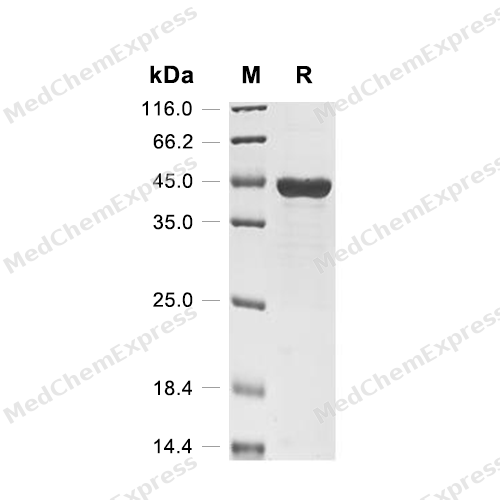
Purity - SDS-PAGE


Technical Parameters
-
Species E.coli
-
Source E. coli
-
Tag C-Myc;N-10*His
-
Accession
P02931 (A23-F362)
-
Gene ID945554 [NCBI]
-
Molecular Construction
-
N-term
-
10*His
-
OmpF (A23-F362)
Accession # P02931 -
C-term
-
-
Protein Length
Full Length of Mature Protein
-
Synonyms
Outer membrane porin F; Outer membrane protein 1A; Outer membrane protein B; Outer membrane protein F; Outer membrane protein IA; Porin OmpF; ompF; cmlB; coa; cry; tolF; JW0912; b0929
-
AA Sequence
AEIYNKDGNKVDLYGKAVGLHYFSKGNGENSYGGNGDMTYARLGFKGETQINSDLTGYGQWEYNFQGNNSEGADAQTGNKTRLAFAGLKYADVGSFDYGRNYGVVYDALGYTDMLPEFGGDTAYSDDFFVGRVGGVATYRNSNFFGLVDGLNFAVQYLGKNERDTARRSNGDGVGGSISYEYEGFGIVGAYGAADRTNLQEAQPLGNGKKAEQWATGLKYDANNIYLAANYGETRNATPITNKFTNTSGFANKTQDVLLVAQYQFDFGLRPSIAYTKSKAKDVEGIGDVDLVNYFEVGATYYFNKNMSTYVDYIINQIDSDNKLGVGSDDTVAVGIVYQF
-
Predicted Molecular Mass
44.5 kDa
-
Purity
≥ 90%, as determined by reducing SDS-PAGE.


Product Properties
Lyophilized powder
Lyophilized from a 0.22 μm filtered solution of PBS, 6% trehalose, pH 7.4.
<1.0 EU/μg, determined by LAL method.
It is not recommended to reconstitute to a concentration less than 100 μg/mL in ddH2O.
Stored at -20°C for 2 years from date of receipt. After reconstitution, it is stable at 4°C for 1 week or -20°C for longer (with carrier protein). It is recommended to freeze aliquots at -20°C or -80°C for extended storage.
Room temperature in continental US; may vary elsewhere.


Documentation
-
Data Sheet (236 KB)
-
SDS (251 KB)
- English - EN (251 KB)
- Français - FR (251 KB)
- Deutsch - DE (251 KB)
- Norwegian - NO (251 KB)
- Español - ES (251 KB)
- Swedish - SV (251 KB)
- Italian - IT (251 KB)
- Korean - KR (251 KB)
- Portuguese - PT (251 KB)
-
Handling Instructions (2659 KB)

Calculators
Concentration (start) × Volume (start) = Concentration (final) × Volume (final)


 Powered by Bioz

