



p53R2 Protein, Human (His)

Based on 1 Customer Validation
The p53R2 protein is essential for cell survival and operates in a p53/TP53-dependent manner to support DNA repair. It provides essential deoxyribonucleotides for DNA repair, particularly in G1 or G2 arrested cells, and contains an iron-tyrosyl radical center critical for catalysis. p53R2 Protein, Human (His) is the recombinant human-derived p53R2 protein, expressed by E. coli , with N-His labeled tag.
- Species: Human
- Source: E. coli
-
Storage:Stored at -20°C for 2 years from date of receipt. After reconstitution, it is stable at 4°C for 1 week or -20°C for longer (with carrier protein). It is recommended to freeze aliquots at -20°C or -80°C for extended storage.


To place orders, for customer services and technical support, please contact: MedChemExpress USA
Tel: 609-228-6898 E-mail: [email protected] [email protected]


-
 Biological Activity
-
Technical Parameters
-
Product Properties
- Documentation
- Help & FAQs




Biological Activity
Description
The p53R2 protein is essential for cell survival and operates in a p53/TP53-dependent manner to support DNA repair. It provides essential deoxyribonucleotides for DNA repair, particularly in G1 or G2 arrested cells, and contains an iron-tyrosyl radical center critical for catalysis. p53R2 Protein, Human (His) is the recombinant human-derived p53R2 protein, expressed by E. coli , with N-His labeled tag.
Background
p53R2, a crucial player in cellular survival, operates in a p53/TP53-dependent manner to facilitate the repair of damaged DNA. It assumes a vital role by providing deoxyribonucleotides essential for DNA repair processes, particularly in cells arrested at G1 or G2 phases. The protein harbors an iron-tyrosyl free radical center, indispensable for its catalytic function. Notably, p53R2 forms an active ribonucleotide reductase (RNR) complex in conjunction with RRM1. This complex is expressed in both resting and proliferating cells, responding adeptly to DNA damage, highlighting its significance in maintaining genomic integrity.
MCE Validation Data
-
Purity - SDS-PAGE
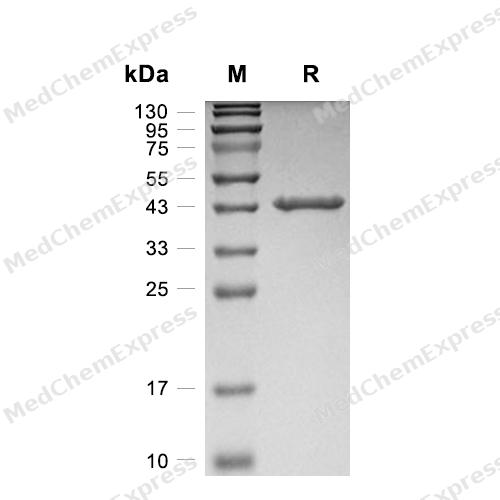
Purity - SDS-PAGE


Technical Parameters
-
Species Human
-
Source E. coli
-
Tag N-6*His
-
Accession
Q7LG56-1 (M1-F351)
-
Molecular Construction
-
N-term
-
His
-
p53R2 (M1-F351)
Accession # Q7LG56-1 -
C-term
-
-
Protein Length
Full Length of Isoform-1
-
Synonyms
RRM2B; P53-Inducible Ribonucleotide Reductase Small Subunit 2 Short Form Beta; Ribonucleotide Reductase Regulatory TP53 Inducible Subunit M2B; P53-Inducible Ribonucleotide Reductase Small Subunit 2 Homolog; P53R2; Ribonucleoside-Diphosphate Reductase; P53
-
AA Sequence
MGDPERPEAAGLDQDERSSSDTNESEIKSNEEPLLRKSSRRFVIFPIQYPDIWKMYKQAQASFWTAEEVDLSKDLPHWNKLKADEKYFISHILAFFAASDGIVNENLVERFSQEVQVPEARCFYGFQILIENVHSEMYSLLIDTYIRDPKKREFLFNAIETMPYVKKKADWALRWIADRKSTFGERVVAFAAVEGVFFSGSFAAIFWLKKRGLMPGLTFSNELISRDEGLHCDFACLMFQYLVNKPSEERVREIIVDAVKIEQEFLTEALPVGLIGMNCILMKQYIEFVADRLLVELGFSKVFQAENPFDFMENISLEGKTNFFEKRVSEYQRFAVMAETTDNVFTLDADF
-
Molecular Weight
Approximately 43 kDa, based on SDS-PAGE under reducing conditions.
-
Purity
≥ 95%, as determined by reducing SDS-PAGE.


Product Properties
Lyophilized powder.
Lyophilized from a 0.22 μm filtered solution of PBS, pH 7.4, 8% trehalose.
<1 EU/μg, determined by LAL method.
It is not recommended to reconstitute to a concentration less than 100 μg/mL in ddH2O.
Stored at -20°C for 2 years from date of receipt. After reconstitution, it is stable at 4°C for 1 week or -20°C for longer (with carrier protein). It is recommended to freeze aliquots at -20°C or -80°C for extended storage.
Room temperature in continental US; may vary elsewhere.


Documentation
-
Data Sheet (237 KB)
-
SDS (251 KB)
- English - EN (251 KB)
- Français - FR (251 KB)
- Deutsch - DE (251 KB)
- Norwegian - NO (251 KB)
- Español - ES (251 KB)
- Swedish - SV (251 KB)
- Italian - IT (251 KB)
- Korean - KR (251 KB)
- Portuguese - PT (251 KB)
-
Handling Instructions (2659 KB)

Calculators
Concentration (start) × Volume (start) = Concentration (final) × Volume (final)


 Powered by Bioz

