



PHYH Protein, Human

Based on 1 Customer Validation
PHYH protein catalyzes 2-hydroxylation of various mono-branched and straight-chain acyl-CoA esters, including racemic phytanoyl-CoA and isomers of 3-methylhexadecanoyl-CoA. It acts on acyl-CoAs with a chain length of at least seven carbon atoms, excluding long, very long straight-chain, and 2-methyl or 4-methyl-branched acyl-CoAs. PHYH Protein, Human is the recombinant human-derived PHYH protein, expressed by E. coli , with tag free.
- Species: Human
- Source: E. coli
-
Storage:Stored at -20°C for 2 years from date of receipt. After reconstitution, it is stable at 4°C for 1 week or -20°C for longer (with carrier protein). It is recommended to freeze aliquots at -20°C or -80°C for extended storage.


To place orders, for customer services and technical support, please contact: MedChemExpress USA
Tel: 609-228-6898 E-mail: [email protected] [email protected]


-
 Biological Activity
-
Technical Parameters
-
Product Properties
- Documentation
- Help & FAQs




Biological Activity
Description
PHYH protein catalyzes 2-hydroxylation of various mono-branched and straight-chain acyl-CoA esters, including racemic phytanoyl-CoA and isomers of 3-methylhexadecanoyl-CoA. It acts on acyl-CoAs with a chain length of at least seven carbon atoms, excluding long, very long straight-chain, and 2-methyl or 4-methyl-branched acyl-CoAs. PHYH Protein, Human is the recombinant human-derived PHYH protein, expressed by E. coli , with tag free.
Background
PHYH protein plays a crucial role in cellular metabolism by catalyzing the 2-hydroxylation of various acyl-CoA esters, including racemic phytanoyl-CoA, isomers of 3-methylhexadecanoyl-CoA, and a diverse array of other mono-branched 3-methylacyl-CoA esters with a chain length of at least seven carbon atoms, as well as straight-chain acyl-CoA esters with a chain length longer than four carbon atoms. Notably, PHYH does not hydroxylate long and very long straight-chain acyl-CoAs or 2-methyl- and 4-methyl-branched acyl-CoAs, showcasing its substrate specificity. These enzymatic activities contribute to the regulation of lipid metabolism and cellular homeostasis, highlighting the importance of PHYH in maintaining metabolic balance.
Verified Bioactivity
Measured by its ability to catalyze a reaction to produce inorganic phosphates at 37°C for 30 min. The specific activity is 1104.22 pmol/min/mg.
MCE Validation Data
-
Purity - SDS-PAGE
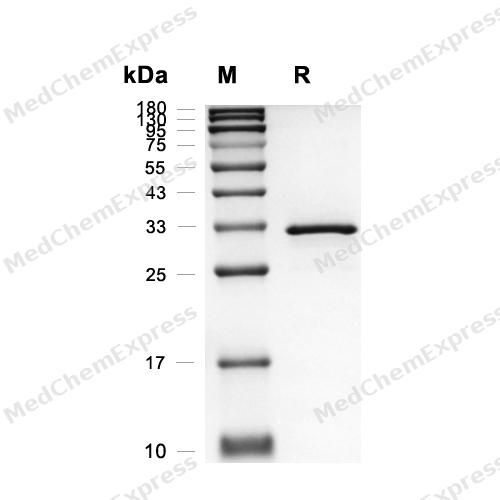
Purity - SDS-PAGE


Technical Parameters
-
Species Human
-
Source E. coli
-
Tag Tag Free
-
Accession
O14832-1 (S31-L338)
-
Molecular Construction
-
N-term
-
PHYH (S31-L338)
Accession # O14832 -
C-term
-
-
Protein Length
Full Length of Mature Protein
-
Synonyms
PHYH; Phytanoyl-CoA Hydroxylase (Refsum Disease); Phytanoyl-CoA 2-Hydroxylase; Phytanoyl-CoA 2 Oxoglutarate Dioxygenase; PAHX; Phytanoil-CoA Alpha Hydroxylase; Phytanoyl-CoA Dioxygenase, Peroxisomal; Phytanoyl-CoA Hydroxylase; Phytanoyl-CoA Alpha-Hydroxyl
-
AA Sequence
SGTISSASFHPQQFQYTLDNNVLTLEQRKFYEENGFLVIKNLVPDADIQRFRNEFEKICRKEVKPLGLTVMRDVTISKSEYAPSEKMITKVQDFQEDKELFRYCTLPEILKYVECFTGPNIMAMHTMLINKPPDSGKKTSRHPLHQDLHYFPFRPSDLIVCAWTAMEHISRNNGCLVVLPGTHKGSLKPHDYPKWEGGVNKMFHGIQDYEENKARVHLVMEKGDTVFFHPLLIHGSGQNKTQGFRKAISCHFASADCHYIDVKGTSQENIEKEVVGIAHKFFGAENSVNLKDIWMFRARLVKGERTNL
-
Molecular Weight
Approximately 26-32 kDa, based on SDS-PAGE under reducing conditions.
-
Purity
≥ 95%, as determined by reducing SDS-PAGE.


Product Properties
Lyophilized powder.
Lyophilized from a 0.22 μm filtered solution of PBS, pH 7.4.
<1 EU/μg, determined by LAL method.
It is not recommended to reconstitute to a concentration less than 100 μg/mL in ddH2O. For long term storage it is recommended to add a carrier protein (0.1% BSA, 5% HSA, 10% FBS or 5% Trehalose).
Stored at -20°C for 2 years from date of receipt. After reconstitution, it is stable at 4°C for 1 week or -20°C for longer (with carrier protein). It is recommended to freeze aliquots at -20°C or -80°C for extended storage.
Room temperature in continental US; may vary elsewhere.


Documentation
-
Data Sheet (236 KB)
-
SDS (252 KB)
- English - EN (252 KB)
- Français - FR (252 KB)
- Deutsch - DE (252 KB)
- Norwegian - NO (252 KB)
- Español - ES (252 KB)
- Swedish - SV (252 KB)
- Italian - IT (252 KB)
- Korean - KR (252 KB)
- Portuguese - PT (252 KB)
-
Handling Instructions (2659 KB)

Calculators
Concentration (start) × Volume (start) = Concentration (final) × Volume (final)


 Powered by Bioz

