



PSME3 Protein, Human (N-His)

Based on 1 Customer Validation
PSME3 is a subunit of the 11S REG-gamma proteasome modulator that forms a homoheptamer and is essential for activating the trypsin-like subunit of the proteasome and inhibiting the chymotrypsin-like and PGPH subunits. PSME3 promotes MDM2-p53 interaction, leading to p53 degradation and inhibiting apoptosis after DNA damage. PSME3 Protein, Human (N-His) is the recombinant human-derived PSME3 protein, expressed by E. coli , with N-His labeled tag.
- Species: Human
- Source: E. coli
-
Storage:Stored at -20°C for 2 years from date of receipt. After reconstitution, it is stable at 4°C for 1 week or -20°C for longer (with carrier protein). It is recommended to freeze aliquots at -20°C or -80°C for extended storage.


To place orders, for customer services and technical support, please contact: MedChemExpress USA
Tel: 609-228-6898 E-mail: [email protected] [email protected]


-
 Biological Activity
-
Technical Parameters
-
Product Properties
- Documentation
- Help & FAQs




Biological Activity
Description
PSME3 is a subunit of the 11S REG-gamma proteasome modulator that forms a homoheptamer and is essential for activating the trypsin-like subunit of the proteasome and inhibiting the chymotrypsin-like and PGPH subunits. PSME3 promotes MDM2-p53 interaction, leading to p53 degradation and inhibiting apoptosis after DNA damage. PSME3 Protein, Human (N-His) is the recombinant human-derived PSME3 protein, expressed by E. coli , with N-His labeled tag.
Background
PSME3, a subunit of the 11S REG-gamma (also known as PA28-gamma) proteasome regulator, forms a doughnut-shaped homoheptamer that associates with the proteasome. This homoheptamer plays a crucial role in activating the trypsin-like catalytic subunit of the proteasome while simultaneously inhibiting the chymotrypsin-like and postglutamyl-preferring (PGPH) subunits. Notably, PSME3 facilitates the interaction between MDM2 and p53/TP53, leading to the ubiquitination- and MDM2-dependent proteasomal degradation of p53/TP53. This process limits the accumulation of p53/TP53, thereby inhibiting apoptosis following DNA damage. Additionally, PSME3 may contribute to cell cycle regulation. The stability of the PSME3 homoheptamer is crucial for its specific activation of the trypsin-like subunit and inhibition of the chymotrypsin-like and PGPH subunits of the proteasome. PSME3 interacts with various proteins, including MAP3K3, CCAR2, and PSME3IP1, the latter of which directly promotes PSME3 association with the 20S proteasome. The interaction with COIL is inhibited by PSME3IP1. This intricate network of interactions underscores the multifaceted role of PSME3 in regulating proteasome activity and influencing key cellular processes.
Verified Bioactivity
Measured by its ability to cleave a fluorogenic peptide substrate, suc-LLVY-AMC (HY-P1002). The specific activity is 897.05 pmol/min/μg.
MCE Validation Data
-
Purity - SDS-PAGE
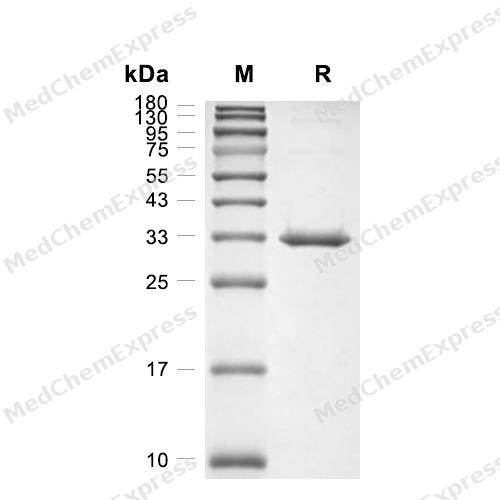
Purity - SDS-PAGE


Technical Parameters
-
Species Human
-
Source E. coli
-
Tag N-6*His
-
Accession
P61289 (M1-Y254)
-
Gene ID10197
-
Molecular Construction
-
N-term
-
His
-
PSME3 (M1-Y254)
Accession # P61289 -
C-term
-
-
Protein Length
Full Length
-
Synonyms
PSME3; CDNA FLJ57249, Highly Similar To Proteasome Activator Complex Subunit 3; Proteasome Activator Subunit 3; Activator Of Multicatalytic Protease Subunit 1; Activator Of Multicatalytic Protease Subunit 3; Proteasome Activator Complex Subunit 1; Proteas
-
AA Sequence
MASLLKVDQEVKLKVDSFRERITSEAEDLVANFFPKKLLELDSFLKEPILNIHDLTQIHSDMNLPVPDPILLTNSHDGLDGPTYKKRRLDECEEAFQGTKVFVMPNGMLKSNQQLVDIIEKVKPEIRLLIEKCNTVKMWVQLLIPRIEDGNNFGVSIQEETVAELRTVESEAASYLDQISRYYITRAKLVSKIAKYPHVEDYRRTVTEIDEKEYISLRLIISELRNQYVTLHDMILKNIEKIKRPRSSNAETLY
-
Predicted Molecular Mass
29.5 kDa
-
Molecular Weight
Approximately 33 kDa, based on SDS-PAGE under reducing conditions.
-
Purity
≥ 95%, as determined by reducing SDS-PAGE.


Product Properties
Lyophilized powder.
Lyophilized from a 0.22 μm filtered solution of PBS, pH 7.4, 8% trehalose.
<1 EU/μg, determined by LAL method.
It is not recommended to reconstitute to a concentration less than 100 μg/mL in ddH2O.
Stored at -20°C for 2 years from date of receipt. After reconstitution, it is stable at 4°C for 1 week or -20°C for longer (with carrier protein). It is recommended to freeze aliquots at -20°C or -80°C for extended storage.
Room temperature in continental US; may vary elsewhere.


Documentation
-
Data Sheet (237 KB)
-
SDS (251 KB)
- English - EN (251 KB)
- Français - FR (251 KB)
- Deutsch - DE (251 KB)
- Norwegian - NO (251 KB)
- Español - ES (251 KB)
- Swedish - SV (251 KB)
- Italian - IT (251 KB)
- Korean - KR (251 KB)
- Portuguese - PT (251 KB)
-
Handling Instructions (2659 KB)

Calculators
Concentration (start) × Volume (start) = Concentration (final) × Volume (final)


 Powered by Bioz

