



ROBO1 Protein, Rat (HEK293, His)
Based on 1 Customer Validation
The ROBO1 protein is a receptor for SLIT1 and SLIT2 and critically mediates cellular responses during migration and axonal navigation. Interaction with FLRT3 promotes axonal attraction to NTN1-expressing cells. ROBO1 Protein, Rat (HEK293, His) is the recombinant rat-derived ROBO1 protein, expressed by HEK293 , with C-10*His labeled tag.
- Species: Rat
- Source: HEK293
-
Storage:Stored at -20°C for 2 years from date of receipt. After reconstitution, it is stable at 4°C for 1 week or -20°C for longer (with carrier protein). It is recommended to freeze aliquots at -20°C or -80°C for extended storage.


To place orders, for customer services and technical support, please contact: MedChemExpress USA
Tel: 609-228-6898 E-mail: [email protected] [email protected]


-
 Biological Activity
-
Technical Parameters
-
Product Properties
- Documentation
- Help & FAQs




Biological Activity
Description
The ROBO1 protein is a receptor for SLIT1 and SLIT2 and critically mediates cellular responses during migration and axonal navigation. Interaction with FLRT3 promotes axonal attraction to NTN1-expressing cells. ROBO1 Protein, Rat (HEK293, His) is the recombinant rat-derived ROBO1 protein, expressed by HEK293 , with C-10*His labeled tag.
Background
The ROBO1 Protein operates as a receptor for SLIT1 and SLIT2, pivotal in mediating cellular responses to molecular guidance cues during cellular migration, encompassing axonal navigation at the ventral midline of the neural tube and the projection of axons to distinct regions during neuronal development. Its interaction with the intracellular domain of FLRT3 facilitates axon attraction towards cells expressing NTN1. In axon growth cones, the suppression of the attractive effect of NTN1 by SLIT2 may necessitate the formation of a ROBO1-DCC complex. Furthermore, ROBO1 contributes to the regulation of cell migration through its interaction with MYO9B, inhibiting MYO9B-mediated stimulation of RHOA GTPase activity, thereby leading to elevated levels of active, GTP-bound RHOA. There is a potential role for ROBO1 in lung development. Existing as a homodimer, dimerization is facilitated by the extracellular domain and is independent of SLIT liganding. ROBO1 Protein interacts with SLIT1, SLIT2, FLRT3, and MYO9B, showcasing its diverse involvement in cellular signaling pathways.
Verified Bioactivity
Measured in a cell proliferation assay using HUVEC cells. The ED50 for this effect is typically 48.92 ng/mL, corresponding to a specific activity is 2.04×10⁴ units/mg.
MCE Validation Data
-
Purity - SDS-PAGE
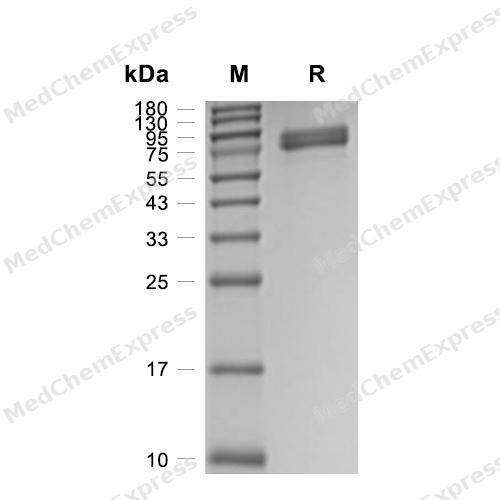
Purity - SDS-PAGE
-
Bioactivity - Cell-Based Assay
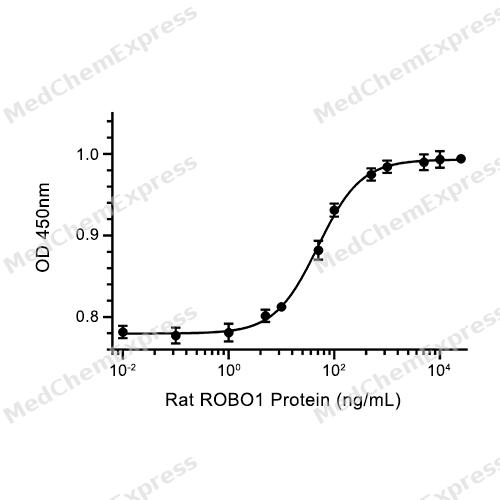
Bioactivity - Cell-Based Assay


Technical Parameters
-
Species Rat
-
Source HEK293
-
Tag C-10*His
-
Accession
O55005 (K19-I560)
-
Gene ID58946
-
Molecular Construction
-
N-term
-
ROBO1 (K19-I560)
Accession # O55005 -
10*His
-
C-term
-
-
Protein Length
Partial
-
Synonyms
ROBO1; Roundabout (Axon Guidance Receptor, Drosophila) Homolog 1; Roundabout Guidance Receptor 1; Roundabout, Axon Guidance Receptor, Homolog 1; DUTT1; ROBO1 Protein; SAX3; H-Robo-1; Deleted In U Twenty Twenty; CPHD8; Roundabout Homolog 1; NORS; FLJ21882;
-
AA Sequence
KKHLLLAQLIPDPEDLERGNDNGTPAPTSDNDDNSLGYTGSRLRQEDFPPRIVEHPSDLIVSKGEPATLNCKAEGRPTPTIEWYKGGERVETDKDDPRSHRMLLPSGSLFFLRIVHGRKSRPDEGVYICVARNYLGEAVSHNASLEVAILRDDFRQNPSDVMVAVGEPAVMECQPPRGHPEPTISWKKDGSPLDDKDERITIRGGKLMITYTRKSDAGKYVCVGTNMVGERESKVADVTVLERPSFVKRPSNLAVTVDDSAEFKCEARGDPVPTFGWRKDDGELPKSRYEIRDDHTLKIRKVTAGDMGSYTCVAENMVGKAEASATLTVQEPPHFVVKPRDQVVALGRTVTFQCEATGNPQPAIFWRREGSQNLLFSYQPPQSSSRFSVSQTGDLTVTNVQRSDVGYYICQTLNVAGSIITKAYLEVTDVIADRPPPVIRQGPVNQTVAVDGTLTLSCVATGSPVPTILWRKDGVLVSTQDSRIKQLESGVLQIRYAKLGDTGRYTCTASTPSGEATWSAYIEVQEFGVPVQPPRPTDPNLI
-
Predicted Molecular Mass
59.6 kDa
-
Molecular Weight
Approximately 70-95 kDa, based on SDS-PAGE under reducing conditions, due to the glycosylation.
-
Purity
≥ 95%, as determined by reducing SDS-PAGE.


Product Properties
Lyophilized powder.
Lyophilized from a 0.22 μm filtered solution of PBS, pH 7.4, 8% trehalose.
<1 EU/μg, determined by LAL method.
It is not recommended to reconstitute to a concentration less than 100 μg/mL in PBS.
Stored at -20°C for 2 years from date of receipt. After reconstitution, it is stable at 4°C for 1 week or -20°C for longer (with carrier protein). It is recommended to freeze aliquots at -20°C or -80°C for extended storage.
Room temperature in continental US; may vary elsewhere.


Documentation
-
Data Sheet (239 KB)
-
SDS (251 KB)
- English - EN (251 KB)
- Français - FR (251 KB)
- Deutsch - DE (251 KB)
- Norwegian - NO (251 KB)
- Español - ES (251 KB)
- Swedish - SV (251 KB)
- Italian - IT (251 KB)
- Korean - KR (251 KB)
- Portuguese - PT (251 KB)
-
Handling Instructions (2659 KB)

Calculators
Concentration (start) × Volume (start) = Concentration (final) × Volume (final)


 Powered by Bioz

