



RPE Protein, Mouse (HEK293, His)

Based on 1 Customer Validation
RPE proteins play a key role in cellular metabolism by catalyzing the reversible epimerization of D-ribulose 5-phosphate to D-xylulose 5-phosphate. This enzyme activity is a key step in the non-oxidative phase of the pentose phosphate pathway and promotes the interconversion of pentose phosphates. RPE Protein, Mouse (HEK293, His) is the recombinant mouse-derived RPE protein, expressed by HEK293 , with C-His labeled tag.
- Species: Mouse
- Source: HEK293
-
Storage:Stored at -20°C for 2 years from date of receipt. After reconstitution, it is stable at 4°C for 1 week or -20°C for longer (with carrier protein). It is recommended to freeze aliquots at -20°C or -80°C for extended storage.


To place orders, for customer services and technical support, please contact: MedChemExpress USA
Tel: 609-228-6898 E-mail: [email protected] [email protected]


-
 Biological Activity
-
Technical Parameters
-
Product Properties
- Documentation
- Help & FAQs




Biological Activity
Description
RPE proteins play a key role in cellular metabolism by catalyzing the reversible epimerization of D-ribulose 5-phosphate to D-xylulose 5-phosphate. This enzyme activity is a key step in the non-oxidative phase of the pentose phosphate pathway and promotes the interconversion of pentose phosphates. RPE Protein, Mouse (HEK293, His) is the recombinant mouse-derived RPE protein, expressed by HEK293 , with C-His labeled tag.
Background
Ribulose-5-phosphate epimerase (RPE) is an enzyme that catalyzes the reversible epimerization of D-ribulose 5-phosphate to D-xylulose 5-phosphate. This enzymatic activity is a key step in the non-oxidative phase of the pentose phosphate pathway, a metabolic pathway essential for the interconversion of sugars and the generation of pentose phosphates. The reversible conversion of ribulose 5-phosphate to xylulose 5-phosphate by RPE contributes to the synthesis of various important cellular components, including nucleotides and coenzymes. The intricate regulation of the pentose phosphate pathway, facilitated by enzymes like RPE, ensures a balanced supply of ribose-5-phosphate for nucleotide biosynthesis and NADPH for redox reactions within the cell. Understanding the functions of RPE provides insights into the regulation of sugar metabolism and its significance in cellular processes.
MCE Validation Data
-
Purity - SDS-PAGE
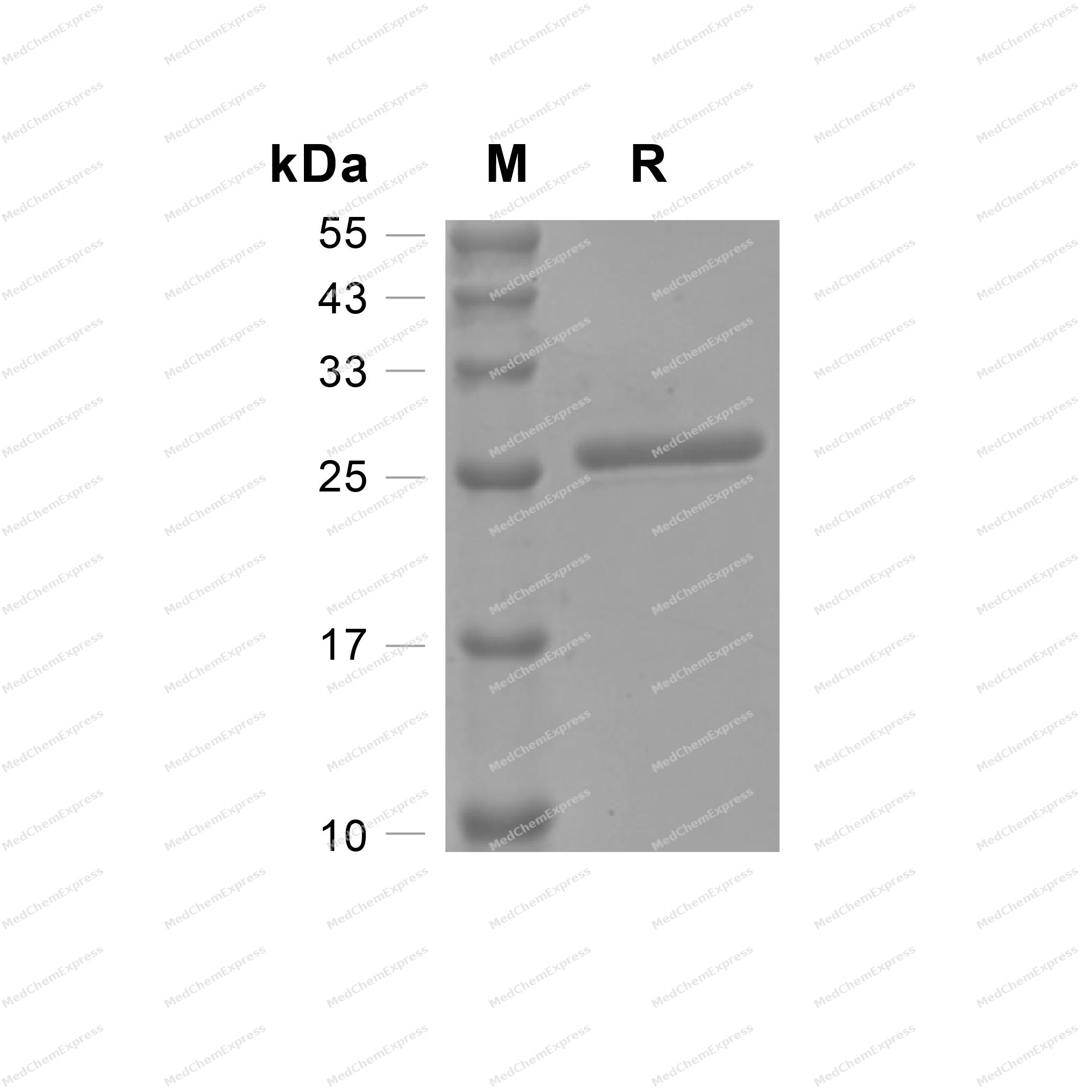
Purity - SDS-PAGE


Technical Parameters
-
Species Mouse
-
Source HEK293
-
Tag C-His
-
Accession
Q8VEE0 (M1-R228)
-
Molecular Construction
-
N-term
-
RPE (M1-R228)
Accession # Q8VEE0 -
His
-
C-term
-
-
Protein Length
Full Length
-
Synonyms
RPE; Ribulose-Phosphate 3-Epimerase; Ribulose-5-Phosphate-3-Epimerase; RPE2-1
-
AA Sequence
MASGCKIGPSILNSDLANLGAECLRMLDSGADYLHLDVMDGHFVPNITFGHPVVESLRKQLGQDPFFDMHMMVSRPEQWVKPMAVAGANQYTFHLEATENPGALIKDIRENGMKVGLAIKPGTTVEYLAPWANQIDMALVMTVEPGFGGQKFMEDMMPKVHWLRTQFPTLDIEVDGGVGPDTVQKCAEAGANMIVSGSAIMRSDDPRAVINLLRNVCSEAAQKRSLDR
-
Molecular Weight
Approximately 27 kDa, based on SDS-PAGE under reducing conditions, due to the glycosylation.
-
Purity
≥ 95%, as determined by reducing SDS-PAGE.


Product Properties
Lyophilized powder.
Lyophilized from a 0.22 μm filtered solution of PBS, pH 7.4.
<1 EU/μg, determined by LAL method.
It is not recommended to reconstitute to a concentration less than 100 μg/mL in ddH2O. For long term storage it is recommended to add a carrier protein (0.1% BSA, 5% HSA, 10% FBS or 5% Trehalose).
Stored at -20°C for 2 years from date of receipt. After reconstitution, it is stable at 4°C for 1 week or -20°C for longer (with carrier protein). It is recommended to freeze aliquots at -20°C or -80°C for extended storage.
Room temperature in continental US; may vary elsewhere.


Documentation
-
Data Sheet (236 KB)
-
SDS (251 KB)
- English - EN (251 KB)
- Français - FR (251 KB)
- Deutsch - DE (251 KB)
- Norwegian - NO (251 KB)
- Español - ES (251 KB)
- Swedish - SV (251 KB)
- Italian - IT (251 KB)
- Korean - KR (251 KB)
- Portuguese - PT (251 KB)
-
Handling Instructions (2659 KB)

Calculators
Concentration (start) × Volume (start) = Concentration (final) × Volume (final)


 Powered by Bioz

