



S100A15A Protein, Mouse (solution)

Based on 1 Customer Validation
The S100A15A protein is part of the Tyr protein kinase family in the ROR subfamily and is related to phosphorylation events, especially phosphorylation events on tyrosine residues. Its association with the receptor tyrosine kinase-like orphan receptor (ROR) family suggests its potential role in cell signaling pathways, affecting processes such as cell growth and differentiation. S100A15A Protein, Mouse (solution) is the recombinant mouse-derived S100A15A protein, expressed by E. coli , with tag free.
- Species: Mouse
- Source: E. coli
-
Storage:Stored at -80°C for 1 year from date of receipt. It is stable at -20°C for 3 months after opening. It is recommended to freeze aliquots at -80°C for extended storage. Avoid repeated freeze-thaw cycles.


To place orders, for customer services and technical support, please contact: MedChemExpress USA
Tel: 609-228-6898 E-mail: [email protected] [email protected]


-
 Biological Activity
-
Technical Parameters
-
Product Properties
- Documentation
- Help & FAQs




Biological Activity
Description
The S100A15A protein is part of the Tyr protein kinase family in the ROR subfamily and is related to phosphorylation events, especially phosphorylation events on tyrosine residues. Its association with the receptor tyrosine kinase-like orphan receptor (ROR) family suggests its potential role in cell signaling pathways, affecting processes such as cell growth and differentiation. S100A15A Protein, Mouse (solution) is the recombinant mouse-derived S100A15A protein, expressed by E. coli , with tag free.
Background
ROR1 Protein belongs to the protein kinase superfamily, specifically the Tyr protein kinase family within the ROR subfamily. As a member of this superfamily, ROR1 is characterized by its potential involvement in phosphorylation events, particularly on tyrosine residues. The designation within the ROR subfamily emphasizes its association with the Receptor Tyrosine Kinase-Like Orphan Receptor (ROR) family. This suggests that ROR1 may play a role in cellular signaling pathways, possibly influencing processes related to cell growth, differentiation, or other signaling cascades. The inclusion in the broader protein kinase superfamily underscores the diversity and importance of kinase activities in cellular regulation, highlighting ROR1's potential functional significance in various cellular processes.
MCE Validation Data
-
Purity - SDS-PAGE
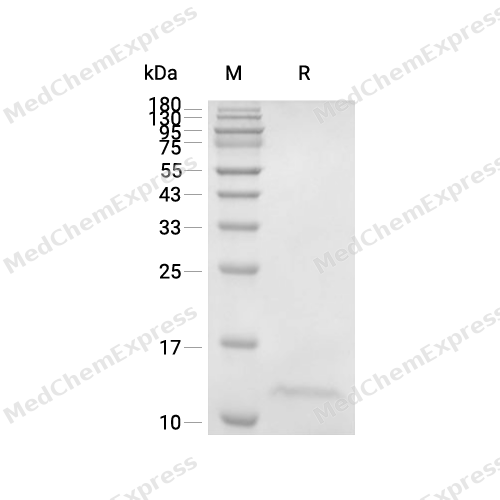
Purity - SDS-PAGE


Technical Parameters
-
Species Mouse
-
Source E. coli
-
Tag Tag Free
-
Accession
Q6S5I3 (M1-Y108)
-
Molecular Construction
-
N-term
-
S100A15A (M1-Y108)
Accession # Q6S5I3 -
C-term
-
-
Protein Length
Full Length
-
Synonyms
S100A15A; S100 Calcium Binding Protein A15A (Pseudogene)
-
AA Sequence
MPDTPVEDSLFQIIHCFHHYAAREGDKETLSLEELKALLLDSVPRFMDTLGRRQPYYITELFRAADKNKDNQICFDEFLYILGKLVKDYHLQFHRQLCAHYCTEHSLY
-
Predicted Molecular Mass
12.9 kDa
-
Molecular Weight
Approximately 12 kDa, based on SDS-PAGE under reducing conditions.
-
Purity
≥ 95%, as determined by reducing SDS-PAGE.


Product Properties
Solution
Supplied as a 0.22 μm filtered solution of 20 mM Tris-HCl, 100 mM NaCl, 30% glycerol, 1 mM DTT, pH 8.0.
Note: For SPR assay, please replace the buffer. Primary amine components (e.g., Tris, imidazole) can affect protein-coupled chips.
<1 EU/μg, determined by LAL method.
Stored at -80°C for 1 year from date of receipt. It is stable at -20°C for 3 months after opening. It is recommended to freeze aliquots at -80°C for extended storage. Avoid repeated freeze-thaw cycles.
Shipping with dry ice.


Documentation
-
Data Sheet (235 KB)
-
SDS (251 KB)
- English - EN (251 KB)
- Français - FR (251 KB)
- Deutsch - DE (251 KB)
- Norwegian - NO (251 KB)
- Español - ES (251 KB)
- Swedish - SV (251 KB)
- Italian - IT (251 KB)
- Korean - KR (251 KB)
- Portuguese - PT (251 KB)
-
Handling Instructions (2659 KB)

Calculators
Concentration (start) × Volume (start) = Concentration (final) × Volume (final)


 Powered by Bioz

