



sFRP-3 Protein, Mouse (HEK293, His)
Based on 1 Customer Validation
The sFRP-3 protein is a soluble Frizzled-related protein that modulates Wnt signaling by directly interacting with Wnt, thereby regulating cell growth and differentiation. Known as FRZB, it acts as a Wnt8 signaling antagonist with crucial effects on limb skeletogenesis. sFRP-3 Protein, Mouse (HEK293, His) is the recombinant mouse-derived sFRP-3 protein, expressed by HEK293 , with C-6*His labeled tag.
- Species: Mouse
- Source: HEK293
-
Storage:Stored at -20°C for 2 years from date of receipt. After reconstitution, it is stable at 4°C for 1 week or -20°C for longer (with carrier protein). It is recommended to freeze aliquots at -20°C or -80°C for extended storage.


To place orders, for customer services and technical support, please contact: MedChemExpress USA
Tel: 609-228-6898 E-mail: [email protected] [email protected]


-
 Biological Activity
-
Technical Parameters
-
Product Properties
- Documentation
- Help & FAQs




Biological Activity
Description
The sFRP-3 protein is a soluble Frizzled-related protein that modulates Wnt signaling by directly interacting with Wnt, thereby regulating cell growth and differentiation. Known as FRZB, it acts as a Wnt8 signaling antagonist with crucial effects on limb skeletogenesis. sFRP-3 Protein, Mouse (HEK293, His) is the recombinant mouse-derived sFRP-3 protein, expressed by HEK293 , with C-6*His labeled tag.
Background
sFRP-3, a soluble frizzled-related protein, operates as a modulator of Wnt signaling through its direct interaction with Wnts, contributing to the regulation of cell growth and differentiation in specific cell types. Notably, SFRP-3, also known as FRZB, plays a key role in limb skeletogenesis, functioning as an antagonist of Wnt8 signaling. Its regulatory influence extends to chondrocyte maturation and long bone development. In addition to its participation in Wnt signaling modulation, SFRP-3 interacts with MYOC, showcasing its engagement in molecular interactions associated with cellular processes. These diverse functions underscore the multifaceted regulatory role of sFRP-3 in Wnt-mediated pathways and skeletogenesis.
Verified Bioactivity
Measured by its ability to inhibit proliferation in MC3T3-E1 mouse preosteoblast cells. The ED50 for this effect is 5.797 µg/mL.
MCE Validation Data
-
Purity - SDS-PAGE
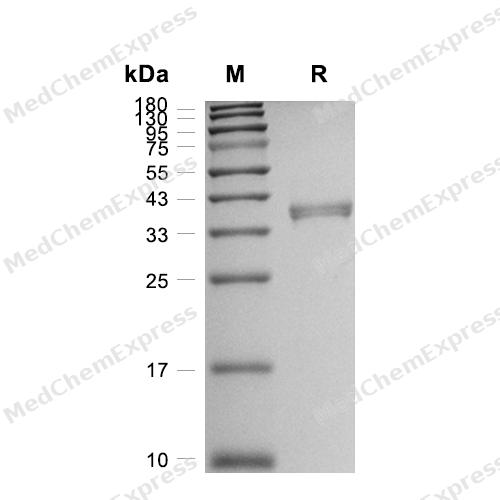
Purity - SDS-PAGE
-
Bioactivity - Cell-Based Assay
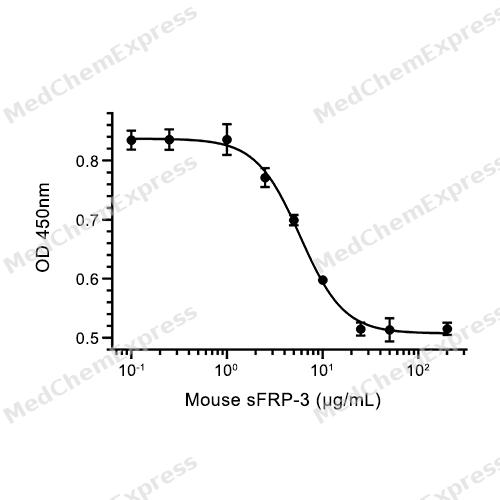
Bioactivity - Cell-Based Assay


Technical Parameters
-
Species Mouse
-
Source HEK293
-
Tag C-6*His
-
Accession
P97401 (A33-S323)
-
Gene ID20378
-
Molecular Construction
-
N-term
-
sFRP-3 (A33-S323)
Accession # P97401 -
6*His
-
C-term
-
-
Protein Length
Full Length of Mature Protein
-
Synonyms
FRZB; FZRB; Frizzled Related Protein; HFIZ; Secreted Frizzled-Related Protein 3; Frezzled; FRZB1; SFRP-3; SFRP3; FrzB-1; FRE; Uncharacterized Protein FRZB; Frizzled-Related Protein 1; Frizzled Homolog-Related; FRZB-PEN; Frizzled-Related Protein; FRZB-1; F
-
AA Sequence
AACEPVRIPLCKSLPWNMTKMPNHLHHSTQANAILAMEQFEGLLGTHCSPDLLFFLCAMYAPICTIDFQHEPIKPCKSVCERARQGCEPILIKYRHSWPESLACDELPVYDRGVCISPEAIVTADGADFPMDSSTGHCRGASSERCKCKPVRATQKTYFRNNYNYVIRAKVKEVKMKCHDVTAVVEVKEILKASLVNIPRDTVNLYTTSGCLCPPLTVNEEYVIMGYEDEERSRLLLVEGSIAEKWKDRLGKKVKRWDMKLRHLGLGKTDASDSTQNQKSGRNSNPRPARS
-
Molecular Weight
Approximately 37 kDa, based on SDS-PAGE under reducing conditions.
-
Purity
≥ 95%, as determined by reducing SDS-PAGE.


Product Properties
Lyophilized powder.
Lyophilized from a 0.22 μm filtered solution of PBS, pH 7.4, 8% trehalose.
<1 EU/μg, determined by LAL method.
It is not recommended to reconstitute to a concentration less than 100 μg/mL in PBS.
Stored at -20°C for 2 years from date of receipt. After reconstitution, it is stable at 4°C for 1 week or -20°C for longer (with carrier protein). It is recommended to freeze aliquots at -20°C or -80°C for extended storage.
Room temperature in continental US; may vary elsewhere.


Documentation
-
Data Sheet (237 KB)
-
SDS (251 KB)
- English - EN (251 KB)
- Français - FR (251 KB)
- Deutsch - DE (251 KB)
- Norwegian - NO (251 KB)
- Español - ES (251 KB)
- Swedish - SV (251 KB)
- Italian - IT (251 KB)
- Korean - KR (251 KB)
- Portuguese - PT (251 KB)
-
Handling Instructions (2659 KB)

Calculators
Concentration (start) × Volume (start) = Concentration (final) × Volume (final)


 Powered by Bioz

