



STIM1 Protein, Human (HEK293, His)

Based on 1 Customer Validation
STIM1 (stromal interacting molecule 1) coordinates store-operated Ca(2+) entry (SOCE) and acts as a Ca(2+) sensor in the endoplasmic reticulum. Upon Ca(2+) depletion, STIM1 translocates to the plasma membrane and activates the Ca(2+)-releasing activated Ca(2+) (CRAC) channel subunit ORAI1. STIM1 Protein, Human (HEK293, His) is the recombinant human-derived STIM1 protein, expressed by HEK293 , with C-His labeled tag.
- Species: Human
- Source: HEK293
-
Storage:Stored at -20°C for 2 years from date of receipt. After reconstitution, it is stable at 4°C for 1 week or -20°C for longer (with carrier protein). It is recommended to freeze aliquots at -20°C or -80°C for extended storage.


To place orders, for customer services and technical support, please contact: MedChemExpress USA
Tel: 609-228-6898 E-mail: [email protected] [email protected]


-
 Biological Activity
-
Technical Parameters
-
Product Properties
- Documentation
- Help & FAQs




Biological Activity
Description
STIM1 (stromal interacting molecule 1) coordinates store-operated Ca(2+) entry (SOCE) and acts as a Ca(2+) sensor in the endoplasmic reticulum. Upon Ca(2+) depletion, STIM1 translocates to the plasma membrane and activates the Ca(2+)-releasing activated Ca(2+) (CRAC) channel subunit ORAI1. STIM1 Protein, Human (HEK293, His) is the recombinant human-derived STIM1 protein, expressed by HEK293 , with C-His labeled tag.
Background
STIM1 (Stromal interaction molecule 1) plays a pivotal role in mediating store-operated Ca(2+) entry (SOCE), a process that involves Ca(2+) influx following the depletion of intracellular Ca(2+) stores. Functioning as a Ca(2+) sensor in the endoplasmic reticulum through its EF-hand domain, STIM1 translocates from the endoplasmic reticulum to the plasma membrane upon Ca(2+) depletion. In this activated state, it interacts with and activates the Ca(2+) release-activated Ca(2+) (CRAC) channel subunit ORAI1. STIM1 forms homooligomers and heterooligomers with STIM2, and its interaction with other proteins, such as SPPL3, MAPRE1, CRACR2A/EFCAB4B, SARAF, EFHB, ASPH, SLC35G1, TMEM203, CASQ1, and ADCY8, further regulates its cellular functions, including SOCE activity. Additionally, STIM1 has been implicated in enamel formation and undergoes conformational changes facilitated by interactions with STIMATE. These dynamic interactions highlight the multifaceted role of STIM1 in cellular Ca(2+) signaling and homeostasis.
MCE Validation Data
-
Purity - SDS-PAGE
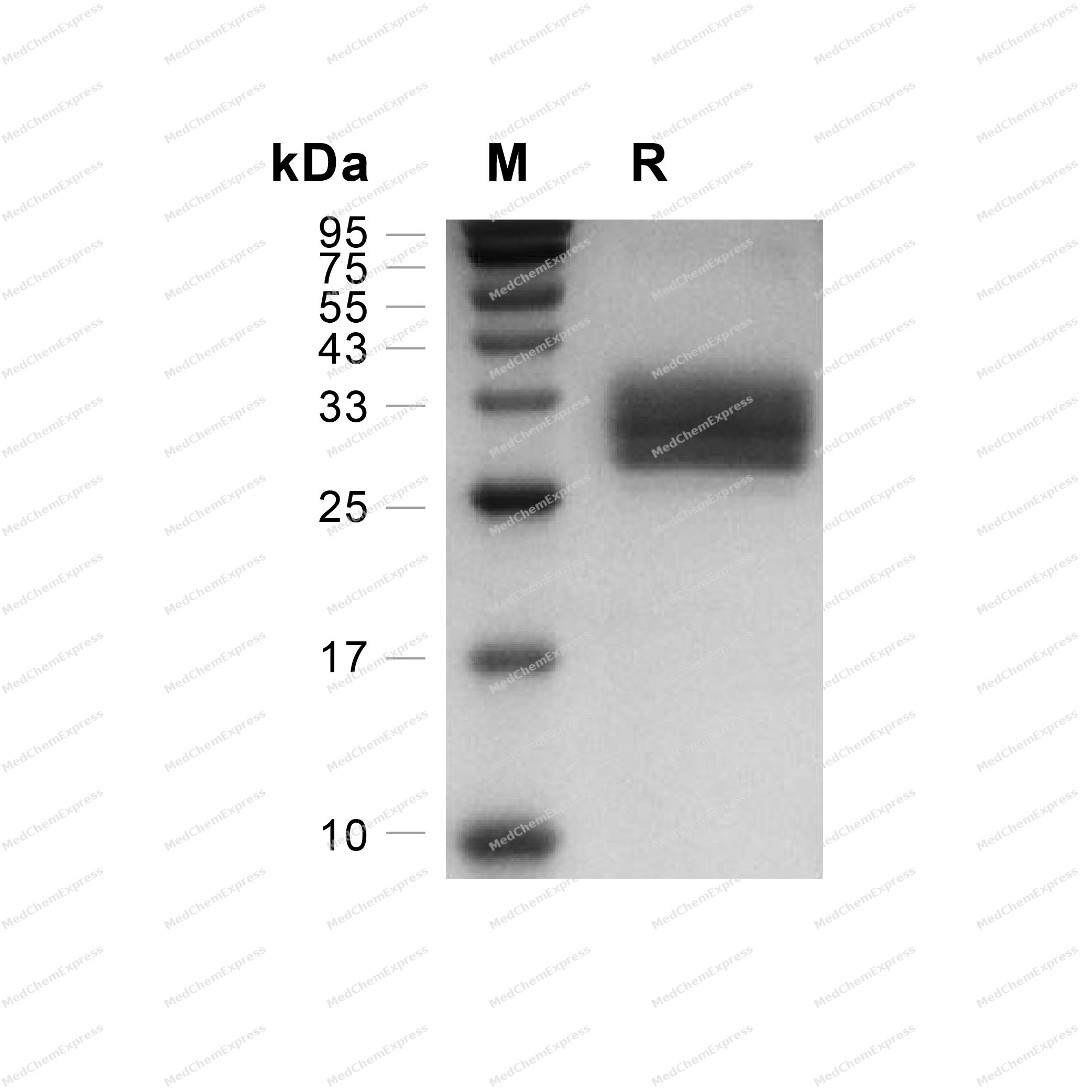
Purity - SDS-PAGE


Technical Parameters
-
Species Human
-
Source HEK293
-
Tag C-His
-
Accession
Q13586/NP_003147.2(L23-D213)
-
Molecular Construction
-
N-term
-
STIM1 (L23-D213)
Accession # Q13586/NP_003147.2 -
His
-
C-term
-
-
Protein Length
Extracellular Domain
-
Synonyms
STIM1; IMD10; Stromal Interaction Molecule 1; STRMK; GOK; TAM1; D11S4896E; TAM; STIM1L
-
AA Sequence
LSHSHSEKATGTSSGANSEESTAAEFCRIDKPLCHSEDEKLSFEAVRNIHKLMDDDANGDVDVEESDEFLREDLNYHDPTVKHSTFHGEDKLISVEDLWKAWKSSEVYNWTVDEVVQWLITYVELPQYEETFRKLQLSGHAMPRLAVTNTTMTGTVLKMTDRSHRQKLQLKALDTVLFGPPLLTRHNHLKD
-
Predicted Molecular Mass
21.9 kDa
-
Molecular Weight
Approximately 27-34 kDa, based on SDS-PAGE under reducing conditions, due to the glycosylation.
-
Glycosylation
Yes
-
Purity
≥ 95%, as determined by reducing SDS-PAGE.


Product Properties
Lyophilized powder.
Lyophilized from a 0.22 μm filtered solution of PBS, pH 7.4.
<1 EU/μg, determined by LAL method.
It is not recommended to reconstitute to a concentration less than 100 μg/mL in ddH2O. For long term storage it is recommended to add a carrier protein (0.1% BSA, 5% HSA, 10% FBS or 5% Trehalose).
Stored at -20°C for 2 years from date of receipt. After reconstitution, it is stable at 4°C for 1 week or -20°C for longer (with carrier protein). It is recommended to freeze aliquots at -20°C or -80°C for extended storage.
Room temperature in continental US; may vary elsewhere.


Documentation
-
Data Sheet (236 KB)
-
SDS (251 KB)
- English - EN (251 KB)
- Français - FR (251 KB)
- Deutsch - DE (251 KB)
- Norwegian - NO (251 KB)
- Español - ES (251 KB)
- Swedish - SV (251 KB)
- Italian - IT (251 KB)
- Korean - KR (251 KB)
- Portuguese - PT (251 KB)
-
Handling Instructions (2659 KB)

Calculators
Concentration (start) × Volume (start) = Concentration (final) × Volume (final)


 Powered by Bioz

