



Streptokinase G Protein, Streptococcus sp. (His)

Based on 1 Customer Validation
Streptokinase G protein, devoid of protease activity, complexes with plasminogen, inducing its activation. Serving as a potential virulence factor, Streptokinase G is implicated in hindering robust fibrin barriers at infection sites, potentially augmenting microbial pathogenicity. Its activation of plasminogen highlights its role in manipulating the host's fibrinolytic system—a strategy employed to evade defenses and enhance infection. Streptokinase G Protein, Streptococcus sp. (His) is the recombinant Streptokinase G protein, expressed by E. coli , with N-6*His labeled tag.
- Species: Others
- Source: E. coli
-
Storage:Stored at -20°C for 2 years from date of receipt. After reconstitution, it is stable at 4°C for 1 week or -20°C for longer (with carrier protein). It is recommended to freeze aliquots at -20°C or -80°C for extended storage.


To place orders, for customer services and technical support, please contact: MedChemExpress USA
Tel: 609-228-6898 E-mail: [email protected] [email protected]


-
 Biological Activity
-
Technical Parameters
-
Product Properties
- Documentation
- Help & FAQs




Biological Activity
Description
Streptokinase G protein, devoid of protease activity, complexes with plasminogen, inducing its activation. Serving as a potential virulence factor, Streptokinase G is implicated in hindering robust fibrin barriers at infection sites, potentially augmenting microbial pathogenicity. Its activation of plasminogen highlights its role in manipulating the host's fibrinolytic system—a strategy employed to evade defenses and enhance infection. Streptokinase G Protein, Streptococcus sp. (His) is the recombinant Streptokinase G protein, expressed by E. coli , with N-6*His labeled tag.
Background
Streptokinase G protein, despite not being a protease itself, functions by forming complexes with plasminogen, leading to the activation of plasminogen. As a potential virulence factor, Streptokinase G is believed to play a role in impeding the formation of effective fibrin barriers around the site of infection. This mechanism is thought to contribute to the invasiveness of the cells by preventing the establishment of robust fibrin defenses, potentially enhancing the pathogenicity of the microorganism. The activation of plasminogen by Streptokinase G underscores its significance in modulating the host's fibrinolytic system and represents a strategy employed by the microorganism to evade host defenses and facilitate infection.
Verified Bioactivity
Fully biologically active when compared to standard. The specific activity determined by using chromogenic substrate s-2251 that incubate at 37°C for 10 minutes is 8.71 × 10^4 IU/mg.
MCE Validation Data
-
Purity - SDS-PAGE
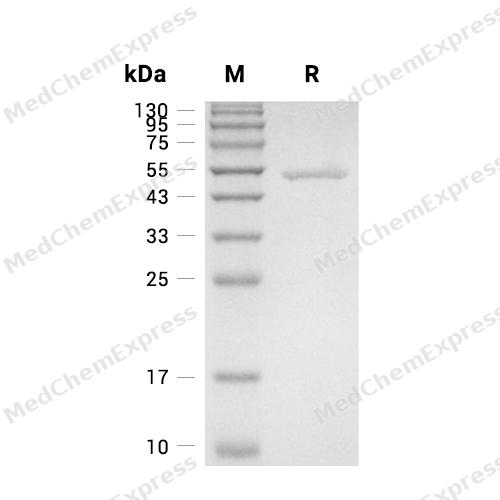
Purity - SDS-PAGE


Technical Parameters
-
Species Others
-
Source E. coli
-
Tag N-6*His
-
Accession
P10519 (I27-K440)
-
Gene ID/
-
Molecular Construction
-
N-term
-
6*His
-
Streptokinase G (I27-K440)
Accession # P10519 -
C-term
-
-
Protein Length
Full Length of Mature Protein
-
Synonyms
Streptokinase G; skg
-
AA Sequence
IAGPEWLLDRPSVNNSQLVVSVAGTVEGTNQDISLKFFEIDLTSRPAHGGKTEQGLSPKSKLFATDSGAMPHKLEKADLLKAIQEQLIANVHSNDDYFEVIDFASDATITDRNGKVYFADKDGSVTLPIQPVQEFLLKGHVRVRPYKEKPVQNQAKSVDVEYTVQFTPLNPDDDFRPALKDTKLLKTLAIGDTITSQELLAQAQSILNKNHPGYTIYERDSSIVTHDNDIFRTILPMDQEFTYHVKNREQAYRINKKSGLNEEINNTDLISEKYYVLKKGEKPYDPFDRSHLKLFTIKYVDVNTNELLKSEQLLTASERNLDFRDLYDPRDKAKLLYNNLDAFGIMDYTLTGKVEDNHDDTNRIITVYMGKRPEGENASYHLAYDKDRYTEEEREVYSYLRYTGTPIPDNPNDK
-
Predicted Molecular Mass
48.2 kDa
-
Molecular Weight
Approximately 50 kDa, based on SDS-PAGE under reducing conditions.
-
Purity
≥ 95%, as determined by reducing SDS-PAGE.


Product Properties
Lyophilized powder.
Lyophilized from a 0.22 μm filtered solution of PBS, pH 7.4.
<1 EU/μg, determined by LAL method.
It is not recommended to reconstitute to a concentration less than 100 μg/mL in ddH2O. For long term storage it is recommended to add a carrier protein (0.1% BSA, 5% HSA, 10% FBS or 5% Trehalose).
Stored at -20°C for 2 years from date of receipt. After reconstitution, it is stable at 4°C for 1 week or -20°C for longer (with carrier protein). It is recommended to freeze aliquots at -20°C or -80°C for extended storage.
Room temperature in continental US; may vary elsewhere.


Documentation
-
Data Sheet (237 KB)
-
SDS (251 KB)
- English - EN (251 KB)
- Français - FR (251 KB)
- Deutsch - DE (251 KB)
- Norwegian - NO (251 KB)
- Español - ES (251 KB)
- Swedish - SV (251 KB)
- Italian - IT (251 KB)
- Korean - KR (251 KB)
- Portuguese - PT (251 KB)
-
Handling Instructions (2659 KB)

Calculators
Concentration (start) × Volume (start) = Concentration (final) × Volume (final)


 Powered by Bioz

