



Thrombomodulin Protein, Human (HEK293, His)
Based on 2 publication(s) in Google Scholar
Thrombomodulin, an endothelial cell receptor, forms a 1:1 complex with thrombin, vital for coagulation regulation. This complex activates protein C, converting it to protein Ca. Protein Ca then inhibits the activated cofactors (factor Va and factor VIIIa) of the coagulation cascade, suppressing thrombin generation. Thrombomodulin's interaction with ITGAL, ITGAM, and ITGB2 emphasizes its role in immune response modulation. Thrombomodulin Protein, Human (HEK293, His) is the recombinant human-derived Thrombomodulin protein, expressed by HEK293 , with C-6*His labeled tag.
- Species: Human
- Source: HEK293
-
Storage:Stored at -20°C for 2 years from date of receipt. After reconstitution, it is stable at 4°C for 1 week or -20°C for longer (with carrier protein). It is recommended to freeze aliquots at -20°C or -80°C for extended storage.


To place orders, for customer services and technical support, please contact: MedChemExpress USA
Tel: 609-228-6898 E-mail: [email protected] [email protected]


-
 Biological Activity
-
Technical Parameters
-
Product Properties
- Documentation
- Help & FAQs




Biological Activity
Description
Thrombomodulin, an endothelial cell receptor, forms a 1:1 complex with thrombin, vital for coagulation regulation. This complex activates protein C, converting it to protein Ca. Protein Ca then inhibits the activated cofactors (factor Va and factor VIIIa) of the coagulation cascade, suppressing thrombin generation. Thrombomodulin's interaction with ITGAL, ITGAM, and ITGB2 emphasizes its role in immune response modulation. Thrombomodulin Protein, Human (HEK293, His) is the recombinant human-derived Thrombomodulin protein, expressed by HEK293 , with C-6*His labeled tag.
Background
Thrombomodulin, a distinctive endothelial cell receptor, establishes a precise 1:1 stoichiometric complex with thrombin, playing a crucial role in the regulation of coagulation. This complex facilitates the conversion of protein C to its activated form, protein Ca. Once activated, protein Ca acts by cleaving the activated cofactors of the coagulation cascade, namely factor Va and factor VIIIa, effectively curbing the generation of thrombin. Thrombomodulin's interaction with ITGAL, ITGAM, and ITGB2 further underscores its involvement in modulating immune responses.
Verified Bioactivity
Measured by its ability to mediate thrombin activation of protein C (HY-P74237) to cleave a peptide substrate, BOC-Val-Pro-Arg-AMC (HY-137784). Read at excitation and emission wavelengths of 380 nm and 460 nm (top read). The specific activity is > 45,000 pmol/min/µg.
MCE Validation Data
-
Purity - SDS-PAGE
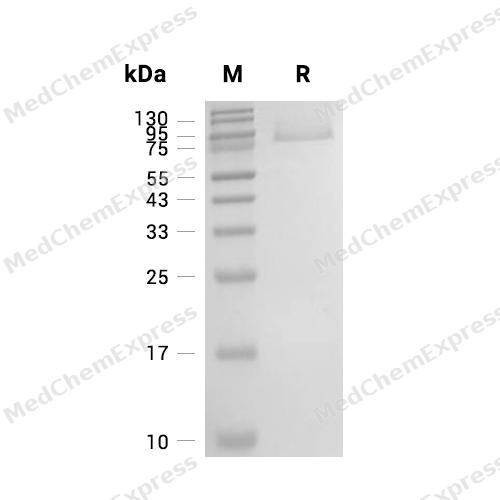
Purity - SDS-PAGE


Publications (2)
-
Journal Impact Factor
-
Most Recent
-
Int J Biol Macromol
Screening for novel variable domains of the heavy chains of heavy-chain antibodies targeting different epitopes of thrombomodulin and Luminex fluorescence immunoassay for soluble thrombomodulin. [Abstract]2026 Jan:336:149289. PMID: 41314569 -
Cell Mol Life Sci
rTM reprograms macrophages via the HIF-1α/METTL3/PFKM axis to protect mice against sepsis. [Abstract]2024 Nov 16;81(1):456. PMID: 39549085


Technical Parameters
-
Species Human
-
Source HEK293
-
Tag C-6*His
-
Accession
P07204 (A19-S515)
-
Gene ID7056
-
Molecular Construction
-
N-term
-
Thrombomodulin (A19-S515)
Accession # P07204 -
6*His
-
C-term
-
-
Protein Length
Extracellular Domain
-
Synonyms
THBD; CD141 Antigen; Thrombomodulin; TM; THRM; THPH12; Fetomodulin; AHUS6; BDCA-3; BDCA3; CD141
-
AA Sequence
APAEPQPGGSQCVEHDCFALYPGPATFLNASQICDGLRGHLMTVRSSVAADVISLLLNGDGGVGRRRLWIGLQLPPGCGDPKRLGPLRGFQWVTGDNNTSYSRWARLDLNGAPLCGPLCVAVSAAEATVPSEPIWEEQQCEVKADGFLCEFHFPATCRPLAVEPGAAAAAVSITYGTPFAARGADFQALPVGSSAAVAPLGLQLMCTAPPGAVQGHWAREAPGAWDCSVENGGCEHACNAIPGAPRCQCPAGAALQADGRSCTASATQSCNDLCEHFCVPNPDQPGSYSCMCETGYRLAADQHRCEDVDDCILEPSPCPQRCVNTQGGFECHCYPNYDLVDGECVEPVDPCFRANCEYQCQPLNQTSYLCVCAEGFAPIPHEPHRCQMFCNQTACPADCDPNTQASCECPEGYILDDGFICTDIDECENGGFCSGVCHNLPGTFECICGPDSALARHIGTDCDSGKVDGGDSGSGEPPPSPTPGSTLTPPAVGLVHS
-
Predicted Molecular Mass
52.9 kDa
-
Molecular Weight
Approximately 64-67 kDa, based on SDS-PAGE under reducing conditions.
-
Glycosylation
Yes
-
Purity
≥ 95%, as determined by reducing SDS-PAGE.


Product Properties
Lyophilized powder
Lyophilized from a 0.22 μm filtered solution of 20 mM Tris-HCl, 150 mM NaCl, pH 8.0.
Note: For SPR assay, please replace the buffer. Primary amine components (e.g., Tris, imidazole) can affect protein-coupled chips.
<1 EU/μg, determined by LAL method.
It is not recommended to reconstitute to a concentration less than 100 μg/mL in ddH2O. For long term storage it is recommended to add a carrier protein (0.1% BSA, 5% HSA, 10% FBS or 5% Trehalose).
Stored at -20°C for 2 years from date of receipt. After reconstitution, it is stable at 4°C for 1 week or -20°C for longer (with carrier protein). It is recommended to freeze aliquots at -20°C or -80°C for extended storage.
Room temperature in continental US; may vary elsewhere.


Documentation
-
Data Sheet (238 KB)
-
SDS (252 KB)
- English - EN (252 KB)
- Français - FR (252 KB)
- Deutsch - DE (252 KB)
- Norwegian - NO (252 KB)
- Español - ES (252 KB)
- Swedish - SV (252 KB)
- Italian - IT (252 KB)
- Korean - KR (252 KB)
- Portuguese - PT (252 KB)
-
Handling Instructions (2659 KB)

Calculators
Concentration (start) × Volume (start) = Concentration (final) × Volume (final)


 Powered by Bioz

