



TLR4 Protein, Human (sf9, His, Solution)
Based on 1 publication(s) in Google Scholar
TLR4 is a transmembrane receptor that recognizes PAMPs and DAMPs and cooperates with LY96 for LPS detection. TLR4 activates MYD88-dependent and independent signaling pathways and participates in TIRAP, TRAF6 and CD14-mediated endocytosis. TLR4 Protein, Human (sf9, His, Solution) is the recombinant human-derived TLR4 protein, expressed by Sf9 insect cells, with C-His labeled tag.
- Species: Human
- Source: Sf9 insect cells
-
Storage:Stored at -80°C for 1 year from date of receipt. It is stable at -20°C for 3 months after opening. It is recommended to freeze aliquots at -80°C for extended storage. Avoid repeated freeze-thaw cycles.


To place orders, for customer services and technical support, please contact: MedChemExpress USA
Tel: 609-228-6898 E-mail: [email protected] [email protected]


-
 Biological Activity
-
Technical Parameters
-
Product Properties
- Documentation
- Help & FAQs




Biological Activity
Description
TLR4 is a transmembrane receptor that recognizes PAMPs and DAMPs and cooperates with LY96 for LPS detection. TLR4 activates MYD88-dependent and independent signaling pathways and participates in TIRAP, TRAF6 and CD14-mediated endocytosis. TLR4 Protein, Human (sf9, His, Solution) is the recombinant human-derived TLR4 protein, expressed by Sf9 insect cells, with C-His labeled tag.
Background
TLR4, a transmembrane receptor, operates as a pattern recognition receptor, detecting pathogen- and damage-associated molecular patterns (PAMPs and DAMPs) to initiate innate immune responses. At the plasma membrane, it collaborates with LY96 to recognize bacterial lipopolysaccharide (LPS), triggering an immune response. Moreover, TLR4 is involved in LPS-independent inflammatory responses induced by free fatty acids and Ni(2+). The receptor acts through signaling pathways involving MYD88, TIRAP, and TRAF6, leading to NF-kappa-B activation and cytokine secretion. Additionally, CD14-mediated TLR4 internalization via endocytosis initiates a MYD88-independent signaling pathway through the TICAM1-TBK1-IRF3 axis, resulting in type I interferon production. TLR4 activation also leads to the activation of the NLRP3 inflammasome and a positive feedback loop between autophagy and the NF-kappa-B signaling cascade. In complex with TLR6, TLR4 promotes inflammation in monocytes/macrophages, and ligand binding triggers internalization and an inflammatory response. TLR4's diverse interactions, including those with LY96, MYD88, TIRAP, TICAM2, NOX4, CNPY3, HSP90B1, CD36, WDFY1, SMPDL3B, CEACAM1, RFTN1, SCIMP, TRAF3IP3, and TREM1, further highlight its pivotal role in orchestrating immune responses and cellular signaling.
Verified Bioactivity
1. Immobilized Recombinant Human TLR4/ CD284 Protein at 1 μg/mL (100 μL/well) on His Tag Antibody, Mouse MAb precoated (5 μg/mL, 100 μL/well) can bind Anti-TLR4 Antibody, the EC50 is 0.8-15 ng/mL.
2. Immobilized Human TLR4 at 2 µg/mL (100 µL/well) can bind bind biotinylated recombinant Human MD2 Protein (HY-P79098). The ED50 for this effect is 0.03486 μg/mL.
MCE Validation Data
-
Bioactivity - ELISA
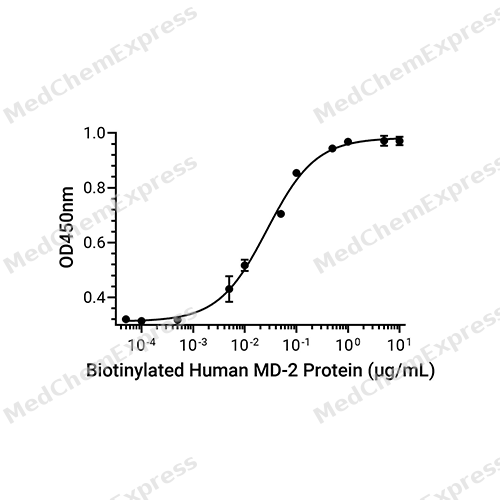
Bioactivity - ELISA


Publications (1)
-
Journal Impact Factor
-
Most Recent
-
Phytomedicine
Simiao Yongan decoction alleviates sepsis-induced liver injury by modulating macrophage polarization via gut-derived ursodeoxycholic acid. [Abstract]2026 Aug:158:158363. PMID: 42284645


Technical Parameters
-
Species Human
-
Source Sf9 insect cells
-
Tag C-His
-
Accession
O00206-1 (E24-K631)
-
Gene ID7099
-
Molecular Construction
-
N-term
-
TLR4 (E24-K631)
Accession # O00206-1 -
His
-
C-term
-
-
Protein Length
Extracellular Domain
-
Synonyms
TLR4; CD284; Toll Like Receptor 4; Toll Like Receptor 4 Protein; Toll-Like Receptor 4; Homolog Of Drosophila Toll; HToll; CD284 Antigen; TLR-4; TOLL; ARMD10
-
AA Sequence
ESWEPCVEVVPNITYQCMELNFYKIPDNLPFSTKNLDLSFNPLRHLGSYSFFSFPELQVLDLSRCEIQTIEDGAYQSLSHLSTLILTGNPIQSLALGAFSGLSSLQKLVAVETNLASLENFPIGHLKTLKELNVAHNLIQSFKLPEYFSNLTNLEHLDLSSNKIQSIYCTDLRVLHQMPLLNLSLDLSLNPMNFIQPGAFKEIRLHKLTLRNNFDSLNVMKTCIQGLAGLEVHRLVLGEFRNEGNLEKFDKSALEGLCNLTIEEFRLAYLDYYLDDIIDLFNCLTNVSSFSLVSVTIERVKDFSYNFGWQHLELVNCKFGQFPTLKLKSLKRLTFTSNKGGNAFSEVDLPSLEFLDLSRNGLSFKGCCSQSDFGTTSLKYLDLSFNGVITMSSNFLGLEQLEHLDFQHSNLKQMSEFSVFLSLRNLIYLDISHTHTRVAFNGIFNGLSSLEVLKMAGNSFQENFLPDIFTELRNLTFLDLSQCQLEQLSPTAFNSLSSLQVLNMSHNNFFSLDTFPYKCLNSLQVLDYSLNHIMTSKKQELQHFPSSLAFLNLTQNDFACTCEHQSFLQWIKDQRQLLVEVERMECATPSDKQGMPVLSLNITCQMNK
-
Predicted Molecular Mass
70.5 kDa
-
Molecular Weight
Approximately 75-85 kDa, based on SDS-PAGE under reducing conditions, due to the glycosylation.
-
Glycosylation
Yes
-
Structure/Form
Monomer
-
Purity
≥ 85%, as determined by reducing SDS-PAGE.


Product Properties
Solution
Supplied as a 0.22 μm filtered solution of 20 mM PB, 500 mM NaCl, pH 6.0, 10% Glycerol.
<1 EU/μg, determined by LAL method.
Please use rapid thawing with running water to thaw the protein.
Stored at -80°C for 1 year from date of receipt. It is stable at -20°C for 3 months after opening. It is recommended to freeze aliquots at -80°C for extended storage. Avoid repeated freeze-thaw cycles.
Shipping with dry ice.


Documentation
-
Data Sheet (239 KB)
-
SDS (252 KB)
- English - EN (252 KB)
- Français - FR (252 KB)
- Deutsch - DE (252 KB)
- Norwegian - NO (252 KB)
- Español - ES (252 KB)
- Swedish - SV (252 KB)
- Italian - IT (252 KB)
- Korean - KR (252 KB)
- Portuguese - PT (252 KB)
-
Handling Instructions (2659 KB)

Calculators
Concentration (start) × Volume (start) = Concentration (final) × Volume (final)


 Powered by Bioz

