



Tryptase beta-2 Protein, Mouse (HEK293, His)
Based on 1 publication(s) in Google Scholar
Tryptase beta-2, a neutral protease abundant in mast cells, plays a key role in innate immunity.As the primary proteolytic enzyme released during mast cell activation, Tryptase beta-2 contributes significantly to immune functions.Its involvement underscores its importance in mediating cellular responses linked to innate immunity, highlighting its role in the intricate defense mechanisms of the immune system.Tryptase beta-2 Protein, Mouse (HEK293, His) is the recombinant mouse-derived Tryptase beta-2 protein, expressed by HEK293 , with C-6*His labeled tag.
- Species: Mouse
- Source: HEK293
-
Storage:Stored at -80°C for 1 year from date of receipt. It is stable at -20°C for 3 months after opening. It is recommended to freeze aliquots at -80°C for extended storage. Avoid repeated freeze-thaw cycles.


To place orders, for customer services and technical support, please contact: MedChemExpress USA
Tel: 609-228-6898 E-mail: [email protected] [email protected]


-
 Biological Activity
-
Technical Parameters
-
Product Properties
- Documentation
- Help & FAQs




Biological Activity
Description
Tryptase beta-2, a neutral protease abundant in mast cells, plays a key role in innate immunity.As the primary proteolytic enzyme released during mast cell activation, Tryptase beta-2 contributes significantly to immune functions.Its involvement underscores its importance in mediating cellular responses linked to innate immunity, highlighting its role in the intricate defense mechanisms of the immune system.Tryptase beta-2 Protein, Mouse (HEK293, His) is the recombinant mouse-derived Tryptase beta-2 protein, expressed by HEK293 , with C-6*His labeled tag.
Background
Tryptase beta-2, a neutral protease primarily found in mast cells, assumes a significant role in innate immunity. It acts as the major proteolytic enzyme released during the activation-degranulation response of mast cells, contributing to their immune functions. The involvement of Tryptase beta-2 underscores its importance in mediating cellular responses associated with innate immunity, emphasizing its role in the complex and dynamic defense mechanisms of the immune system.
MCE Validation Data
-
Purity - SDS-PAGE
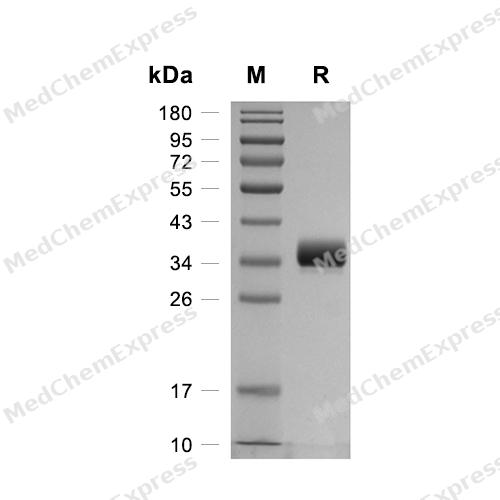
Purity - SDS-PAGE


Publications (1)
-
Journal Impact Factor
-
Most Recent
-
J Invest Dermatol
Mast cells Initiate Type 2 Inflammation via Tryptase Released by MRGPRX2/MrgprB2 Activation in Atopic Dermatitis. [Abstract]2024 Jan;144(1):53-62.e2. PMID: 37482287


Technical Parameters
-
Species Mouse
-
Source HEK293
-
Tag C-6*His
-
Accession
P21845 (A22-S276)
-
Molecular Construction
-
N-term
-
TPSB2 (A22-S276)
Accession # P21845 -
6*His
-
C-term
-
-
Protein Length
Full Length of Mature Protein (with Propeptide)
-
Synonyms
TPSB2; Tryptase Beta III; Tryptase Beta 2; Tryptase Beta II; Testicular Tissue Protein Li 163; TPSB2 Protein; Tryptase Beta-2; Tryptase II; TPS2; Tryptase-2; Tryptase Beta 2 (Gene/Pseudogene); TryptaseB; Mast Cell Tryptase Beta III; TryptaseC; Mast Cell T
-
AA Sequence
APRPANQRVGIVGGHEASESKWPWQVSLRFKLNYWIHFCGGSLIHPQWVLTAAHCVGPHIKSPQLFRVQLREQYLYYGDQLLSLNRIVVHPHYYTAEGGADVALLELEVPVNVSTHIHPISLPPASETFPPGTSCWVTGWGDIDNDEPLPPPYPLKQVKVPIVENSLCDRKYHTGLYTGDDFPIVHDGMLCAGNTRRDSCQGDSGGPLVCKVKGTWLQAGVVSWGEGCAQPNKPGIYTRVTYYLDWIHRYVPEHS
-
Predicted Molecular Mass
29.3 kDa
-
Molecular Weight
Approximately 32-38 kDa, based on SDS-PAGE under reducing conditions, due to the glycosylation.
-
Glycosylation
Yes
-
Purity
≥ 95%, as determined by reducing SDS-PAGE.


Product Properties
Solution
Supplied as a 0.22 μm filtered solution of 20 mM PB, 50% glycerin, pH 8.0.
<1 EU/μg, determined by LAL method.
Stored at -80°C for 1 year from date of receipt. It is stable at -20°C for 3 months after opening. It is recommended to freeze aliquots at -80°C for extended storage. Avoid repeated freeze-thaw cycles.
Shipping with dry ice.


Documentation
-
Data Sheet (236 KB)
-
SDS (251 KB)
- English - EN (251 KB)
- Français - FR (251 KB)
- Deutsch - DE (251 KB)
- Norwegian - NO (251 KB)
- Español - ES (251 KB)
- Swedish - SV (251 KB)
- Italian - IT (251 KB)
- Korean - KR (251 KB)
- Portuguese - PT (251 KB)
-
Handling Instructions (2659 KB)

Calculators
Concentration (start) × Volume (start) = Concentration (final) × Volume (final)


 Powered by Bioz

