1. Search Result
Search Result
Results for "

ATCC 25923

" in MedChemExpress (MCE) Product Catalog:

15

Inhibitors & Agonists

1

Peptides

5

Natural
Products

1

Isotope-Labeled Compounds

Cat. No. Product Name Target Research Areas Chemical Structure
  • HY-B0960
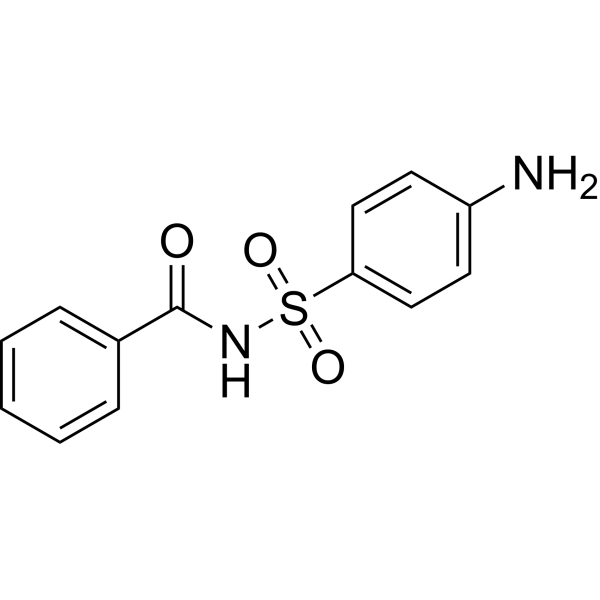
    Sulfabenzamide
    1 Publications Verification

    N-Sulfanilylbenzamide

    Bacterial Autophagy MDM-2/p53 Caspase PARP DNA-PK Akt Infection Cancer
    Sulfabenzamide (N-Sulfanilylbenzamide) is a sulfonamide antibacterial agent. Sulfabenzamide exhibit antibacterial activity against Staphylococcus aureus (ATCC 25923) and Escherichia coli (ATCC 8739). Sulfabenzamide can promote autophagic cell autophagy in breast cancer cells through p53/ DRAM pathway. Sulfabenzamide increases caspase-3 activity, deactivates PARP1 and DNA-PK, downregulates AKT1 and AKT2. Sulfabenzamide can be used for the researches of breast cancer and bacterial infections .
    Sulfabenzamide
  • HY-W076794

    Bacterial Infection
    3-Bromo-1H-pyrrole-2,5-dione (compound 2c) is a 3-substituted pyrrole-2,5-dione compound with antibacterial activity. 3-Bromo-1H-pyrrole-2,5-dione inhibits pathogenic strains of S. aureus ATCC 25923, E. coli ATCC 25922, P. aeruginosa ATCC 27853, with MIC values of 32 μg/mL, 32 μg/mL, and 64 μg/mL, respectively .
    3-Bromo-1H-pyrrole-2,5-dione
  • HY-N7430

    Bacterial Infection Inflammation/Immunology
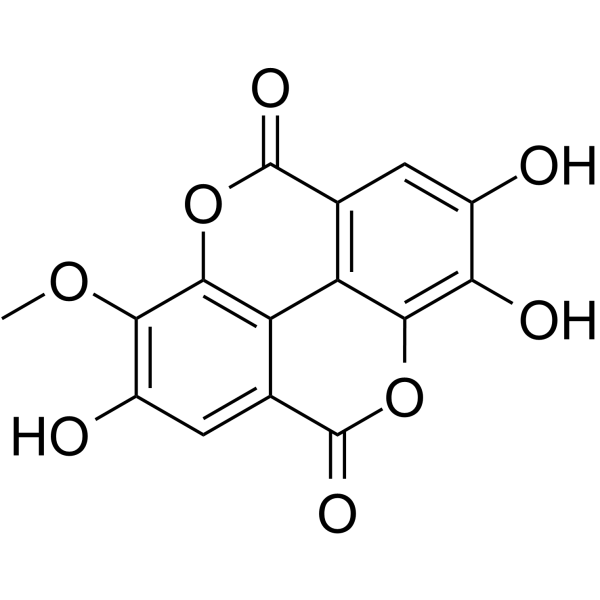
    3-O-Methylellagic acid is a nature product that can be isolated from Myrciaria cauliflora, with anti-inflammatory activity. 3-O-Methylellagic acid shows an inhibitory effect on glucose transport assay. 3-O-Methylellagic acid has antibacterial activity, with a MIC of 32 μg/mL for Staph. Aureus ATCC 25923 .
    3-O-Methylellagic acid
  • HY-B0960S

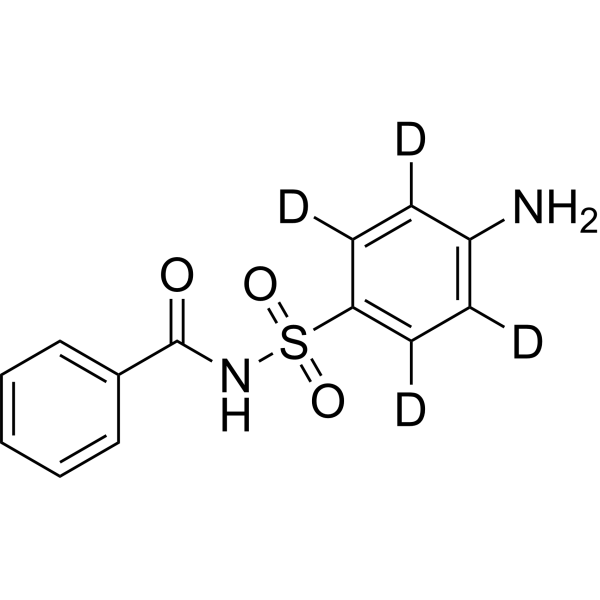
    N-Sulfanilylbenzamide-d4

    Bacterial Autophagy Isotope-Labeled Compounds MDM-2/p53 Caspase PARP DNA-PK Akt Infection Cancer
    Sulfabenzamide (N-Sulfanilylbenzamide)-d4 is the deuterium labeled Sulfabenzamide (HY-B0960). Sulfabenzamide is a sulfonamide antibacterial agent. Sulfabenzamide exhibit antibacterial activity against Staphylococcus aureus (ATCC 25923) and Escherichia coli (ATCC 8739). Sulfabenzamide can promote autophagic cell autophagy in breast cancer cells through p53/ DRAM pathway. Sulfabenzamide increases caspase-3 activity, deactivates PARP1 and DNA-PK, downregulates AKT1 and AKT2. Sulfabenzamide can be used for the researches of breast cancer and bacterial infections .
    Sulfabenzamide-d4
  • HY-N16339

    Bacterial Infection
    8-Desmethyleleutherin (Compound 2) is an antibacterial agent that can be extracted from the bulbs of Eleutherine americana. 8-Desmethyleleutherin has MIC values of both 62.5 µg/mL for S. aureus strains ATCC27664 and ATCC25923 .
    8-Desmethyleleutherin
  • HY-173054

    Bacterial Infection
    FtsZ-IN-12 (Compound 16e) is the inhibitor for filamentous temperature-sensitive mutant Z (FtsZ) that promotes the polymerization of FtsZ protein, inhibits its GTPase activity, thereby interfering with bacterial cell division process. FtsZ-IN-12 exhibits boardspectrum antibacterial activity that inhibits B. subtilis ATCC9372, B. pumilus CMCC63202, S. aureus ATCC25923, E. coli BW25113 and A. baumannii ATCC19606 with MIC of 0.062-1 μg/mL. FtsZ-IN-12 inhibits the formation of bacterial biofilms and exhibits a clearing effect on mature biofilms. FtsZ-IN-12 exhibits bactericidal activity without hemolytic toxicity to mammalian red blood cells (15 mg/kg) .
    FtsZ-IN-12
  • HY-N10211

    Bacterial Endogenous Metabolite Infection
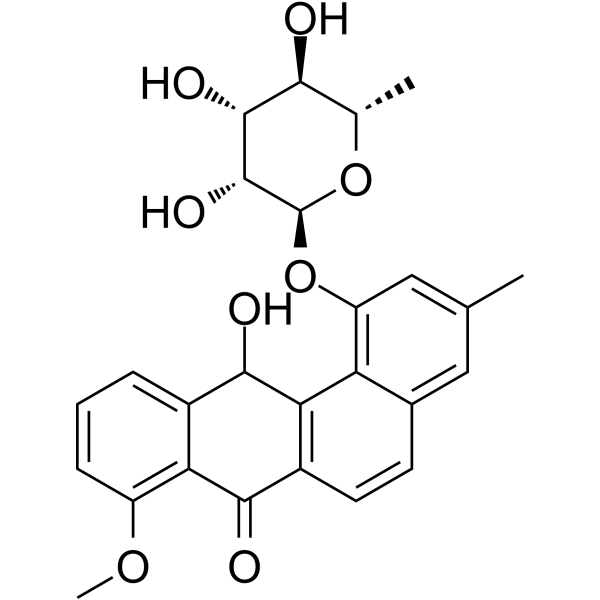
    Saccharothrixin K, a glycosylated saccharothrixin, shows moderate inhibition against Helicobacter pylori G27, H. pylori 159, and Staphylococcus aureus ATCC25923 with MIC values of 16 μg/mL .
    Saccharothrixin K
  • HY-B0960R

    N-Sulfanilylbenzamide (Standard)

    Reference Standards Bacterial Autophagy MDM-2/p53 Caspase PARP DNA-PK Akt Infection Cancer
    Sulfabenzamide (N-Sulfanilylbenzamide) (Standard) is the analytical standard of Sulfabenzamide (HY-B0960). This product is intended for research and analytical applications. Sulfabenzamide is a sulfonamide antibacterial agent. Sulfabenzamide exhibit antibacterial activity against Staphylococcus aureus (ATCC 25923) and Escherichia coli (ATCC 8739). Sulfabenzamide can promote autophagic cell autophagy in breast cancer cells through p53/ DRAM pathway. Sulfabenzamide increases caspase-3 activity, deactivates PARP1 and DNA-PK, downregulates AKT1 and AKT2. Sulfabenzamide can be used for the researches of breast cancer and bacterial infections .
    Sulfabenzamide (Standard)
  • HY-177539

    Drug Isomer Bacterial Parasite Infection
    ent-Epanorin is an enantiomer of Epanorin (HY-N16418). ent-Epanorin has more potent antibacterial and antiparasitic activity against Bacillus subtilis (ATCC 6633), Staphylococcus aureus (ATCC 25923) and Giardiaduodenalis 713 compared to Epanorin .
    ent-Epanorin
  • HY-155282

    Fatty Acid Synthase (FASN) Bacterial Inflammation/Immunology
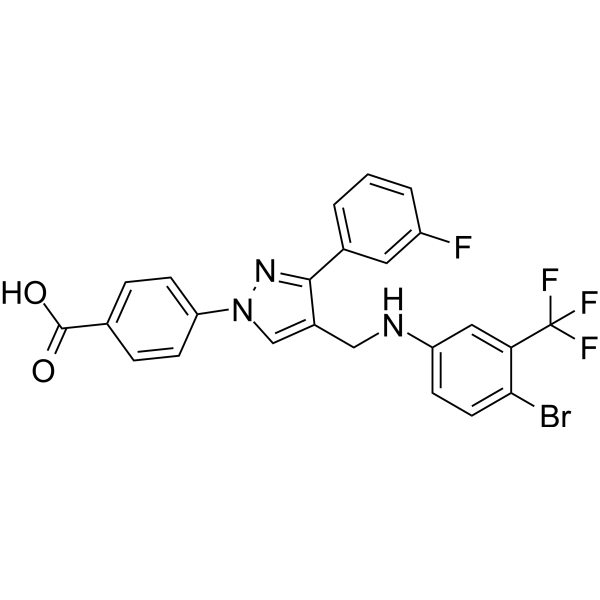
    FASN-IN-6 (compound 44) is a potent fatty acid biosynthesis (FAB) inhibitor. FASN-IN-6 is an antibacterial agent with MICs of 1 μg/mL and 4 μg/mL for S. aureus ATCC 25923 and E. faecalis ATCC 29212, respectively .
    FASN-IN-6
  • HY-177540

    Drug Isomer Bacterial Parasite Infection Cancer
    ent-Rhizocarpic acid is an enantiomer of Rhizocarpic acid. ent-Rhizocarpic acid has more potent antibacterial and antiparasitic activity against Staphylococcus aureus (ATCC 25923) and Giardiaduodenalis 713 compared to Rhizocarpic acid. ent-Rhizocarpic acid also has a weak but selective antitumor activity against NS-1 cells .
    ent-Rhizocarpic acid
  • HY-173240

    Bacterial Infection
    IPMCL-28b is an antibacterial agent targeting the bacterial cell membrane. Its minimum inhibitory concentration (MIC) against Staphylococcus aureus ATCC 25923 is 1.56 μg/mL, and the MIC against methicillin-resistant Staphylococcus aureus (MRSA) is 6.25 μg/mL. IPMCL-28b is expected to be used in the research of the anti-infection field .
    IPMCL-28b
  • HY-N10907

    Bacterial Infection
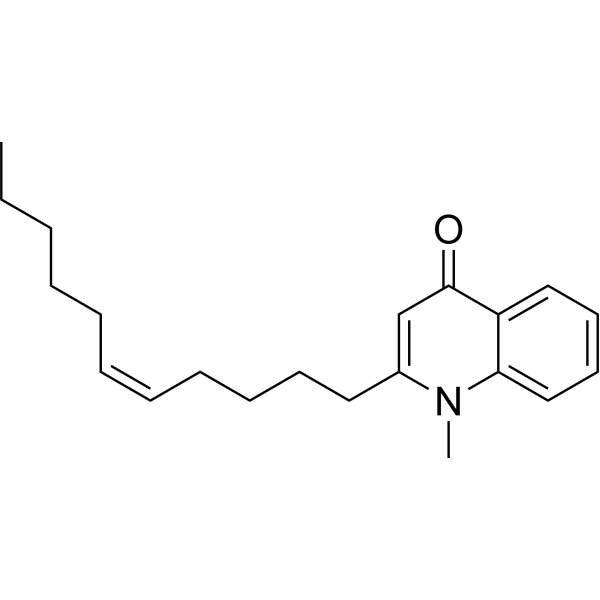
    4(1H)-Quinolinone, 1-methyl-2-(5Z)-5-undecen-1-yl- (compound 2) is a quinolone alkaloid that can be isolated from Cnidium. 4(1H)-Quinolinone, 1-methyl-2-(5Z)-5-undecen-1-yl- has methicillin-resistant Staphylococcus aureus (MRSA) activity, with MIC values of 32 μg/mL (ATCC 33591) and 16 μM/mL (ATCC 25923), respectively .
    4(1H)-Quinolinone, 1-methyl-2-(5Z)-5-undecen-1-yl-
  • HY-N18009

    Bacterial Infection Cancer
    1-Hydroxy-3,5-dimethoxyxanthone is a xanthone and Antibacterial agent. 1-Hydroxy-3,5-dimethoxyxanthone can be isolated from Lomatogonium rotatum. 1-Hydroxy-3,5-dimethoxyxanthone inhibits the growth of Pseudomonas aeruginosa ATCC27853 and Escherichia coli ATCC25923 with an MIC of 640 μg/mL. 1-Hydroxy-3,5-dimethoxyxanthone exhibits anticancer activity against cervical cancer, breast cancer, melanoma, liver cancer, and gastric cancer .
    1-Hydroxy-3,5-dimethoxyxanthone
  • HY-P11468

    Bacterial Antibiotic Cardiovascular Disease Infection
    wkwkwNGwkwkw-NH2 is a self-assembling β-hairpin antimicrobial peptide. wkwkwNGwkwkw-NH2 self-assembles into nanofibers. wkwkwNGwkwkw-NH2 interacts with LPS on the surface of the bacterial membrane and then disrupts the bacterial outer membrane, inner membrane, and cytoplasmic membrane to exert its antibacterial effects. wkwkwNGwkwkw-NH2 has high antibacterial activity and low hemolytic activity. wkwkwNGwkwkw-NH2 significantly reduces the S. aureus ATCC 25923 load at the skin wound. wkwkwNGwkwkw-NH2 displays synergistic effects when combined with antibiotics. wkwkwNGwkwkw-NH2 facilitates wound healing .
    wkwkwNGwkwkw-NH2

Inquiry Online

Your information is safe with us. * Required Fields.

Salutation


Country or Region *

Applicant Name *


Organization Name *

Department *


Email Address *


Product Name *

Cat. No.


Requested quantity *

Phone Number *


Remarks

Inquiry Online

Inquiry Information

Product Name:
Cat. No.:
Quantity:
MCE Japan Authorized Agent:

