4 Results for "

DNA major grooves

" in MedChemExpress (MCE) Product Catalog:
Products (4)

4 Results for "DNA major grooves" in MCE Product Catalog:

1
1 Cited Publications
Cat. No.: HY-D0163
CAS No.: 14855-76-6
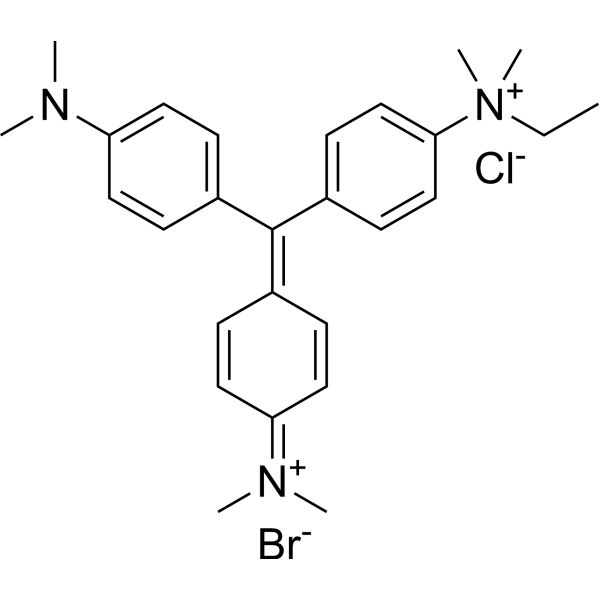
Methyl Green is a non-intercalating fluorescent labeling agent that selectively binds to the major groove of DNA. Methyl Green electrostatically interacts with the major groove of DNA through positively charged groups, exhibiting key activities such as high affinity, resistance to photobleaching, and stable fluorescence emission. Methyl Green can be directly measured by microscopy and flow cytometry, with peaks at 633 and 677 nm. Methyl Green can be used for fluorescent labeling of the nuclei of embryonic tissues or cells, or DNA staining and cell activity detection in gel electrophoresis[1][2][3].
loading...
    loading...
1
1 Cited Publications
Cat. No.: HY-13747
CAS No.: 13909-09-6
Purity:  ≥98.0%
Research Areas:  

Cancer

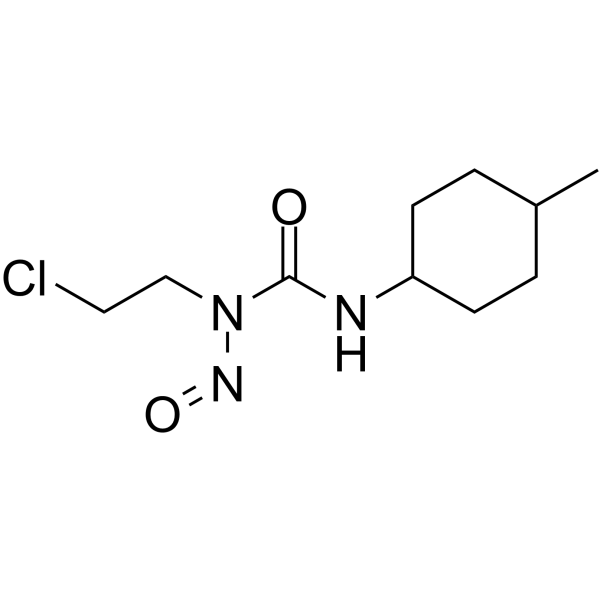
Semustine is an orally active, blood-brain barrier permeable antitumor alkylating agent with a binding affinity of 1.53 × 10 3 M -1 for guanine and thymine residues in bovine DNA. Semustine undergoes major groove-directed alkylation at guanine residues to form O6-chloroethylguanine and N1-O6-ethanoguanine adducts, and generates dG-dC interstrand crosslinks. Semustine induces partial B- to C-type transition of DNA, base stacking and helical structure distortion, mild dehydration, as well as partial DNA double-strand unwinding. Semustine can be used in research related to Lewis lung cancer, leukemia, Hodgkin's lymphoma, malignant melanoma, glioma, and diffuse large B-cell lymphoma .
loading...
    loading...
Cat. No.: HY-D0074
CAS No.: 70504-01-7
Target:  

Fluorescent Dye

Research Areas:  

Others

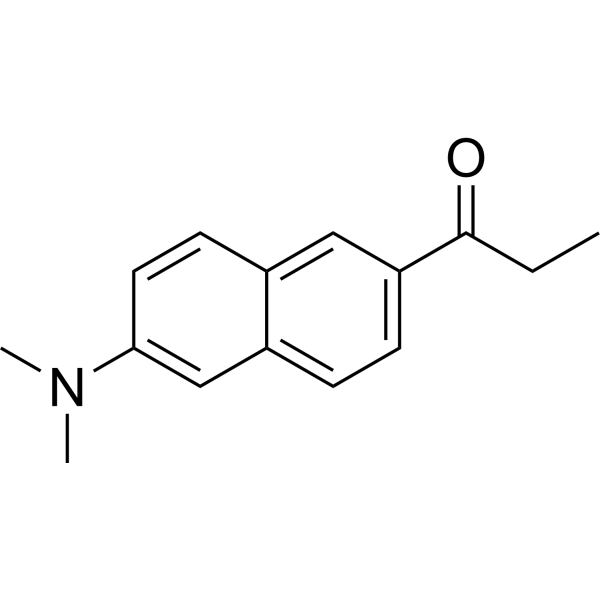
Prodan is an environment-sensitive fluorescent probe used to investigate the polarity, fluidity, and structure of lipid membranes. Prodan exhibits environment-dependent excitation/emission wavelengths, with its wavelength range covering Ex = 360-410 nm and Em = 430-530 nm when in solvents, bound to DNA, located in lipid bilayers, or associated with proteins. Prodan can interact with the major groove of DNA, regions of lipid bilayers, and hydrophobic pockets of proteins. During phase transitions, Prodan localizes to different regions of the bilayer: the emission minimum is 430-440 nm in the gel phase, while it shifts to 480-500 nm in the liquid-crystalline phase or interdigitated gel phase. When bound to rigid hydrophobic sites of proteins, the emission peak of Prodan undergoes a blue shift and its fluorescence intensity increases .
loading...
    loading...
Cat. No.: HY-183480
CAS No.: 80841-47-0
Synonyms: CI-921; NSC 343499
Target:  

Topoisomerase

Research Areas:  

Cancer

Asulacrine (CI-921) is an orally active DNA intercalating topoisomerase II inhibitor. Asulacrine binds to DNA via intercalation, with its acridine chromophore intercalated between base pairs and substituents located in the major/minor grooves, which stabilizes DNA against acid denaturation. Asulacrine acts as a cell cycle inhibitor, disruptor, and arrest inducer, slowing cell progression in late S/G2 phase, causing G2 phase arrest and inducing unbalanced growth. Asulacrine inhibits cell growth, clonogenicity, and colony formation, and leads to histological destruction of tumor cells. Compared to cells in exponential growth phase, Asulacrine exhibits lower toxicity to quiescent cells; its activity depends on cationic properties, and it has better water solubility and metabolic stability. Asulacrine can be used in research related to leukemia, lung cancer, colon cancer, breast cancer, melanoma, adriamycin-resistant mammary adenocarcinoma, and mouse solid tumors .
loading...
    loading...

