
7 Results for "

DNase I cleavage

" in MedChemExpress (MCE) Product Catalog:
Products (7)

7 Results for "DNase I cleavage" in MCE Product Catalog:

46
46 Publications Verification
Cat. No.: HY-108882
CAS No.: 9003-98-9
Synonyms: DNase
Target:  

Others

Research Areas:  

Inflammation/Immunology Cancer

DNase I (EC 3.1.21.1) is an enzyme that degrade DNA, it plays a key role in the cleavage of extracellular DNA is crucial for limiting the inflammatory response and maintaining homeostasis. Exogenous deoxyribonuclease shows beneficial effects in inflammatory diseases and cancer .
loading...
    loading...
46
46 Publications Verification
Cat. No.: HY-108882B
CAS No.: 9003-98-9
Target:  

DNA/RNA Synthesis

Research Areas:  

Inflammation/Immunology

DNase I is an enzyme that degrades DNA. DNase I is mainly produced by digestive system organs, such as the pancreas and parotid gland. Three types of DNase I are known in mammals: pancreatic type, parotid type, and pancreatico-parotid type. DNase I plays a key role in the cleavage of extracellular DNA, and is critical for limiting inflammatory responses and maintaining homeostasis. DNase I is responsible for digesting extracellular nucleoproteins, which may be essential for preventing autoimmune responses. Decreased DNase I activity may be associated with the onset and progression of systemic lupus erythematosus (SLE). DNase I (RNase & Protease free) is a molecular biology-grade DNase I purified by chromatography to remove RNase and protease .
loading...
    loading...
46
46 Publications Verification
Cat. No.: HY-108882C
CAS No.: 9003-98-9
Target:  

DNA/RNA Synthesis

Research Areas:  

Inflammation/Immunology

DNase I is an enzyme that degrades DNA. DNase I is mainly produced by digestive system organs, such as the pancreas and parotid gland. Three types of DNase I are known in mammals: pancreatic type, parotid type, and pancreatico-parotid type. DNase I plays a key role in the cleavage of extracellular DNA, and is critical for limiting inflammatory responses and maintaining homeostasis. DNase I is responsible for digesting extracellular nucleoproteins, which may be essential for preventing autoimmune reactions. Decreased DNase I activity may be associated with the occurrence and development of systemic lupus erythematosus (SLE). DNase I (filtered) is filtered through a 0.22 μM membrane and is not tested for pyrogenicity .
loading...
    loading...
6
6 Cited Publications
Cat. No.: HY-100875
CAS No.: 78186-34-2
Purity:  98.08%
Synonyms: CL216942
Target:  

Topoisomerase

Research Areas:  

Cancer

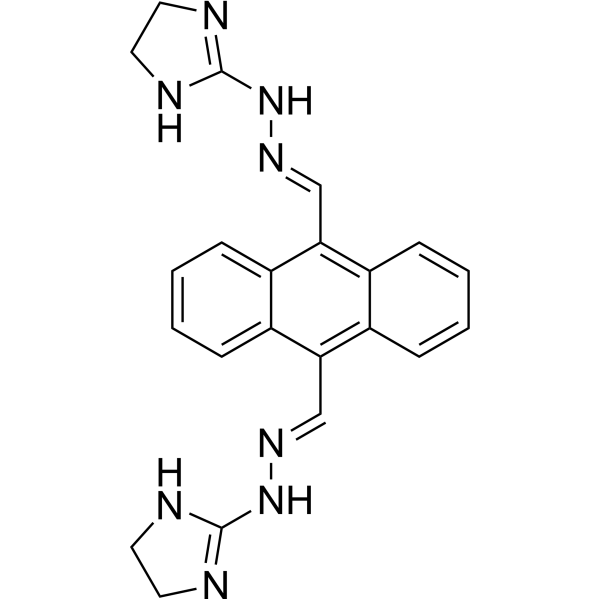
Bisantrene is a highly effective antitumor agent, it exerts its cytotoxicity by affecting DNA intercalation. Bisantrene targets eukaryotic type II topoisomerases. Bisantrene is a substrate of MDR1 .
loading...
    loading...
6
6 Cited Publications
Cat. No.: HY-100875A
CAS No.: 71439-68-4
Purity:  98.86%
Synonyms: CL-216942 dihydrochloride
Target:  

Topoisomerase

Research Areas:  

Cancer

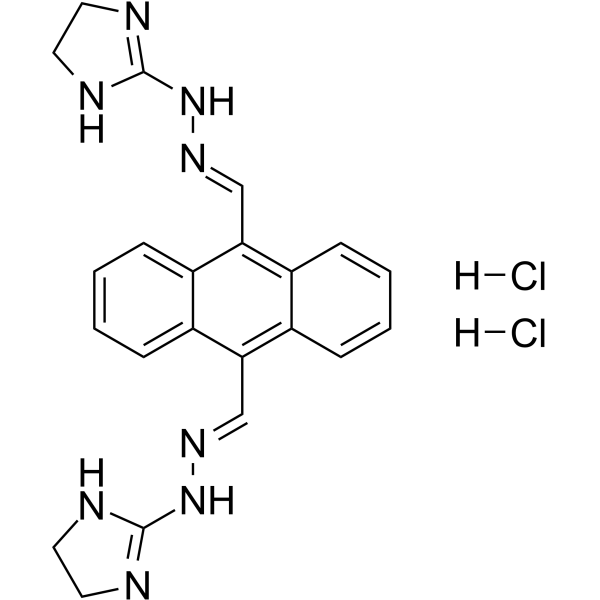
Bisantrene dihydrochloride is a highly effective antitumor agent, it exerts its cytotoxicity by affecting DNA intercalation. Bisantrene dihydrochloride targets eukaryotic type II topoisomerases. Bisantrene dihydrochloride is a substrate of MDR1 .
loading...
    loading...
Cat. No.: HY-100875R
CAS No.: 78186-34-2
Synonyms: CL216942 (Standard)
Research Areas:  

Cancer

Bisantrene (Standard) is the analytical standard of Bisantrene. This product is intended for research and analytical applications. Bisantrene is a highly effective antitumor agent, it exerts its cytotoxicity by affecting DNA intercalation. Bisantrene targets eukaryotic type II topoisomerases. Bisantrene is a substrate of MDR1 .
loading...
    loading...
Cat. No.: HY-100875AR
CAS No.: 71439-68-4
Synonyms: CL-216942 dihydrochloride (Standard)
Research Areas:  

Cancer

Bisantrene (dihydrochloride) (Standard) is the analytical standard of Bisantrene (dihydrochloride) (HY-100875A). This product is intended for research and analytical applications. Bisantrene dihydrochloride is a highly effective antitumor agent, it exerts its cytotoxicity by affecting DNA intercalation. Bisantrene dihydrochloride targets eukaryotic type II topoisomerases. Bisantrene dihydrochloride is a substrate of MDR1 .
loading...
    loading...

