16 Results for "

H460 cell lines

" in MedChemExpress (MCE) Product Catalog:
Products (16)

16 Results for "H460 cell lines" in MCE Product Catalog:

1
1 Cited Publications
Cat. No.: HY-123298
CAS No.: 156951-82-5
Purity:  99.52%
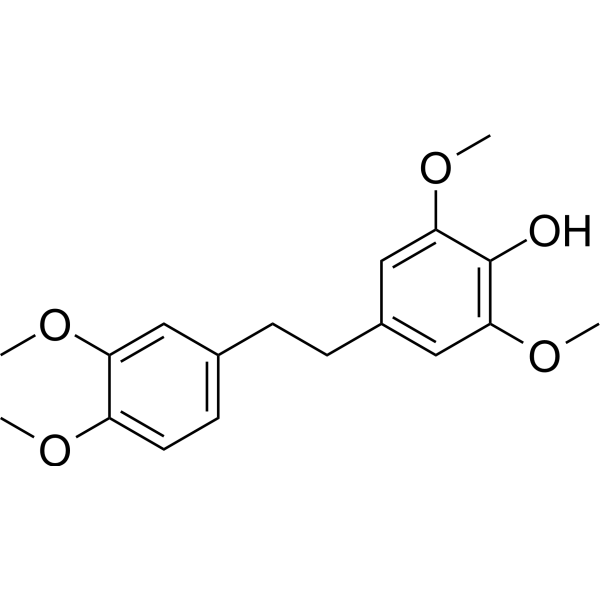
Chrysotoxine is a dual inhibitor of Src/Akt. Chrysotoxine suppresses cancer stem cells (CSCs) phenotypes by down-regulating Src/Akt signaling. Chrysotoxine reduces cell viability and increases apoptosis level in H460 and H23 cells instead of non-tumor cell lines. Chrysotoxine shows rapid excretion and low bioavailability in rats. Chrysotoxine is used in cancer research .
loading...
    loading...
Cat. No.: HY-142094
CAS No.: 675190-57-5
Research Areas:  

Cancer

NSD3-IN-2 is a potent NSD3 inhibitor with an IC50 value of 17.97 μM. NSD3-IN-2 inhibits the growth and proliferation of non-small cell lung cancer cell lines H460, H1299 and H1650 with anti-cancer activity .
loading...
    loading...
Cat. No.: HY-101741
CAS No.: 256934-83-5
Synonyms: A-289099
Research Areas:  

Cancer

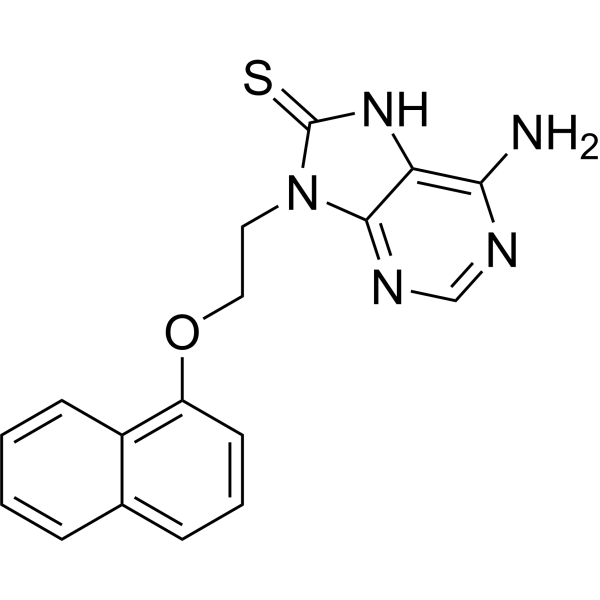
A-259745 is an orally active antimitotic agent that binds to the colchicine-binding site of tubulin. A-259745 exhibits potent in vitro cytotoxic activity against both multi-drug-resistant and non-multi-drug-resistant cancer cell lines, with ED50 values of 0.018 μM against HCT-15 and 0.028 μM against NCI-H460 cell lines. A-259745 inhibits tubulin polymerization, disrupts the dynamic equilibrium of the mitotic spindle, arrests dividing cells in metaphase, and subsequently induces apoptosis. A-259745 shows dose-dependent antitumor efficacy in murine tumor models. A-259745 can be used for the study of cancer .
loading...
    loading...
Cat. No.: HY-147724
CAS No.: 1236141-96-0
Target:  

Microtubule/Tubulin

Research Areas:  

Cancer

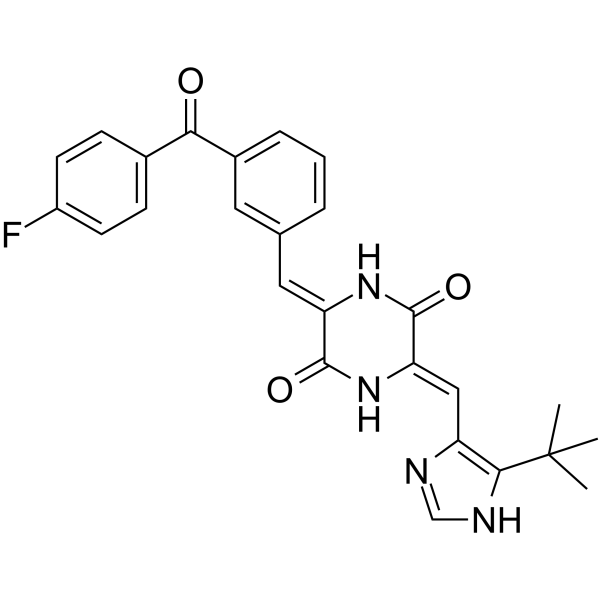
Compounds 17O (ic50= 14.0 nm, NCI-H460) and 17p (ic50= 2.9 nm, NCI-H460) and furan groups showed effective cytotoxic activity against various human cancer cell lines at the nanomolar level.
loading...
    loading...
Cat. No.: HY-147728
CAS No.: 2416338-65-1
Target:  

Microtubule/Tubulin

Research Areas:  

Cancer

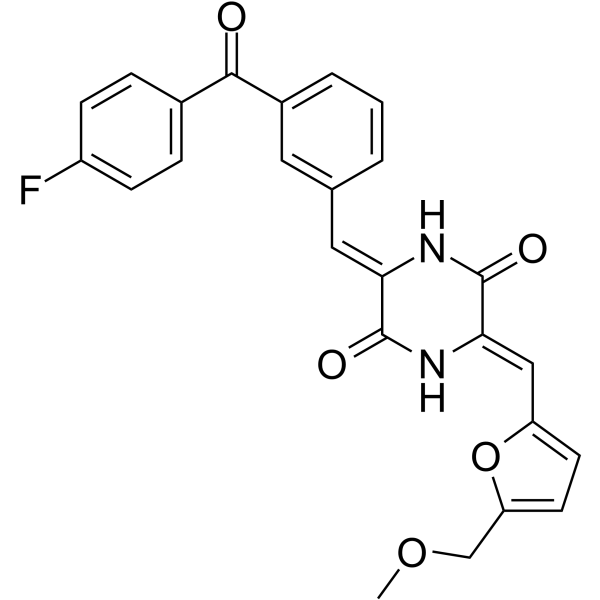
Compounds 17O (ic50= 14.0 nm, NCI-H460) and 17p (ic50= 2.9 nm, NCI-H460) and furan groups showed effective cytotoxic activity against various human cancer cell lines at the nanomolar level.
loading...
    loading...
Cat. No.: HY-173074
CAS No.: 3025180-14-4
Research Areas:  

Cancer

Microtubulin-IN-1 (Compound 8g) is the inhibitor for microtubulin that targets colchicine-binding site, disrupts the microtubulin integrity, and induces the upregulation of p53. Microtubulin-IN-1 exhibits antiproliferative activity in a variety of cancer cell lines (IC50 for NCI-H460, BxPC-3 and HT-29 is 2.4, 1.6 and 2.07 nM, respectively), arrests the cell cycle at G2/M phase, and induces apoptosis in NCI-H460 .
loading...
    loading...
Cat. No.: HY-N10877
CAS No.: 1461760-59-7
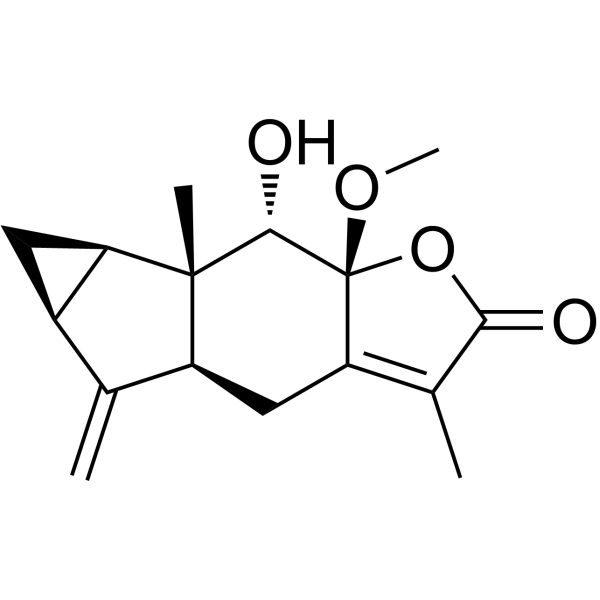
Chlorajapolide F is a nature product that could be isolated from the aerial part of Chloranthus japonicas. Chlorajapolide F has low cytotoxic activity against NCI-H460 and SMMC-7721 cell lines .
loading...
    loading...
Cat. No.: HY-139882
CAS No.: 2761205-38-1
Research Areas:  

Cancer

Anticancer agent 16 exhibits good cytotoxic activity against HCT-116, NCI-H460, and SKOV3 cell lines with IC50 8.55 μΜ, 5.41 μΜ, and 6.4 μΜ, respectively.
loading...
    loading...
Cat. No.: HY-117872
CAS No.: 1452396-10-9
Synonyms: 20-O-Acetylsartorypyrone D
Target:  

Fungal

Sartorypyrone A (20-O-Acetylsartorypyrone D) is a monocyclic terpenoid isolated from the soil fungus Neosartorya fischeri. Sartorypyrone A exhibits in vitro growth inhibitory activity against MCF-7, NCI-H460, and A375-C5 cell lines, and has potential anticancer properties.
loading...
    loading...
Cat. No.: HY-157564
CAS No.: 2922110-00-5
Target:  

Apoptosis

Research Areas:  

Cancer

Antitumor agent-135 (Compound 13) is a potent antitumor agent. Antitumor agent-135 induces cell apoptosis, with IC50s of 3.79 , 10.55, 1.14, and 4.14 μM for NSCLC cell lines (A549, H460, PC-9, and PC-9/GR) .
loading...
    loading...
Cat. No.: HY-N10876
CAS No.: 863301-69-3
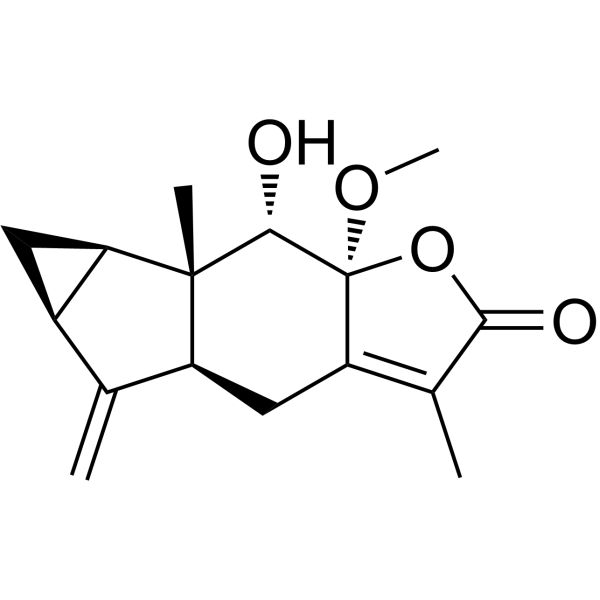
8-epi-Chlorajapolide F (compound 1) a sesquiterpene that can be isolated from the aboveground part of the Chloranthus japonicus. 8-epi-Chlorajapolide has few cytotoxic to human cancer cell lines NCI-H460 and SMMC-7721 (IC50s>50 μg/mL) .
loading...
    loading...
Cat. No.: HY-169476
CAS No.: 3140-51-0
Target:  

Drug Derivative

Research Areas:  

Cancer

Pyrrolidine linoleamide is a derivative of linoleic acid amide with anticancer activity. Pyrrolidine linoleamide exhibits antiproliferative activity against a range of cancer cell lines, with IC50 values of 12.0, 27.5, 7.7, 21.9, 36.6, 32.6, and 33.9 μg/mL against U251, MCF-7, NCI-ADR/RES, 786-0, NCI-H460, PC-3, and OVCAR-3 cell lines, respectively .
loading...
    loading...
Cat. No.: HY-146454
CAS No.: 2389016-82-2
Target:  

DNA/RNA Synthesis

Research Areas:  

Cancer

Antiproliferative agent-6 (compound 8a) is a potent antitumor agent. Antiproliferative agent-6 has antiproliferative activity against cancer cell lines HCT116, MCF-7, H460 and non-tumor aneuploid immortal keratinocyte HaCaT cells with GI50s of 0.5 μM, 2 μM, 0.7 μM and 3.5 μM, respectively .
loading...
    loading...
Cat. No.: HY-155522
CAS No.: 2748673-86-9
Target:  

Carbonic Anhydrase

Research Areas:  

Cancer

WES-1 (Compound 8g) is an inhibitor of carbonic anhydrase IX (Ki: 55.9 μM). WES-1 has broad spectrum anti-proliferative activity against the cancer cells, such as leukemia (K-562 and MOLT-4), non-small cell lung cancer (NCI–H460), colon cancer (HCT 116 and HCT-15) and melanoma (LOX IMVI) cell lines .
loading...
    loading...
Cat. No.: HY-172364
Research Areas:  

Cancer

PLK1-IN-12 is a highly selective and orally active PLK1 inhibitor with an IC50 of 20 nM. PLK1-IN-12 shows more selective for PLK1 than PLK2 (IC50: >10000 nM) and PLK3 (IC50: 3953 nM). PLK1-IN-12 exhibits anticancer potency across a broad spectrum of cell lines. PLK1-IN-12 can be used in anti-leukemia research .
loading...
    loading...
Cat. No.: HY-181890
CAS No.: 3080792-24-8
Target:  

Glutaminase

Research Areas:  

Cancer

TRG-192 is a potent and selective glutaminase (GLS) inhibitor with an IC50 of 68 nM. TRG-192 inhibits intracellular glutamate levels. TRG-192 is applicable to related research on non-small cell lung cancer .
loading...
    loading...
  • 1

