1. Search Result
Search Result
Results for "

K Channel

" in MedChemExpress (MCE) Product Catalog:

316

Inhibitors & Agonists

4

Screening Libraries

6

Fluorescent Dye

1

Biochemical Assay Reagents

38

Peptides

30

Natural
Products

31

Isotope-Labeled Compounds

3

Antibodies

2

Oligonucleotides

Cat. No. Product Name Target Research Areas Chemical Structure
  • HY-B0246
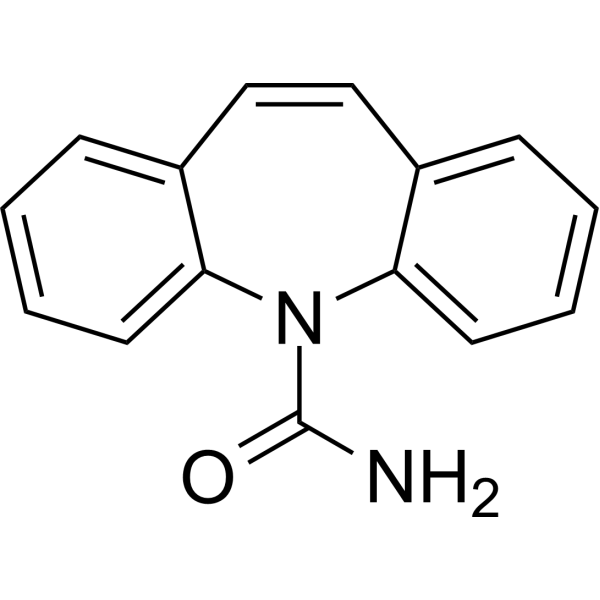
    Carbamazepine
    15+ Cited Publications

    CBZ; NSC 169864

    Sodium Channel Autophagy Mitophagy Potassium Channel Calcium Channel HDAC Neurological Disease Cancer
    Carbamazepine is an orally active pressure-sensitive sodium ion channel blocker with an IC50 of 131 μM. Carbamazepine blocks voltage gated Na +, Ca 2+, and K + channels, and is also a HDAC inhibitor (IC50: 2 μM). Carbamazepine is an anticonvulsant and can be used for research of epilepsy and neuropathic pain .
    Carbamazepine
  • HY-10588
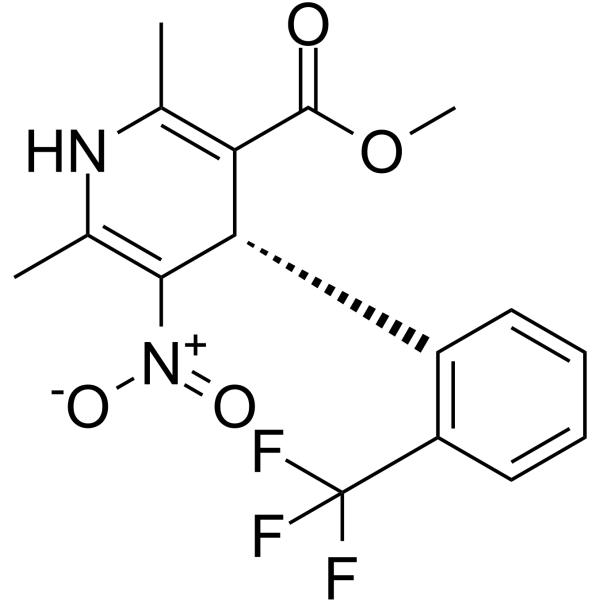
    Bay K 8644
    5+ Cited Publications

    (±)-Bay K 8644

    Calcium Channel Cardiovascular Disease Neurological Disease
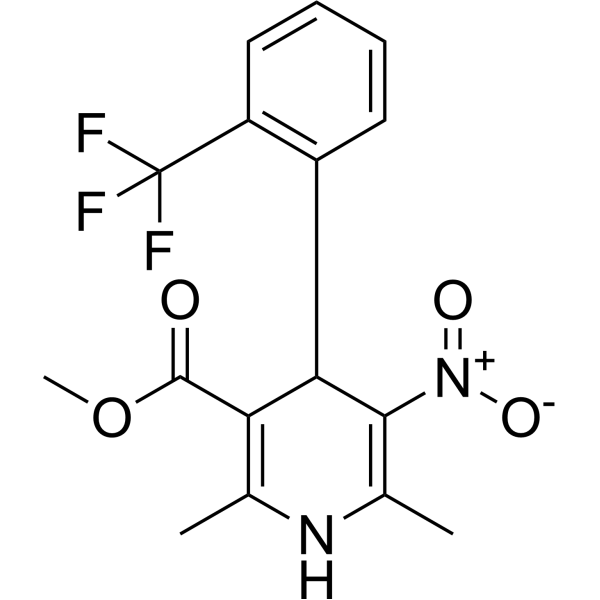
    Bay K 8644 ((±)-Bay K 8644) is a racemate consisting of two isomers (R)-(+)-Bay-K-8644 and (S)-(-)-Bay-K-8644 . Bay K 8644 is a L-type Ca 2+ channel agonist with an EC50 of 17.3 nM. Bay K 8644 increases Ca 2+ influx through sarcolemmal Ca 2+ channels by increasing the open time of the channel. Bay K 8644 has vasoconstrictive effects .
    Bay K 8644
  • HY-W004260
    Arachidic acid
    3 Publications Verification

    Eicosanoic acid

    Endogenous Metabolite Neurological Disease
    Arachidic acid is an orally bioavailable membrane fluidity modulator and receptor/ion channel effector. Arachidic acid does not activate arachidonic acid-sensitive K + channels in rat midbrain and hypothalamic neurons. Arachidic acid alleviates age-related spatial cognitive impairment. Arachidic acid is applicable for research related to age-related spatial cognitive impairment .
    Arachidic acid
  • HY-B1221
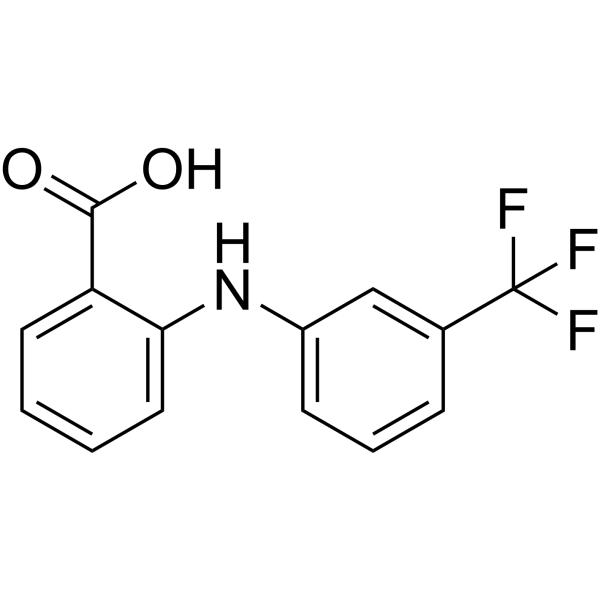
    Flufenamic acid
    5+ Cited Publications

    COX AMPK Potassium Channel Chloride Channel Calcium Channel Parasite Inflammation/Immunology
    Flufenamic acid is a non-steroidal anti-inflammatory agent, inhibits cyclooxygenase (COX), activates AMPK, and also modulates ion channels, blocking chloride channels and L-type Ca 2+ channels, modulating non-selective cation channels (NSC), activating K + channels. Flufenamic acid binds to the central pocket of TEAD2 YBD and inhibits both TEAD function and TEAD-YAP-dependent processes, such as cell migration and proliferation.
    Flufenamic acid
  • HY-50694
    Senicapoc
    10+ Cited Publications

    ICA-17043

    Potassium Channel Others
    Senicapoc (ICA-17043) is a potent and selective Gardos channel (Ca 2+-activated K + channel; KCa3.1) blocker with an IC50 of 11 nM. Senicapoc blocks Ca 2+-induced rubidium flux from human RBCs with an IC50 value of 11 nM and inhibits RBC dehydration with IC50 of 30 nM .
    Senicapoc
  • HY-P0190
    Iberiotoxin
    2 Publications Verification

    Potassium Channel Cardiovascular Disease
    Iberiotoxin is a toxin isolated from Buthus tamulus scorpion venom. Iberiotoxin is a selective high conductance high conductance Ca 2+-activated K + channel inhibitor with a Kd of ~1 nM. Iberiotoxin does not block other types of voltage-dependent ion channels .
    Iberiotoxin
  • HY-B1445

    Potassium Channel Metabolic Disease
    Minoxidil sulfate, a potent and ATP-sensitive K + channel opener, is the sulfated metabolite of minoxidil. Minoxidil sulfate is considered as a vasodilator to promote hair growth in vivo .
    Minoxidil sulfate
  • HY-15124
    (S)-(-)-Bay-K-8644
    5+ Cited Publications

    Calcium Channel Cardiovascular Disease
    (S)-(-)-Bay-K-8644 is an agonist of L-type Ca 2+ channel. (S)-(-)-Bay-K-8644 activates Ba 2+ currents (IBa) (EC50=32 nM).
    (S)-(-)-Bay-K-8644
  • HY-14290
    Pinacidil
    4 Publications Verification

    P-1134

    Potassium Channel Cardiovascular Disease
    Pinacidil (P-1134) is a potent activator of ATP-sensitive potassium channel. Pinacidil is an antihypertensive agent hyperpolarizes vascular smooth muscle by opening K + channels. Pinacidil enhances K +-efflux in smooth muscle. Pinacidil has vasorelaxant properties. Pinacidil is able to inhibit spontaneous tone and of reducing agonist induced contractions. Pinacidil can be studied in research area such as cardiovascular diseases .
    Pinacidil
  • HY-13519
    TRAM-34
    Maximum Cited Publications
    28 Publications Verification

    Potassium Channel Neurological Disease
    TRAM-34 is a highly selective blocker of intermediate-conductance calcium-activated K + channel (IKCa1) (Kd=20 nM).
    TRAM-34
  • HY-13103
    NS 11021
    3 Publications Verification

    Potassium Channel Others
    NS 11021 is a potent and specific Ca 2+-activated big-conductance K + Channels (KCa1.1 channels) activator. NS 11021 at concentrations above 0.3 μM activates KCa1.1 in a concentration-dependent manner by parallelshifting the channel activation curves to more negative potentials .
    NS 11021
  • HY-12343
    ML277
    1 Publications Verification

    CID-53347902

    Potassium Channel Cardiovascular Disease
    ML277 (CID-53347902) is a potent and selective activator of K(v)7.1 (KCNQ1) potassium channel activator (EC50=270 nM), rescues function of pathophysiologically important mutant channel complexes in human induced pluripotent stem cell-derived cardiomyocytes .
    ML277
  • HY-15125
    (R)-(+)-Bay-K-8644
    1 Publications Verification

    Calcium Channel Cardiovascular Disease
    (R)-(+)-Bay-K-8644 is a calcium channel inhibitor. (R)-(+)-Bay-K-8644 inhibits Ba 2+ currents (IBa) (IC50=975 nM).
    (R)-(+)-Bay-K-8644
  • HY-110105
    NS8593 hydrochloride
    1 Publications Verification

    Potassium Channel Neurological Disease
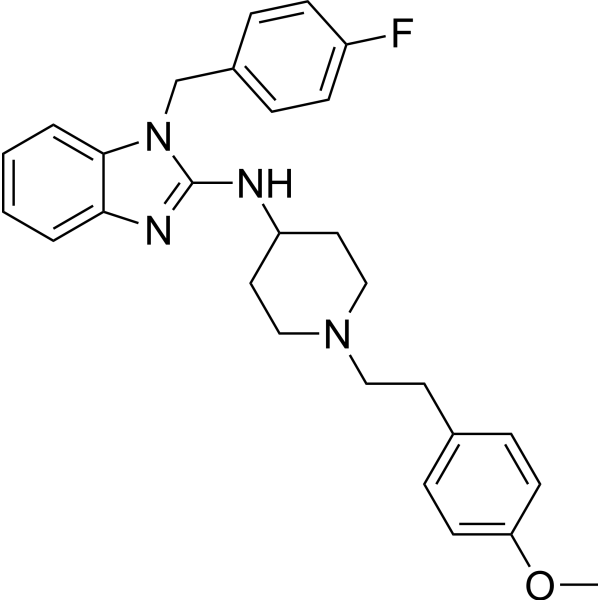
    NS8593 hydrochloride is a potent and selective small conductance Ca 2+-activated K + channels (SK channels) inhibitor. NS8593 hydrochloride reversibly inhibits SK3-mediated currents with a Kd value of 77 nM. NS8593 hydrochloride inhibits all the SK1-3 subtypes Ca 2+-dependently (Kds of 0.42, 0.60, and 0.73 μM, respectively, at 0.5 μM Ca 2+), and does not affect the Ca 2+-activated K + channels of intermediate and large conductance (hIK and hBK channels, respectively) .
    NS8593 hydrochloride
  • HY-P3467
    (Thr4,Gly7)-Oxytocin
    3 Publications Verification

    Oxytocin Receptor Potassium Channel Neurological Disease
    (Thr4,Gly7)-Oxytocin, an Oxytocin analogue, is a specific OT receptor agonist. (Thr4,Gly7)-Oxytocin also excites subicular neurons via activation of TRPV1 channels, and depression of K + channels. .
    (Thr4,Gly7)-Oxytocin
  • HY-B0341
    Nicorandil
    1 Publications Verification

    SG-75

    Potassium Channel Cardiovascular Disease
    Nicorandil (SG-75) is a potent potassium channel activator and targets vascular nucleoside diphosphate-dependent K + channels and cardiac ATP-sensitive K + channels (KATP). Nicorandil is a nicotinamide ester with vasodilatory and cardioprotective effects and has the potential for angina and forischemic heart diseases .
    Nicorandil
  • HY-107319
    Almitrine mesylate
    1 Publications Verification

    Almitrine bismesylate; Almitrine bismethanesulfonate; Almitrine dimesylate

    Potassium Channel Cardiovascular Disease Neurological Disease
    Almitrine mesylate, a peripheral chemoreceptor agonist, inhibits selectively the Ca 2+-dependent K + channel.
    Almitrine mesylate
  • HY-108584

    BMS-204352

    Potassium Channel Neurological Disease
    Flindokalner (BMS-204352) is a potassium channel modulator. Flindokalner is a positive modulator of all neuronal Kv7 channel subtypes expressed in HEK293 cells. Flindokalner is also a large conductance calcium-activated K channel (BKca) positive modulator. Flindokalner shows a negative modulatory activity at Kv7.1 channels (Ki=3.7 μM), and acts as a negative modulator of GABAA receptors. Flindokalner shows anxiolytic efficacy in vivo .
    Flindokalner
  • HY-B1500
    2,2,2-Trichloroethanol
    2 Publications Verification

    Potassium Channel Endogenous Metabolite Neurological Disease
    2,2,2-Trichloroethanol, the active form of Chloral hydrate, is an agonist for the nonclassical K2P channels TREK-1 (KCNK2) and TRAAK (KCNK4) .
    2,2,2-Trichloroethanol
  • HY-101360

    1-Ethyl-2-benzimidazolinone

    Potassium Channel Neurological Disease
    1-EBIO is an activator of Ca 2+ sensitive K + channels. 1-EBIO is used to study the role of K + channels in diverse physiological functions .
    1-EBIO
  • HY-P0191

    Potassium Channel Inflammation/Immunology
    Charybdotoxin, a 37-amino acid peptide, is a K + channel blocker .
    Charybdotoxin
  • HY-112075

    Potassium Channel Calcium Channel Cardiovascular Disease
    Lidoflazine is a high affinity blocker of the HERG (human ether-a-go-go-related gene) K + channel. Lidoflazine is an antianginal calcium channel blocker that carries a significant risk of QT interval prolongation and ventricular arrhythmia .
    Lidoflazine
  • HY-14290A
    Pinacidil monohydrate
    4 Publications Verification

    P-1134 monohydrate

    Potassium Channel Cardiovascular Disease
    Pinacidil (P-1134) monohydrate is a potent activator of ATP-sensitive potassium channel. Pinacidil monohydrate is an antihypertensive agent hyperpolarizes vascular smooth muscle by opening K + channels. Pinacidil monohydrate enhances K +-efflux in smooth muscle. Pinacidil monohydrate has vasorelaxant properties. Pinacidil monohydrate is able to inhibit spontaneous tone and of reducing agonist induced contractions. Pinacidil monohydrate can be studied in research area such as cardiovascular diseases .
    Pinacidil monohydrate
  • HY-17391

    Adenosine Receptor Endocrinology
    Pamabrom is a diuretic that acts on the opioid receptor-nitric oxide (NO) -cyclic guanosine monophosphate (cGMP) -K + channel pathway. Pamabrom exerts peripheral antinociceptive activity by activating this pathway. The mechanism involves activating opioid receptors, promoting the release of nitric oxide, and then influencing cyclic guanosine monophosphate and K channels to produce an analgesic effect. Pamabrom is orally active and is mainly used in the research and treatment of premenstrual syndrome and primary dysmenorrhea[1].
    Pamabrom
  • HY-14183
    Vernakalant Hydrochloride
    3 Publications Verification

    RSD1235 hydrochloride

    Potassium Channel Cardiovascular Disease
    Vernakalant hydrochloride is a mixed voltage- and frequency-dependent Na + and atria-preferred K + channel blocker. IC50 for block by Vernakalant of wild-type and mutant Kv1.5 channels Fractional block is 13.35±0.93 μM, 0.61±0.03 μM, and 1.63±0.09 μM for Kv1.5 channel wt, Kv1.5 channel I508F, Kv1.5 channel T479A, respectively.
    Vernakalant Hydrochloride
  • HY-14255
    Levcromakalim
    4 Publications Verification

    (-)-Cromakalim; BRL 38227

    Potassium Channel Cardiovascular Disease
    Levcromakalim ((-)-Cromakalim) is an ATP-sensitive K + channel (KATP) activator.
    Levcromakalim
  • HY-B1109
    N-Acetylprocainamide
    1 Publications Verification

    Acecainide; NAPA

    Potassium Channel Drug Metabolite Cardiovascular Disease
    N-Acetylprocainamide is a class III antiarrhythmic, which blocks K + channels.
    N-Acetylprocainamide
  • HY-P0191A

    Potassium Channel Inflammation/Immunology
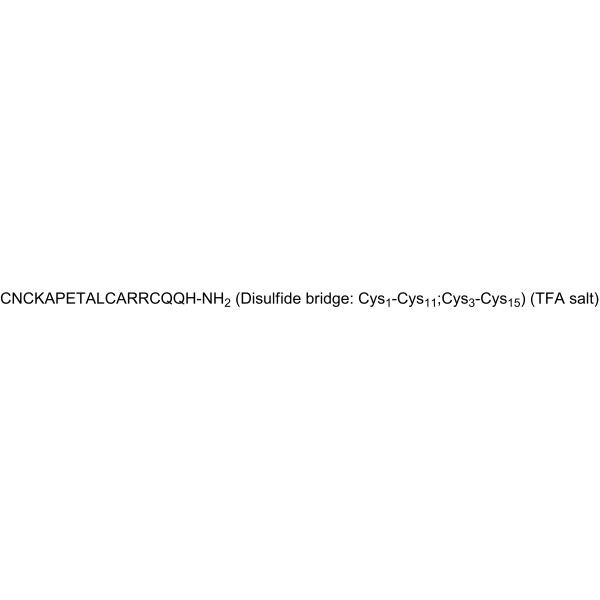
    Charybdotoxin TFA, a 37-amino acid peptide, is a K + channel blocker .
    Charybdotoxin TFA
  • HY-N6688

    Potassium Channel Bacterial Infection Neurological Disease
    Verruculogen is a tremorgenic mycotoxin and inhibitor of the M phase of the mammalian cell cycle. Verruculogen is produced by Penicillium and Aspergillus species. Verruculogen enhances the binding of ChTX to maxi-k channels with a K1/2 value of 170 nM. Verruculogen inhibits the amplitude of Ca 2+-activated K + currents. Verruculogen induces severe tremors in infected animals .
    Verruculogen
  • HY-N3463

    Potassium Channel Neurological Disease
    Isopimaric acid is a potent opener of large conductance calcium activated K + (BK) channels.
    Isopimaric acid
  • HY-110184

    Potassium Channel Neurological Disease
    PK-THPP is a potent and brain-penetrant TWIK-related acid-sensitive K + ion channel (K2P9.1 or TASK-3) blocker with IC50s of 35 nM and 300 nM for TASK-3 and TASK-1, respectively. PK-THPP shows no or less activity against other K + channels. PK-THPP is an effective breathing stimulant and can be used for the study of breathing disorders .
    PK-THPP
  • HY-110153

    Potassium Channel Neurological Disease
    NS19504 is a Ca 2+-activated K + channel (BK channel, KCa1.1 channel) activator (EC50=11.0 μM) with relaxing effect on bladder smooth muscle spontaneous phasic contractions .
    NS19504
  • HY-P0190A
    Iberiotoxin TFA
    2 Publications Verification

    Potassium Channel Others
    Iberiotoxin (TFA) is a selective high conductance high conductance Ca 2+-activated K + channel inhibitor with a Kd of ~1 nM. Iberiotoxin (TFA) does not block other types of voltage-dependent ion channels .
    Iberiotoxin TFA
  • HY-107301

    Soyasaponin Be; DHS-I

    Potassium Channel Neurological Disease
    Dehydrosoyasaponin I (Soyasaponin Be;DHS-I), a triterpene glycoside, is a potent and reversible calcium-activated potassium (maxi-K) channels activator .
    Dehydrosoyasaponin I
  • HY-16952A
    Bepridil hydrochloride hydrate
    5+ Cited Publications

    (±)-Bepridil hydrochloride hydrate; Org 5730 hydrochloride hydrate

    Calcium Channel Cardiovascular Disease
    Bepridil hydrochloride hydrate ((±)-Bepridil hydrochloride hydrate) is a non-selective, long-acting Ca + channel antagonist and Na +, K + channel inhibitor, with antianginal and type I antiarrhythmic effects. Bepridil hydrochloride hydrate also acts as a cardiac Na +/Ca2 + exchange (NCX1) inhibitor. Bepridil hydrochloride hydrate can be used for the research of cardiovascular disorders .
    Bepridil hydrochloride hydrate
  • HY-139064

    Potassium Channel Neurological Disease Inflammation/Immunology
    NPBA, a potassium K2P channel TASK-3 (KCNK9) agonist, is a tandem pore domain weak inward rectifying K + channel (TWIK2) channel blocker. NPBA suppresses NLRP3 inflammasome activation in macrophages .
    NPBA
  • HY-14256
    BMS-191095
    1 Publications Verification

    Potassium Channel Cardiovascular Disease Neurological Disease
    BMS-191095 is a selective activator of mitochondrial ATP-sensitive potassium (mitoKATP) channels. BMS-191095 inhibits human platelet aggregation by opening mitochondrial K(ATP) channels .
    BMS-191095
  • HY-151891
    TASK-1-IN-1
    2 Publications Verification

    Potassium Channel Cancer
    TASK-1-IN-1 is a potent and selective TASK-1 (Potassium Channel) inhibitor with an IC50 of 148 nM. TASK-1-IN-1 shows a reduced inhibition of TASK-3 channels (IC50 of 1750 nM) and not a significant effect on other K+ channels. TASK-1-IN-1 has anticancer effects.
    TASK-1-IN-1
  • HY-131012

    Potassium Channel Others
    GoSlo-SR-5-69 is a potent activator of large conductance Ca 2+-activated K + (BK) channels, with an EC50 of 251 nM .
    GoSlo-SR-5-69
  • HY-137952

    Potassium Channel TRP Channel Neurological Disease
    NS8593 is an SK channel (small conductance Ca 2+-activated K+ channels) inhibitor. NS8593 reversibly inhibited recombinant SK3-mediated currents (human SK3 and rat SK3). NS8593 inhibits all the SK1-3 subtypes Ca 2+-dependently (Kd = 0.42, 0.60, and 0.73 μM, respectively, at 0.5 μM Ca 2+). NS8593 does not affect the Ca 2+-activated K channels of intermediate and large conductance (hlk and hBK channels, respectively). NS8593 can also inhibit TRPM7 (melastatin-related TRP cation channel 7) (IC50 = 1.6 mM). NS8593 can be used for the study of central nervous system (CNS) related diseases .
    NS8593
  • HY-117825

    Potassium Channel Neurological Disease
    RU-TRAAK-2 is a completely reversible TRAAK (TWIK-related arachidonic acid-stimulated K + channel) inhibitor. RU-TRAAK-2 exerts no activity for non-K2P channels (Kv1.2, Slo1 and GIRK2) . RU-TRAAK-2 is a click chemistry reagent, it contains an Alkyne group and can undergo copper-catalyzed azide-alkyne cycloaddition (CuAAc) with molecules containing Azide groups.
    RU-TRAAK-2
  • HY-149591

    TGF-β Receptor Anaplastic lymphoma kinase (ALK) Cancer
    M4K-2009 is an orally bioactive ALK2 inhibitor with an IC50 of 13 nM. M4K-2009 exerts comparable inhibitory potency against wild-type and mutant ALK2 G328V, ALK2 R206H, and ALK2 R258G. M4K-2009 exhibits moderate off-target inhibitory activity against hERG potassium channels. M4K-2009 can be used in studies related to diffuse intrinsic pontine glioma .
    M4K-2009
  • HY-110162

    Potassium Channel Neurological Disease
    QO 58 is a potent modulator of K(v)7 channels. QO-58 increases the current amplitudes, shifts the voltage-dependent activation curve in a more negative direction and slows the deactivation of K(v)7.2/K(v)7.3 currents. QO-58 has the potential for the research of diseases associated with neuronal hyperexcitability .
    QO 58
  • HY-101069
    Y-26763
    2 Publications Verification

    Potassium Channel Cardiovascular Disease
    Y-26763 is a K + channel opener and active metabolite of Y-27152 . Y-26763 is an ATP-sensitive K + (KATP) channel activator .
    Y-26763
  • HY-B0341S

    Isotope-Labeled Compounds Potassium Channel Cardiovascular Disease
    Nicorandil-d4 (SG-75-d4) is the deuterium labeled Nicorandil. Nicorandil (SG-75) is a potent potassium channel activator and targets vascular nucleoside diphosphate-dependent K+ channels and cardiac ATP-sensitive K+ channels (KATP). Nicorandil is a nicotinamide ester with vasodilatory and cardioprotective effects and has the potential for angina and forischemic heart diseases .
    Nicorandil-d4
  • HY-155941

    Potassium Channel Neurological Disease
    5-Hydroxydecanoic acid (5-HD) is a KATP channel antagonist,which has the effect of blocking the K KATP channel only during ischaemia by competing with the ATP binding site and does not affect pancreatic KATP channels .
    5-Hydroxydecanoic acid
  • HY-135809

    Potassium Channel Neurological Disease
    A2764 dihydrochloride is a highly selective inhibitor of TRESK (TWIK-related spinal cord K + channel, K2P18.1), which has moderate inhibitory effects on TREK-1 and TALK-1. A2764 dihydrochloride is more sensitive to the activated mTRESK channels (IC50=6.8 μM) than the basal current. A2764 dihydrochloride can lead to cell depolarization and increased excitability in native cells, it has the potential for probing the role of TRESK channel in migraine and nociception .
    A2764 dihydrochloride
  • HY-P3089A

    Potassium Channel Others
    Dendrotoxin K TFA is a Kv1.1 channel blocker. Dendrotoxin K TFA determines glutamate release in CA3 neurons in a time-dependent manner through the control of the presynaptic spike waveform .
    Dendrotoxin K TFA
  • HY-P2707

    α-DTX

    Sodium Channel Potassium Channel Neurological Disease
    α-Dendrotoxin (α-DTX) is a voltage-gated K + channel blocker and an acid-sensing ion channel (ASIC) inhibitor. α-Dendrotoxin blocks Kv1.1, Kv1.2, Kv1.6 and D-type (ID) voltage-gated K + channels, and reversibly inhibits slowly inactivating potassium currents. α-Dendrotoxin induces epilepsy-related behaviors in mice. α-Dendrotoxin can be used in studies related to tonic-clonic seizures .
    α-Dendrotoxin
  • HY-A0176

    Potassium Channel Cardiovascular Disease Metabolic Disease
    Glisoxepide, a sulphonamide derivative, is an orally available nonselective K(ATP) channel blocker, with antihyperglycemic activity and cardiovascular regulation effect .
    Glisoxepide

Inquiry Online

Your information is safe with us. * Required Fields.

Salutation


Country or Region *

Applicant Name *


Organization Name *

Department *


Email Address *


Product Name *

Cat. No.


Requested quantity *

Phone Number *


Remarks

Inquiry Online

Inquiry Information

Product Name:
Cat. No.:
Quantity:
MCE Japan Authorized Agent:

