



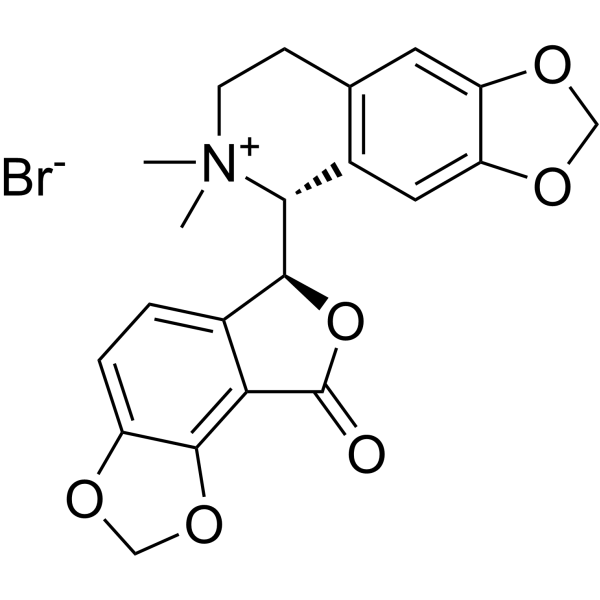
(-)-Bicuculline methobromide
Based on 8 publication(s) in Google Scholar
(-)-Bicuculline methobromide is a potent GABAA blocker. (-)-Bicuculline methobromide alters membrane properties and firing pattern. (-)-Bicuculline methobromide reduces the Apamin-sensitive afterhyperpolarization, while Apamin is a toxin isolated from bee venom to block small conductance Ca2+ -activated K+ channels. (-)-Bicuculline methobromide facilitates burst firing via blocking apamin-sensitive Ca2+ -activated K+ current.
For research use only. We do not sell to patients.
- Purity : 99.94%
- CAS No.: 73604-30-5
- Formula: C21H20BrNO6
- Molecular Weight:462.29
-
Storage:
4°C, sealed storage, away from moisture
* In solvent : -80°C, 6 months; -20°C, 1 month (sealed storage, away from moisture)

To place orders, for customer services and technical support, please contact: MedChemExpress USA
Tel: 609-228-6898 E-mail: [email protected] [email protected]


-
 Biological Activity
-
Chemical Information
-
Solvent & Solubility
- Protocols
- Purity & Documentation
- References
-
 Help & FAQs


Publications Citing Use of MedChemExpress (MCE) (-)-Bicuculline methobromide
More- Nat Commun. 2026 May 19;17(1):4418. [Abstract]
- Phytomedicine. 2026 Nov:161:158727.
- Acta Pharmacol Sin. 2026 Aug 4. [Abstract]
- Cell Rep. 2025 May 14;44(5):115712. [Abstract]
- Brain Behav Immun. 2019 Nov:82:45-62. [Abstract]
- Neurosci Bull. 2026 Feb 2. [Abstract]
- SSRN. 2026 Aug 8.
- bioRxiv. 2024 November 26.


Biological Activity
Description
IC50 & Target
GABAA[1]
In Vitro
(-)-Bicuculline methobromide (30 μM) promotes N-methyl-d-aspartate (NMDA) stimulation to facilitate burst firing in dopamine neurons[1].
Cluster discharges in the lateral habenular nucleus (LHb) of the antireward center are sufficient conditions for depression to occur. LHb neurons are usually classified into three types: silent, tonic-firing, burst-firing[2].
MedChemExpress (MCE) has not independently confirmed the accuracy of these methods. They are for reference only.
In Vivo
-
Animal Model:Rat L5-SNL model[2]
-
Dosage:0.6 nmol/rat
-
Administration:Intrathecal injection, 5 minutes before administration of Neurotropin (100 NU/kg, i.v.)
-
Result:Attenuated the antiallodynic effect of Neurotropin.
Induced Disease Models
Please do not refer to only one article to determine the experimental conditions. It is recommended to determine the optimal experimental conditions (animal strain, age, dosage, frequency and cycle, detection time and indicators, etc.) through preliminary experiments before the formal experiment.
(-)-Bicuculline methobromide (0.6 nmol/rat) attenuates the antiallodynic effect of Neurotropin[3].
(-)-Bicuculline methobromide can be used in animal modeling to create epilepsy models and is capable of crossing the blood-brain barrier[4].
Administration: 12.5, 25, 50 or 100 ng/0.25 μL • inject into SN or corpus striatum through bilateral catheter implantation
(2) Simultaneously administer bilateral infusions at a rate of 0.25 μ L/min, and after the infusion is completed, insert the catheter in situ for an additional minute to prevent drug reflux.
(3) Due to the short-lived effect of (-) - Bicuculine methoromide in SN, rats were tested 5 minutes after completing the infusion.
MedChemExpress (MCE) has not independently confirmed the accuracy of these methods. They are for reference only.


Chemical Information
-
CAS No. 73604-30-5
-
Appearance Solid
-
Molecular Weight 462.29
-
Formula C21H20BrNO6
-
Color White to off-white
-
SMILES
C[N+]1(C)[C@@H]([C@H]2OC(C3=C4OCOC4=CC=C32)=O)C5=C(C=C6C(OCO6)=C5)CC1.[Br-]
-
Shipping
Room temperature in continental US; may vary elsewhere.
-
Storage
4°C, sealed storage, away from moisture
* In solvent : -80°C, 6 months; -20°C, 1 month (sealed storage, away from moisture)


Publications (8)
-
Journal Impact Factor
-
Most Recent
-
Nat Commun
Novelty exploration-activated ensemble in the lateral hypothalamus confers analgesic and anxiolytic effects. [Abstract]2026 May 19;17(1):4418. PMID: 42156381 -
-
Acta Pharmacol Sin
Enhanced substance P-NK1R signaling in the parabrachial-parasubthalamic pathway promotes hyperalgesia and affective aversion in neuropathic pain. [Abstract]2026 Aug 4. PMID: 42552466 -
Cell Rep
Septo-subicular cholinergic circuit promotes seizure development via astrocytic inflammation. [Abstract]2025 May 14;44(5):115712. PMID: 40372911 -
Brain Behav Immun
Trans-cinnamaldehyde improves neuroinflammation-mediated NMDA receptor dysfunction and memory deficits through blocking NF-κB pathway in presenilin1/2 conditional double knockout mice. [Abstract]2019 Nov:82:45-62. PMID: 31376499 -
Neurosci Bull
FOXG1 Hierarchically Shapes Synaptic Functions in Striatal iSPNs and Contributes to ASD Etiology. [Abstract]2026 Feb 2. PMID: 41627775 -
-


Solvent & Solubility
In Vitro:
DMSO : 50 mg/mL (108.16 mM; Need ultrasonic; Hygroscopic DMSO has a significant impact on the solubility of product, please use newly opened DMSO)
Please refer to the solubility information to select the appropriate solvent. Once prepared, please aliquot and store the solution to prevent product inactivation from repeated freeze-thaw cycles.
Storage method and period of stock solution: -80°C, 6 months; -20°C, 1 month (sealed storage, away from moisture). When stored at -80°C, please use it within 6 months. When stored at -20°C, please use it within 1 month.
Please refer to the solubility information to select the appropriate solvent. Once prepared, please aliquot and store the solution to prevent product inactivation from repeated freeze-thaw cycles.
Storage method and period of stock solution: -80°C, 6 months; -20°C, 1 month (sealed storage, away from moisture). When stored at -80°C, please use it within 6 months. When stored at -20°C, please use it within 1 month.
Concentration (start) × Volume (start) = Concentration (final) × Volume (final)
In Vivo:
Select the appropriate dissolution method based on your experimental animal and administration route.
- For the following dissolution methods, please ensure to first prepare a clear stock solution using an In Vitro approach and then sequentially add co-solvents:
- To ensure reliable experimental results, the clarified stock solution can be appropriately stored based on storage conditions. As for the working solution for In Vivo experiments, it is recommended to prepare freshly and use it on the same day.
- The percentages shown for the solvents indicate their volumetric ratio in the final prepared solution. If precipitation or phase separation occurs during preparation, heat and/or sonication can be used to aid dissolution.
Add each solvent one by one: 10% DMSO 40% PEG300 5% Tween-80 45% Saline
Solubility: ≥ 2.5 mg/mL (5.41 mM); Clear solution
This protocol yields a clear solution of ≥ 2.5 mg/mL (saturation unknown).
Taking 1 mL working solution as an example, add 100 μL DMSO stock solution (25.0 mg/mL) to 400 μL PEG300, and mix evenly; then add 50 μL Tween-80 and mix evenly; then add 450 μL Saline to adjust the volume to 1 mL.
Preparation of Saline: Dissolve 0.9 g sodium chloride in ddH₂O and dilute to 100 mL to obtain a clear Saline solution.
Add each solvent one by one: 10% DMSO 90% (20% SBE-β-CD in Saline)
Solubility: ≥ 2.5 mg/mL (5.41 mM); Clear solution
This protocol yields a clear solution of ≥ 2.5 mg/mL (saturation unknown).
Taking 1 mL working solution as an example, add 100 μL DMSO stock solution (25.0 mg/mL) to 900 μL 20% SBE-β-CD in Saline, and mix evenly.
Preparation of 20% SBE-β-CD in Saline (4°C, storage for one week): 2 g SBE-β-CD powder is dissolved in 10 mL Saline, completely dissolve until clear.
In Vivo Dissolution Calculator
Please enter the basic information of animal experiments:
-
-
-
-
Recommended: Prepare an additional quantity of animals to account for potential losses during experiments.
Please enter your animal formula composition:
-
%DMSO +
Recommended: Keep the proportion of DMSO in working solution below 2% if your animal is weak.
-
%+
-
+%Tween-80 + +
-
%Saline +
The co-solvents required include: DMSO, . All of co-solvents are available by MedChemExpress (MCE). , Tween 80. All of co-solvents are available by MedChemExpress (MCE).
Working solution concentration: 0.22 mg/mL
Method for preparing stock solution: mg drug dissolved in μL DMSO. Stock solution concentration: mg/mL. * In solvent : -80°C, 6 months; -20°C, 1 month (sealed storage, away from moisture)
1. Take μL DMSO stock solution;
2. Add μL .
μL , mix evenly;
3. Then add μL Tween 80, mix evenly;
4. Then add μL
Please ensure that the stock solution in the first step is dissolved to a clear state, and add co-solvents in sequence. You can use ultrasonic heating (ultrasonic cleaner, recommended frequency 20-40 kHz), vortexing, etc. to assist dissolution.


Purity & Documentation
-
Data Sheet (288 KB)
-
SDS (564 KB)
- English - EN (564 KB)
- Français - FR (564 KB)
- Deutsch - DE (564 KB)
- Norwegian - NO (564 KB)
- Español - ES (564 KB)
- Swedish - SV (564 KB)
- Italian - IT (564 KB)
- Korean - KR (564 KB)
- Portuguese - PT (564 KB)
-
Handling Instructions (2659 KB)
References
[1]. Johnson SW, et al. Bicuculline methiodide potentiates NMDA-dependent burst firing in rat dopamine neurons by blocking apamin-sensitive Ca2+-activated K+ currents. Neurosci Lett. 1997 Aug 1;231(1):13-6. [Content Brief]
[2]. Yang Y, et al. Ketamine blocks bursting in the lateral habenula to rapidly relieve depression[J]. Nature, 2018, 554(7692): 317-322. [Content Brief]
[3]. Okazaki R, et al. The antiallodynic effect of Neurotropin is mediated via activation of descending pain inhibitory systems in rats with spinal nerve ligation. Anesth Analg. 2008 Sep;107(3):1064-9. [Content Brief]
[4]. Sperber EF, et al. Nigral infusions of muscimol or bicuculline facilitate seizures in developing rats. Brain Res. 1987 Dec 15;465(1-2):243-50. [Content Brief]


Complete Stock Solution Preparation Table
Please refer to the solubility information to select the appropriate solvent. Once prepared, please aliquot and store the solution to prevent product inactivation from repeated freeze-thaw cycles.
Storage method and period of stock solution: -80°C, 6 months; -20°C, 1 month (sealed storage, away from moisture). When stored at -80°C, please use it within 6 months. When stored at -20°C, please use it within 1 month.
| Optional Solvent | Concentration Solvent Mass | 1 mg | 5 mg | 10 mg | 25 mg |
|---|---|---|---|---|---|
| DMSO | 1 mM | 2.1631 mL | 10.8157 mL | 21.6314 mL | 54.0786 mL |
| 5 mM | 0.4326 mL | 2.1631 mL | 4.3263 mL | 10.8157 mL | |
| 10 mM | 0.2163 mL | 1.0816 mL | 2.1631 mL | 5.4079 mL | |
| 15 mM | 0.1442 mL | 0.7210 mL | 1.4421 mL | 3.6052 mL | |
| 20 mM | 0.1082 mL | 0.5408 mL | 1.0816 mL | 2.7039 mL | |
| 25 mM | 0.0865 mL | 0.4326 mL | 0.8653 mL | 2.1631 mL | |
| 30 mM | 0.0721 mL | 0.3605 mL | 0.7210 mL | 1.8026 mL | |
| 40 mM | 0.0541 mL | 0.2704 mL | 0.5408 mL | 1.3520 mL | |
| 50 mM | 0.0433 mL | 0.2163 mL | 0.4326 mL | 1.0816 mL | |
| 60 mM | 0.0361 mL | 0.1803 mL | 0.3605 mL | 0.9013 mL | |
| 80 mM | 0.0270 mL | 0.1352 mL | 0.2704 mL | 0.6760 mL | |
| 100 mM | 0.0216 mL | 0.1082 mL | 0.2163 mL | 0.5408 mL |


(-)-Bicuculline methobromide Related Classifications
HY-100783 Related Classifications
 Powered by Bioz