



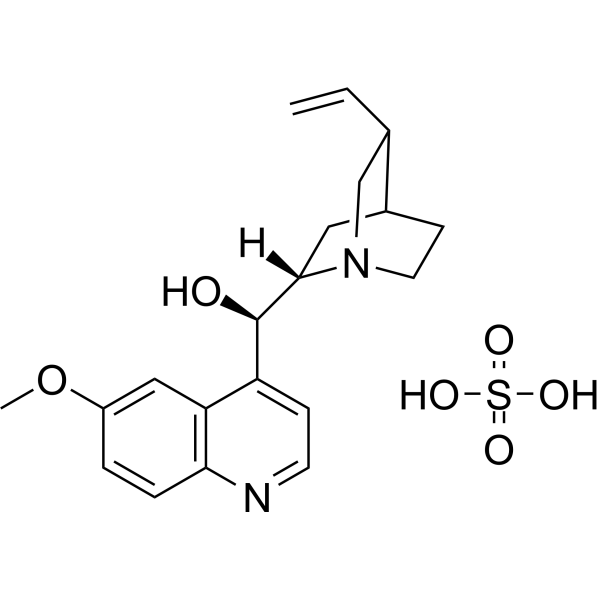
Quinine sulfate
Based on 7 publication(s) in Google Scholar
Quinidine sulfate is an antiarrhythmic agent. Quinidine sulfate is a potent, orally active, selective cytochrome P450db inhibitor. Quinidine sulfate is also a K+ channel blocker with an IC50 of 19.9 μM. Quinidine sulfate can be used for malaria research.
For research use only. We do not sell to patients.
- Purity : 99.38%
- CAS No.: 549-56-4
- Formula: C20H26N2O6S
- Molecular Weight:422.50
-
Storage:
-20°C, protect from light, stored under nitrogen
* In solvent : -80°C, 6 months; -20°C, 1 month (protect from light, stored under nitrogen)

To place orders, for customer services and technical support, please contact: MedChemExpress USA
Tel: 609-228-6898 E-mail: [email protected] [email protected]


-
 Biological Activity
-
Chemical Information
-
Solvent & Solubility
- Purity & Documentation
- References
-
 Help & FAQs


Publications Citing Use of MedChemExpress (MCE) Quinine sulfate
More- Neurosci Bull. 2025 May 6. [Abstract]
- Cell Mol Life Sci. 2025 Nov 25;82(1):419. [Abstract]
- J Mol Cell Biol. 2025 May 22;16(11):mjae051. [Abstract]
- ACS Omega. 2024 Feb 28;9(10):11870-11882. [Abstract]
- Mol Med Rep. 2021 May;23(5):313. [Abstract]
- Vet Microbiol. 2026 May:316:110992. [Abstract]
- Norwegian University of Science and Technology. 2019 Sep.
 Customer Validation & Images

-
In Vivo Efficacy Study

-
Cell Imaging/Staining

-
Cell Proliferation/Viability Assay

-
Cell Proliferation/Viability Assay

-
Bio/Physico-chemical Assay

All Parasite Isoforms
More

Biological Activity
Description
IC50 & Target
|
Plasmodium |
Cellular Effect
|
Cell Line

|
Type | Value | Description | References |
|---|---|---|---|---|
| Huh-7 | CC50 |
>6.25 μM
Compound: GNF-Pf-506
|
NOVARTIS: Cytotoxicity against human hepatocellular carcinoma cell line (Huh7)
NOVARTIS: Cytotoxicity against human hepatocellular carcinoma cell line (Huh7)
|
[PMID: 18579783] |
In Vitro
Quinidine sulfate is an anti-arrythmic drug which affects ionic currents in heart muscle and which has also been shown to be a potent blocker of several classes of K+ channel in a variety of cell types[1].
Bath application of quinidine sulfate causes a dose-dependent reduction of the peak amplitude of Ik. The Kd for blockade of Ik at 0 mV is estimated to be 41 μM[1].
Quinidine sulfate elicits a dose-dependent increase of the rate of the decay of Ik and this effect is enhanced by membrane depolarization. Quinidine sulfate also causes a 5 mV hyperpolarizing shift of the steady-state inactivation curve and increases the half-time for recovery from inactivation. Quinidine sulfate does not affect the onset of inactivation measured at -30 mV[1].
MedChemExpress (MCE) has not independently confirmed the accuracy of these methods. They are for reference only.
In Vivo
Quinidine sulfate is approximately 70-90 % bound to plasma proteins. It undergoes hepatic oxidative metabolism to form an N-oxide, a 3-hydroxy form, an O-demethyl form and 2'-quinidinone[2].
Quinidine sulfate inhibits metabolism of amphetamine in rats. Quinidine sulfate pretreatment results in a significant decrease in the excretion of p-hydroxyamphetamine at 24 and 48 h to 7.2 and 24.1% of the vehicle-control levels, respectively, accompanied by a significant increase in amphetamine excretion between 24 and 48 h to 542% of the control[3].
MedChemExpress (MCE) has not independently confirmed the accuracy of these methods. They are for reference only.


Chemical Information
-
CAS No. 549-56-4
-
Appearance Solid
-
Molecular Weight 422.50
-
Formula C20H26N2O6S
-
Color White to off-white
-
SMILES
O[C@H](C1=CC=NC2=C1C=C(OC)C=C2)[C@@]3([H])[N@](C[C@@H]4C=C)CC[C@H]4C3.O=S(O)(O)=O
-
Shipping
Room temperature in continental US; may vary elsewhere.
-
Storage
-20°C, protect from light, stored under nitrogen
* In solvent : -80°C, 6 months; -20°C, 1 month (protect from light, stored under nitrogen)


Publications (7)
-
Journal Impact Factor
-
Most Recent
-
Neurosci Bull
A Novel Functional Method of Protector Screening for Zebrafish Lateral Line Hair Cells via the Acoustic Escape Response. [Abstract]2025 May 6. PMID: 40329138
Quinine sulfate purchased from MedChemExpress. Usage Cited in: Neurosci Bull. 2025 May 6. [Abstract]
Quinine (qui; 10 μM; 5 min) decreased the travel distance upon sound stimulation in zebrafish.
Quinine sulfate purchased from MedChemExpress. Usage Cited in: Neurosci Bull. 2025 May 6. [Abstract]
Quinine (qui; 10 μM; 5 min) remained unchanged in the number of HCs in zebrafish.
-
Cell Mol Life Sci
2025 Nov 25;82(1):419. PMID: 41288707
Quinine sulfate purchased from MedChemExpress. Usage Cited in: Cell Mol Life Sci. 2025 Nov 25;82(1):419. [Abstract]
Quinine (0-320 μM) showed no cytotoxicity for Primary pancreatic β cells.
-
J Mol Cell Biol
2025 May 22;16(11):mjae051. PMID: 39848918
Quinine sulfate purchased from MedChemExpress. Usage Cited in: J Mol Cell Biol. 2025 May 22;16(11):mjae051. [Abstract]
Quinine (0-320 μM; 24 h) showed cytotoxicity in primary pancreatic β cells and HEK293T cells.
Quinine sulfate purchased from MedChemExpress. Usage Cited in: J Mol Cell Biol. 2025 May 22;16(11):mjae051. [Abstract]
Quinine (0-40 μM) potentiated high glucose (25 mM)-evoked insulin secretion in a dose-dependent manner at 5–100 μM. However, under low-glucose (2 mM) conditions, quinine induced insulin secretion only at concentrations of 50–100 μM; without the addition of glucose, 5 μM quinine alone was not sufficient to stimulate insulin secretion.
-
ACS Omega
Identification of New Modulators and Inhibitors of Palmitoyl-Protein Thioesterase 1 for CLN1 Batten Disease and Cancer. [Abstract]2024 Feb 28;9(10):11870-11882. PMID: 38496939 -
Mol Med Rep
2021 May;23(5):313. PMID: 34240224 -
Vet Microbiol
The Chinese medicine monomer Schisandrin C inhibits PRRSV infection by regulating the OGT-PI3K/AKT/mTOR signaling pathway. [Abstract]2026 May:316:110992. PMID: 41865607 -


Solvent & Solubility
In Vitro:
DMSO : 5 mg/mL (11.83 mM; Need ultrasonic; Hygroscopic DMSO has a significant impact on the solubility of product, please use newly opened DMSO)
H2O : 3.33 mg/mL (7.88 mM; ultrasonic and warming and heat to 60°C)
Please refer to the solubility information to select the appropriate solvent. Once prepared, please aliquot and store the solution to prevent product inactivation from repeated freeze-thaw cycles.
Storage method and period of stock solution: -80°C, 6 months; -20°C, 1 month (protect from light, stored under nitrogen). When stored at -80°C, please use it within 6 months. When stored at -20°C, please use it within 1 month.
* Note: If you choose water as the stock solution, please dilute it to the working solution, then filter and sterilize it with a 0.22 μm filter before use.
Please refer to the solubility information to select the appropriate solvent. Once prepared, please aliquot and store the solution to prevent product inactivation from repeated freeze-thaw cycles.
Storage method and period of stock solution: -80°C, 6 months; -20°C, 1 month (protect from light, stored under nitrogen). When stored at -80°C, please use it within 6 months. When stored at -20°C, please use it within 1 month.
* Note: If you choose water as the stock solution, please dilute it to the working solution, then filter and sterilize it with a 0.22 μm filter before use.
Concentration (start) × Volume (start) = Concentration (final) × Volume (final)
In Vivo:
Select the appropriate dissolution method based on your experimental animal and administration route.
- For the following dissolution methods, please ensure to first prepare a clear stock solution using an In Vitro approach and then sequentially add co-solvents:
- To ensure reliable experimental results, the clarified stock solution can be appropriately stored based on storage conditions. As for the working solution for In Vivo experiments, it is recommended to prepare freshly and use it on the same day.
- The percentages shown for the solvents indicate their volumetric ratio in the final prepared solution. If precipitation or phase separation occurs during preparation, heat and/or sonication can be used to aid dissolution.
Add each solvent one by one: 10% DMSO 40% PEG300 5% Tween-80 45% Saline
Solubility: ≥ 0.5 mg/mL (1.18 mM); Clear solution
This protocol yields a clear solution of ≥ 0.5 mg/mL (saturation unknown).
Taking 1 mL working solution as an example, add 100 μL DMSO stock solution (5.0 mg/mL) to 400 μL PEG300, and mix evenly; then add 50 μL Tween-80 and mix evenly; then add 450 μL Saline to adjust the volume to 1 mL.
Preparation of Saline: Dissolve 0.9 g sodium chloride in ddH₂O and dilute to 100 mL to obtain a clear Saline solution.
Add each solvent one by one: 10% DMSO 90% (20% SBE-β-CD in Saline)
Solubility: ≥ 0.5 mg/mL (1.18 mM); Clear solution
This protocol yields a clear solution of ≥ 0.5 mg/mL (saturation unknown).
Taking 1 mL working solution as an example, add 100 μL DMSO stock solution (5.0 mg/mL) to 900 μL 20% SBE-β-CD in Saline, and mix evenly.
Preparation of 20% SBE-β-CD in Saline (4°C, storage for one week): 2 g SBE-β-CD powder is dissolved in 10 mL Saline, completely dissolve until clear.
In Vivo Dissolution Calculator
Please enter the basic information of animal experiments:
-
-
-
-
Recommended: Prepare an additional quantity of animals to account for potential losses during experiments.
Please enter your animal formula composition:
-
%DMSO +
Recommended: Keep the proportion of DMSO in working solution below 2% if your animal is weak.
-
%+
-
+%Tween-80 + +
-
%Saline +
The co-solvents required include: DMSO, . All of co-solvents are available by MedChemExpress (MCE). , Tween 80. All of co-solvents are available by MedChemExpress (MCE).
Working solution concentration: 0.22 mg/mL
Method for preparing stock solution: mg drug dissolved in μL DMSO. Stock solution concentration: mg/mL. * In solvent : -80°C, 6 months; -20°C, 1 month (protect from light, stored under nitrogen)
1. Take μL DMSO stock solution;
2. Add μL .
μL , mix evenly;
3. Then add μL Tween 80, mix evenly;
4. Then add μL
Please ensure that the stock solution in the first step is dissolved to a clear state, and add co-solvents in sequence. You can use ultrasonic heating (ultrasonic cleaner, recommended frequency 20-40 kHz), vortexing, etc. to assist dissolution.


Purity & Documentation
-
Data Sheet (279 KB)
-
SDS (394 KB)
- English - EN (394 KB)
- Français - FR (394 KB)
- Deutsch - DE (394 KB)
- Norwegian - NO (394 KB)
- Español - ES (394 KB)
- Swedish - SV (394 KB)
- Italian - IT (394 KB)
- Korean - KR (394 KB)
- Portuguese - PT (394 KB)
-
Handling Instructions (2659 KB)
References
[1]. Kehl SJ, et al. Quinidine-induced inhibition of the fast transient outward K+ current in rat melanotrophs. Br J Pharmacol. 1991 Jul;103(3):1807-13. [Content Brief]
[2]. Roden DM, et al. Class I antiarrhythmic agents: quinidine, procainamide and N-acetylprocainamide, disopyramide. [Content Brief]
[3]. Moody DE, et al. Quinidine inhibits in vivo metabolism of amphetamine in rats: impact upon correlation between GC/MS and immunoassay findings in rat urine. J Anal Toxicol. 1990 Sep-Oct;14(5):311-7. [Content Brief]


Complete Stock Solution Preparation Table
Please refer to the solubility information to select the appropriate solvent. Once prepared, please aliquot and store the solution to prevent product inactivation from repeated freeze-thaw cycles.
Storage method and period of stock solution: -80°C, 6 months; -20°C, 1 month (protect from light, stored under nitrogen). When stored at -80°C, please use it within 6 months. When stored at -20°C, please use it within 1 month.
| Optional Solvent | Concentration Solvent Mass | 1 mg | 5 mg | 10 mg | 25 mg |
|---|---|---|---|---|---|
| H2O / DMSO | 1 mM | 2.3669 mL | 11.8343 mL | 23.6686 mL | 59.1716 mL |
| 5 mM | 0.4734 mL | 2.3669 mL | 4.7337 mL | 11.8343 mL | |
| DMSO | 10 mM | 0.2367 mL | 1.1834 mL | 2.3669 mL | 5.9172 mL |
* Note: If you choose water as the stock solution, please dilute it to the working solution, then filter and sterilize it with a 0.22 μm filter before use.


Quinine sulfate Related Classifications
HY-B1751B Related Classifications
 Powered by Bioz