



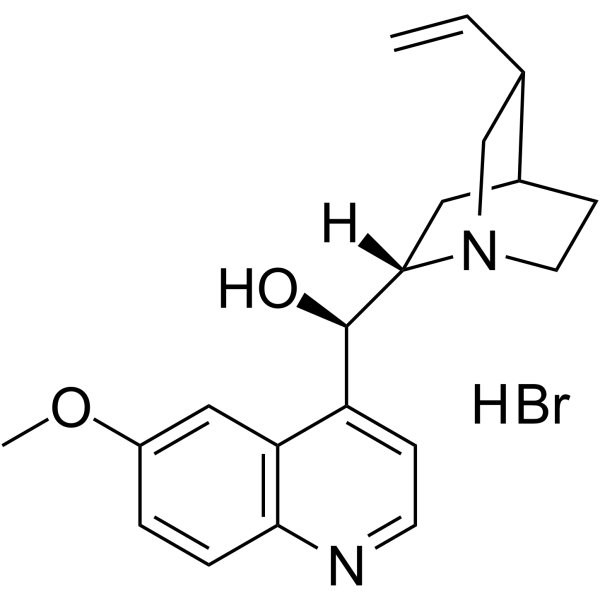
Quinine hydrobromide
Based on 7 publication(s) in Google Scholar
Quinidine hydrobromide is an antiarrhythmic agent. Quinidine is a potent, orally active, selective cytochrome P450db inhibitor. Quinidine hydrobromide is also a K+ channel blocker with an IC50 of 19.9 μM. Quinidine hydrobromide can be used for malaria research.
연구목적의 판매만을 진행합니다. 환자를 대상으로 한 판매는 하지 않습니다.
- CAS No.: 549-49-5
- 화학식: C20H25BrN2O2
- 분자량:405.33
-
보관:
Please store the product under the recommended conditions in the Certificate of Analysis.

To place orders, for customer services and technical support, please contact: MedChemExpress USA
Tel: 609-228-6898 E-mail: [email protected] [email protected]


-
 Biological Activity
-
Chemical Information
- 순도&문서
- References
-
 Help & FAQs


Publications Citing Use of MedChemExpress (MCE) Quinine hydrobromide
More- Neurosci Bull. 2025 May 6. [Abstract]
- Cell Mol Life Sci. 2025 Nov 25;82(1):419. [Abstract]
- J Mol Cell Biol. 2025 May 22;16(11):mjae051. [Abstract]
- ACS Omega. 2024 Feb 28;9(10):11870-11882. [Abstract]
- Mol Med Rep. 2021 May;23(5):313. [Abstract]
- Vet Microbiol. 2026 May:316:110992. [Abstract]
- Norwegian University of Science and Technology. 2019 Sep.
 Customer Validation & Images

-
In Vivo Efficacy Study

-
Cell Imaging/Staining

-
Cell Proliferation/Viability Assay

-
Cell Proliferation/Viability Assay

-
Bio/Physico-chemical Assay

All Parasite Isoforms
More

Biological Activity
제품 설명
In Vitro
Quinidine hydrobromide is an anti-arrythmic drug which affects ionic currents in heart muscle and which has also been shown to be a potent blocker of several classes of K+ channel in a variety of cell types[1].
Bath application of quinidine hydrobromide causes a dose-dependent reduction of the peak amplitude of Ik. The Kd for blockade of Ik at 0 mV is estimated to be 41 μM[1].
Quinidine hydrobromide elicits a dose-dependent increase of the rate of the decay of Ik and this effect is enhanced by membrane depolarization. Quinidine also causes a 5 mV hyperpolarizing shift of the steady-state inactivation curve and increases the half-time for recovery from inactivation. Quinidine hydrobromide does not affect the onset of inactivation measured at -30 mV[1].
MedChemExpress (MCE) has not independently confirmed the accuracy of these methods. They are for reference only.
In Vivo
Quinidine hydrobromide is approximately 70-90 % bound to plasma proteins. It undergoes hepatic oxidative metabolism to form an N-oxide, a 3-hydroxy form, an O-demethyl form and 2'-quinidinone[2].
Quinidine hydrobromide inhibits metabolism of amphetamine in rats. Quinidine hydrobromide pretreatment results in a significant decrease in the excretion of p-hydroxyamphetamine at 24 and 48 h to 7.2 and 24.1% of the vehicle-control levels, respectively, accompanied by a significant increase in amphetamine excretion between 24 and 48 h to 542% of the control[3].
MedChemExpress (MCE) has not independently confirmed the accuracy of these methods. They are for reference only.


Chemical Information
-
CAS No. 549-49-5
-
분자량 405.33
-
화학식 C20H25BrN2O2
-
SMILES
O[C@H](C1=CC=NC2=C1C=C(OC)C=C2)[C@@]3([H])[N@](C[C@@H]4C=C)CC[C@H]4C3.[H]Br
-
선적
Room temperature in continental US; may vary elsewhere.
-
보관
Please store the product under the recommended conditions in the Certificate of Analysis.


Publications (7)
-
Journal Impact Factor
-
Most Recent
-
Neurosci Bull
A Novel Functional Method of Protector Screening for Zebrafish Lateral Line Hair Cells via the Acoustic Escape Response. [Abstract]2025 May 6. PMID: 40329138
Quinine hydrobromide purchased from MedChemExpress. Usage Cited in: Neurosci Bull. 2025 May 6. [Abstract]
Quinine (qui; 10 μM; 5 min) decreased the travel distance upon sound stimulation in zebrafish.
Quinine hydrobromide purchased from MedChemExpress. Usage Cited in: Neurosci Bull. 2025 May 6. [Abstract]
Quinine (qui; 10 μM; 5 min) remained unchanged in the number of HCs in zebrafish.
-
Cell Mol Life Sci
2025 Nov 25;82(1):419. PMID: 41288707
Quinine hydrobromide purchased from MedChemExpress. Usage Cited in: Cell Mol Life Sci. 2025 Nov 25;82(1):419. [Abstract]
Quinine (0-320 μM) showed no cytotoxicity for Primary pancreatic β cells.
-
J Mol Cell Biol
2025 May 22;16(11):mjae051. PMID: 39848918
Quinine hydrobromide purchased from MedChemExpress. Usage Cited in: J Mol Cell Biol. 2025 May 22;16(11):mjae051. [Abstract]
Quinine (0-320 μM; 24 h) showed cytotoxicity in primary pancreatic β cells and HEK293T cells.
Quinine hydrobromide purchased from MedChemExpress. Usage Cited in: J Mol Cell Biol. 2025 May 22;16(11):mjae051. [Abstract]
Quinine (0-40 μM) potentiated high glucose (25 mM)-evoked insulin secretion in a dose-dependent manner at 5–100 μM. However, under low-glucose (2 mM) conditions, quinine induced insulin secretion only at concentrations of 50–100 μM; without the addition of glucose, 5 μM quinine alone was not sufficient to stimulate insulin secretion.
-
ACS Omega
Identification of New Modulators and Inhibitors of Palmitoyl-Protein Thioesterase 1 for CLN1 Batten Disease and Cancer. [Abstract]2024 Feb 28;9(10):11870-11882. PMID: 38496939 -
Mol Med Rep
2021 May;23(5):313. PMID: 34240224 -
Vet Microbiol
The Chinese medicine monomer Schisandrin C inhibits PRRSV infection by regulating the OGT-PI3K/AKT/mTOR signaling pathway. [Abstract]2026 May:316:110992. PMID: 41865607 -


순도&문서
References
[1]. Kehl SJ, et al. Quinidine-induced inhibition of the fast transient outward K+ current in rat melanotrophs. Br J Pharmacol. 1991 Jul;103(3):1807-13. [Content Brief]
[2]. Roden DM, et al. Class I antiarrhythmic agents: quinidine, procainamide and N-acetylprocainamide, disopyramide. [Content Brief]

Calculators
Concentration (start) × Volume (start) = Concentration (final) × Volume (final)


Quinine hydrobromide Related Classifications
HY-B1751C Related Classifications
 Powered by Bioz