



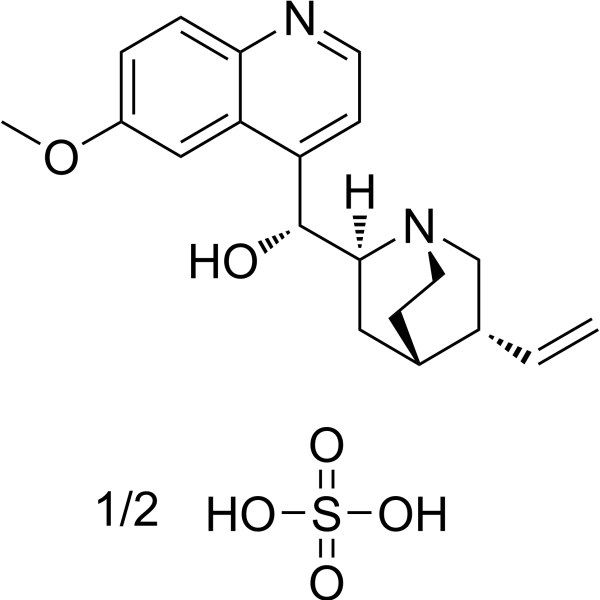
Quinine hemisulfate
Based on 7 publication(s) in Google Scholar
Quinine hemisulfate is an orally active alkaloid extracted from cinchona bark and can be used in anti-malarial studies. Quinine hemisulfate is a potassium channel inhibitor that inhibits WT mouse Slo3 (KCa5.1) channel currents evoked by voltage pulses to +100 mV with an IC50 of 169 μM.
For research use only. We do not sell to patients.
- CAS No.: 804-63-7
- Formula: C20H24N2O2.1/2H2SO4
- Molecular Weight:373.45
-
Storage:
4°C, protect from light, stored under nitrogen
* In solvent : -80°C, 6 months; -20°C, 1 month (protect from light, stored under nitrogen)

To place orders, for customer services and technical support, please contact: MedChemExpress USA
Tel: 609-228-6898 E-mail: [email protected] [email protected]


-
 Biological Activity
-
Chemical Information
- Protocols
- Purity & Documentation
- References
-
 Help & FAQs


Publications Citing Use of MedChemExpress (MCE) Quinine hemisulfate
More- Neurosci Bull. 2025 May 6. [Abstract]
- Cell Mol Life Sci. 2025 Nov 25;82(1):419. [Abstract]
- J Mol Cell Biol. 2025 May 22;16(11):mjae051. [Abstract]
- ACS Omega. 2024 Feb 28;9(10):11870-11882. [Abstract]
- Mol Med Rep. 2021 May;23(5):313. [Abstract]
- Vet Microbiol. 2026 May:316:110992. [Abstract]
- Norwegian University of Science and Technology. 2019 Sep.
 Customer Validation & Images

-
In Vivo Efficacy Study

-
Cell Imaging/Staining

-
Cell Proliferation/Viability Assay

-
Cell Proliferation/Viability Assay

-
Bio/Physico-chemical Assay

All Parasite Isoforms
More

Biological Activity
Description
IC50 & Target
|
Plasmodium |
In Vitro
Quinine hemisulfate (150 μM, 30 min) inhibits the proliferation and cytostatic effects of DENV (Dengue virus) in human hepatocarcinoma HepG2 cell line[1]. Quinine hemisulfate (37.5-150 μM, 24 hours) significantly reduces viral DENV RNA and protein levels in a dose-dependent manner in human hepatocarcinoma HepG2 cell line[1].
MedChemExpress (MCE) has not independently confirmed the accuracy of these methods. They are for reference only. Further protocols information, click here.
-
Cell Line:Human hepatocarcinoma cell line(HepG2)
-
Concentration:150 μM
-
Incubation Time:30 min
-
Result:Inhibited DENV virus replication with 19% yield compared to untreated. Reduced DENV-positive cells from 23.28% to 12.05% in a dose-dependent manner.
In Vivo
MedChemExpress (MCE) has not independently confirmed the accuracy of these methods. They are for reference only.
-
Animal Model:Swiss albino mice 7-8-weeks (weighing 24 g)[2]
-
Dosage:12 mg/kg, 15 mg/kg
-
Administration:Oral gavage; every week; 16 weeks
-
Result:Resulted in a significant reduction in tumor size and weight at 12 mg/kg and little effect at higher dose of 15 mg/kg.
Clinical Trial
| NCT Number | Sponsor | Condition | Start Date |
Phase

|
|---|---|---|---|---|
| NCT01329991 | Plexxikon| | 2011-05 | PHASE1 |


Chemical Information
-
CAS No. 804-63-7
-
Appearance Solid
-
Molecular Weight 373.45
-
Formula C20H24N2O2.1/2H2SO4
-
Color White to off-white
-
SMILES
O[C@@H]([C@@]1([H])[N@@](CC2)C[C@H](C=C)[C@@H]2C1)C3=CC=NC4=CC=C(OC)C=C34.O=S(O)(O)=O.[1/2]
-
Structure Classification
-
Initial Source
-
Shipping
Room temperature in continental US; may vary elsewhere.
-
Storage
4°C, protect from light, stored under nitrogen
* In solvent : -80°C, 6 months; -20°C, 1 month (protect from light, stored under nitrogen)


Publications (7)
-
Journal Impact Factor
-
Most Recent
-
Neurosci Bull
A Novel Functional Method of Protector Screening for Zebrafish Lateral Line Hair Cells via the Acoustic Escape Response. [Abstract]2025 May 6. PMID: 40329138
Quinine hemisulfate purchased from MedChemExpress. Usage Cited in: Neurosci Bull. 2025 May 6. [Abstract]
Quinine (qui; 10 μM; 5 min) decreased the travel distance upon sound stimulation in zebrafish.
Quinine hemisulfate purchased from MedChemExpress. Usage Cited in: Neurosci Bull. 2025 May 6. [Abstract]
Quinine (qui; 10 μM; 5 min) remained unchanged in the number of HCs in zebrafish.
-
Cell Mol Life Sci
2025 Nov 25;82(1):419. PMID: 41288707
Quinine hemisulfate purchased from MedChemExpress. Usage Cited in: Cell Mol Life Sci. 2025 Nov 25;82(1):419. [Abstract]
Quinine (0-320 μM) showed no cytotoxicity for Primary pancreatic β cells.
-
J Mol Cell Biol
2025 May 22;16(11):mjae051. PMID: 39848918
Quinine hemisulfate purchased from MedChemExpress. Usage Cited in: J Mol Cell Biol. 2025 May 22;16(11):mjae051. [Abstract]
Quinine (0-320 μM; 24 h) showed cytotoxicity in primary pancreatic β cells and HEK293T cells.
Quinine hemisulfate purchased from MedChemExpress. Usage Cited in: J Mol Cell Biol. 2025 May 22;16(11):mjae051. [Abstract]
Quinine (0-40 μM) potentiated high glucose (25 mM)-evoked insulin secretion in a dose-dependent manner at 5–100 μM. However, under low-glucose (2 mM) conditions, quinine induced insulin secretion only at concentrations of 50–100 μM; without the addition of glucose, 5 μM quinine alone was not sufficient to stimulate insulin secretion.
-
ACS Omega
Identification of New Modulators and Inhibitors of Palmitoyl-Protein Thioesterase 1 for CLN1 Batten Disease and Cancer. [Abstract]2024 Feb 28;9(10):11870-11882. PMID: 38496939 -
Mol Med Rep
2021 May;23(5):313. PMID: 34240224 -
Vet Microbiol
The Chinese medicine monomer Schisandrin C inhibits PRRSV infection by regulating the OGT-PI3K/AKT/mTOR signaling pathway. [Abstract]2026 May:316:110992. PMID: 41865607 -

Protocols
-
Cell Cytotoxicity Assay
Cytotoxicity assays are usually based on the assessment of cell membrane damage, which can also be indirectly detected by measuring cell viability. Detection methods include MTT assay, CKK-8 assay, LDH assay and ATP assay, etc.


Purity & Documentation
-
Data Sheet (280 KB)
-
SDS (252 KB)
- Français - FR (252 KB)
- Deutsch - DE (252 KB)
- Norwegian - NO (252 KB)
- Español - ES (252 KB)
- Swedish - SV (252 KB)
- Italian - IT (252 KB)
- Korean - KR (252 KB)
- Portuguese - PT (252 KB)
-
Handling Instructions (2659 KB)
References
[1]. Shilu Malakar,et al. Drug repurposing of quinine as antiviral against dengue virus infection. Virus Res. 2018 Aug 15;255:171-178. doi: 10.1016/j.virusres.2018.07.018. Epub 2018 Jul 25. [Content Brief]
[3]. Ebenezer O Farombi, et al. Quercetin protects against testicular toxicity induced by chronic administration of therapeutic dose of quinine sulfate in rats. J Basic Clin Physiol Pharmacol. 2012 Feb 27;23(1):39-44. [Content Brief]

Calculators
Concentration (start) × Volume (start) = Concentration (final) × Volume (final)


Quinine hemisulfate Related Classifications
HY-B0433B Related Classifications
 Powered by Bioz