1. Search Result
Search Result
Results for "

NOD-SCID mice

" in MedChemExpress (MCE) Product Catalog:

17

Inhibitors & Agonists

1

Inhibitory Antibodies

Cat. No. Product Name Target Research Areas Chemical Structure
  • HY-161409

    Androgen Receptor Apoptosis Cancer
    SC912 is an AR-V7 inhibitor (IC50 = 0.36 μM). SC912 possesses safety, potency and selectivity. SC912 binds directly to AR-FL and AR-V7 proteins, inhibites nuclear localization and chromatin binding capabilities. SC912 exerts anticancer activity through inhibition of proliferation, induction of cell cycle arrest and apoptosis .
    SC912
  • HY-149428
    AD4
    1 Publications Verification

    PROTACs Cancer
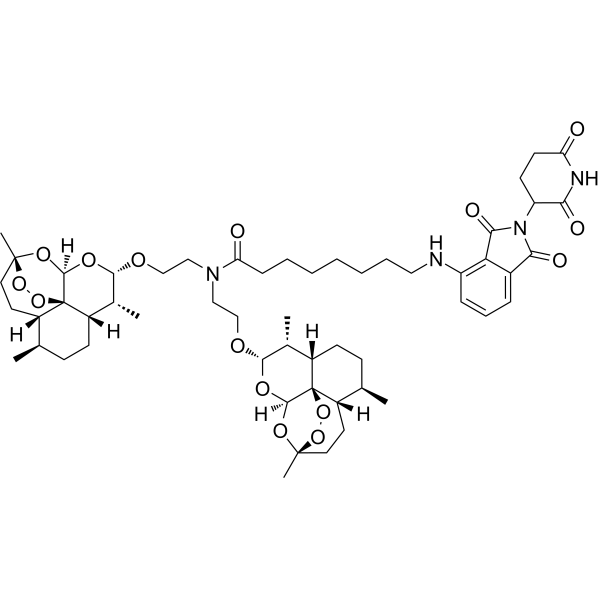
    AD4 is an artemisinin derivative that is a proteolytic targeting chimera (PROTAC) targeting PCLAF. AD4 can effectively degrade PCLAF in RS4;11 cells (IC50: 0.6 nM), thereby activating the p21/Rb axis and exerting anti-tumor activity. AD4 also prolonged survival of RS4;11-transplanted NOD/SCID mice, with in vivo efficacy .
    AD4
  • HY-175541

    PROTACs Btk Cancer
    TQ-3959 is an orally active BTK PROTAC degrader, with a DC50 of 14.6 nM. TQ-3959 exerts antiproliferative activity against both wild-type BTK and C481S mutant BTK cell lines. TQ-3959 exhibits tumor growth inhibition in female NOD-SCID mice bearing TMD-8 xenografts. TQ-3959 can be used in the research on B-cell malignancies such as lymphoma.(Pink: BTK ligand (HY-150885), Blue: CRBN Ligand (HY-W733888), Black: Linker (HY-W061884), E3 ligase ligand-linker conjugate (HY-175545)) .
    TQ-3959
  • HY-162938

    E1/E2/E3 Enzyme Cancer
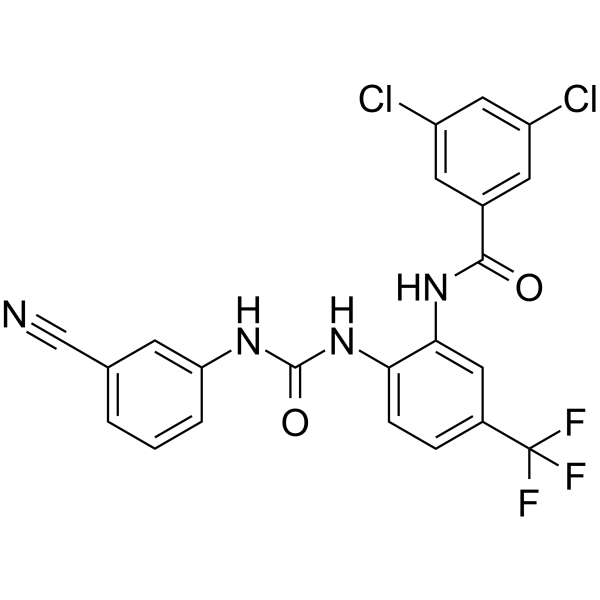
    Skp2 inhibitor 3 is an orally active inhibitor of the Skp2-Cks1 complex, with an IC50 of 4.86 μM. Skp2 inhibitor 3 reduces Skp2 protein expression while upregulating the expression of p21 and p27. Skp2 inhibitor 3 inhibits colony formation and migration of cancer cells, and induces cell cycle arrest at the S phase. Skp2 inhibitor 3 suppresses tumor growth in xenograft mice. Skp2 inhibitor 3 can be used in the research of gastric cancer and prostate cancer .
    Skp2 inhibitor 3
  • HY-174437

    FLT3 Apoptosis Cancer
    FLT3-IN-32 is a potent and orally active FLT3 inhibitor. FLT3-IN-32 shows high selectivity for FLT3 and efficiently inhibits FLT3-activating mutations and induces apoptosis. FLT3-IN-32 shows good tolerability in non-tumor bearing mice. FLT3-IN-32 demonstrates outstanding anti-tumor efficacy in MV4-11 bearing NOD/SCID mice, prolonging the survival noticeably. FLT3-IN-32 can be used for the research of acute myeloid leukemia .
    FLT3-IN-32
  • HY-161494

    PROTACs Epigenetic Reader Domain Cancer
    XYD190 (Compound 14g) is an orally active degrader for CBP/p300. XYD190 inhibits CBP/p300 bromodomain with IC50 of 483.7 nM. XYD190 exhibits antitumor activity against acute myeloid leukemia. (Structure: Pink, CBP/p300 ligand 4 (HY-161495); Blue, E3 ligase ligand (HY-14658); Black: linker (HY-161496)) .
    XYD190
  • HY-175610

    PROTACs FLT3 JAK Epigenetic Reader Domain Cancer
    PROTAC FLT3/JAK2/BRD4 Degrader-1 is a PROTAC degrader that target FLT3, JAK2, and BRD4 with DC50 values of 5.23, 0.678, and 1.17 nM, respectively. PROTAC FLT3/JAK2/BRD4 Degrader-1 exhibits potent antiproliferative activity against MV4;11 cells (IC50 = 0.79 nM) and FLT3 mutant-transformed Ba/F3 cells. PROTAC FLT3/JAK2/BRD4 Degrader-1 induces apoptosis in MV4;11 cells. PROTAC FLT3/JAK2/BRD4 Degrader-1 demonstrates significant anti-tumor efficacy in the MV4;11 xenograft model established in NOD SCID mice. PROTAC FLT3/JAK2/BRD4 Degrader-1 can be used for the study of acute myeloid leukemia (AML). (Pink: FLT3/JAK2/BRD4 ligand (HY-175611), Blue: CRBN Ligand (HY-W087383), Black: Linker, E3 ligase ligand-linker conjugate (HY-W897939)) .
    PROTAC FLT3/JAK2/BRD4 Degrader-1
  • HY-172617

    BMI1 Microtubule/Tubulin Apoptosis Cancer
    APD-94 is a dual inhibitor targeting tubulin and Bmi-1. APD-94 interfers tubulin normal polymerization. APD-94 suppresses the expression of Bmi-1. APD-94 causes cell cycle arrest at the G2/M phase in cancer cells and induces apoptosis, thus inhibiting cancer cell proliferation. APD-94 represses the growth of HT29 cell xenografts in NOD/SCID mice. APD-94 can be used for colorectal cancer study .
    APD-94
  • HY-161498

    PROTACs Epigenetic Reader Domain Cancer
    XYD198 (Compound 14h) is an orally active degrader for CBP/p300. XYD198 inhibits CBP/p300 bromodomain with IC50 of 213.5 nM. XYD198 exhibits antitumor activity against acute myeloid leukemia. (Structure: Pink, CBP/p300 ligand 4 (HY-161495); Blue, E3 ligase ligand (HY-14658); Black: linker (HY-161499))
    XYD198
  • HY-161496

    PROTAC Linkers Cancer
    Boc-NHCH2-Ph-Py-NH2 is the linker for PROTAC molecule XYD190 (HY-161494) .
    Boc-NHCH2-Ph-Py-NH2
  • HY-161495

    Ligands for Target Protein for PROTAC Epigenetic Reader Domain Cancer
    CBP/p300 ligand 4 (Compound 4) is an orally active inhibitor for CBP/p300 bromodomain, with IC50 of 91.4 nM. CBP/p300 ligand 4 serves as a ligand for target protein XYD190 (HY-161495). XYD190 is a PROTAC degrader for CBP/p300 .
    CBP/p300 ligand 4
  • HY-161499

    PROTAC Linkers Cancer
    Boc-NHCH2-Ph-pyrimidine-NH2 is the linker for PROTAC molecule XYD198 (HY-161498) .
    Boc-NHCH2-Ph-pyrimidine-NH2
  • HY-161497

    E3 Ligase Ligand-Linker Conjugates Cancer
    Thalidomide-benzylamine-Py-NH2 is a conjugate of E3 ligase ligand and linker, which is consisted of a Thalidomide (HY-14658) and the Linker Boc-NHCH2-Ph-Py-NH2 (HY-161496). Thalidomide-benzylamine-Py-NH2 is utilized for synthesis of PROTAC molecule XYD190 (HY-161494) .
    Thalidomide-benzylamine-Py-NH2
  • HY-161500

    E3 Ligase Ligand-Linker Conjugates Cancer
    Thalidomide-NHCH2-Ph-pyrimidine-NH2 is a conjugate of E3 ligase ligand and linker, which is consisted of a Thalidomide (HY-14658) and a Linker Boc-NHCH2-Ph-pyrimidine-NH2 (HY-161499). Thalidomide-NHCH2-Ph-pyrimidine-NH2 is utilized for synthesis of PROTAC molecule XYD198 (HY-161498) .
    Thalidomide-NHCH2-Ph-pyrimidine-NH2
  • HY-P992376

    NBE-002 Antibody

    ROR Cancer
    huXBR1-402 (NBE-002 Antibody) is a high-affinity (Kd=5.8 nM) humanized chimeric rabbit/human monoclonal antibody that targets ROR1. huXBR1-402 specifically binds to the Ig/Fz domain epitope of human ROR1, directly inhibits the proliferation of ROR1-positive tumor cells and induces apoptosis of leukemia cells (apoptosis) .
    huXBR1-402
  • HY-181004

    CDK Cancer
    PKMYT1-IN-13 is a potent, orally active and selective PKMYT1 inhibitor that inhibits PKMYT1 with IC50 values < 10.0 nM in ADP-Glo assay and 19.9 nM in NanoBRET cellular assay. PKMYT1-IN-13 exhibits high selectivity over WEE1. PKMYT1-IN-13 shows selective antiproliferative activity in CCNE1-amplified cells, while showing minimal wild-type effects. PKMYT1-IN-13 shows antitumor efficacy in HCC1569 mouse xenografts. PKMYT1-IN-13 can be used for the research of CCNE1-amplified cancers, such as gastric, ovarian, and breast cancer .
    PKMYT1-IN-13
  • HY-118970

    VD/VDR TGF-β Receptor Interleukin Related Cancer
    LG190155 is a nonsteroidal vitamin D receptor (VDR) agonist. LG190155 activates VDR in mesenchymal stem cells, thereby upregulating the BMP6-IL6 autocrine axis. Pretreatment of mesenchymal stem cells with LG190155 significantly enhances their ability to induce differentiation of acute myeloid leukemia cells, without inducing hypercalcemia. LG190155 is applicable to research related to acute myeloid leukemia (AML) .
    LG190155

Inquiry Online

Your information is safe with us. * Required Fields.

Salutation


Country or Region *

Applicant Name *


Organization Name *

Department *


Email Address *


Product Name *

Cat. No.


Requested quantity *

Phone Number *


Remarks

Inquiry Online

Inquiry Information

Product Name:
Cat. No.:
Quantity:
MCE Japan Authorized Agent:

